



THE CANADIAN PRESS/ Patrick Doyle
The event in north-central France underscored how wildfires are ranging even farther from their traditional grounds and fuelling an urgent need for water bombers to fend off climate disasters.
The iconic Canadair turboprops serve as the only amphibious firefighting aircraft currently in production built from the outset for that purpose, rather than being retrofitted to douse flames.
Now, the Canadian company behind the water-scooping planes is calling for a national fleet of them at home, even as it struggles to meet soaring demand from across a warming globe.
De Havilland Aircraft of Canada revived production of the legendary Canadair planes in 2024 after European countries from Portugal to Greece placed orders for a program whose assembly line had halted in 2015, when it was run by Bombardier Inc.
That hiatus meant a supply chain that drew on 60,000 parts for the firefighting turboprop had evaporated, with procurement a major hurdle that pushed the projected delivery date for the first Canadair DHC-515 (formerly called the CL-515) to early 2028.
Neil Sweeney, De Havilland’s vice-president of corporate affairs, says an order for 50 new water bombers from the federal government or the provinces would give it the financial runway — hundreds of millions of dollars — to launch a second production line at its new assembly plant east of Calgary.
“If we want to stop fires from becoming large and becoming megafires, we need to get on them quicker. And the only way to get on them quicker is to have the infrastructure to do so,” he said, citing water bombers as the backbone of an aerial strategy that includes smaller scoopers, evacuation helicopters and air tankers with fire retardants.
“These fires are becoming significantly more damaging — devastating — and either we invest money upfront in prevention or we’re going to pay for it in reconstruction.”
Sweeney pointed to wildfires that took out about 400 structures in Jasper, Alta., in 2024 and hundreds more since. Last summer, fires in northern Ontario blanketed large swaths of the province and some of the United States in a smoky orange haze, forcing First Nations communities to flee. In August, blazes in British Columbia destroyed hundreds of buildings near Vernon and Summerland and forced tens of thousands from their homes.
“We can’t afford to wait any longer,” Sweeney said.
Another reason to forge ahead has to do with competitors. If the backlog of plane orders gets too long, buyers will likely look elsewhere.
“The danger of a slow ramp-up here is that the scarcity creates its own competition,” said Christopher Read, former director of corporate development at Air Canada. “If it can’t turn that into delivered aircraft quick enough, customers won’t wait. They will find alternatives.”
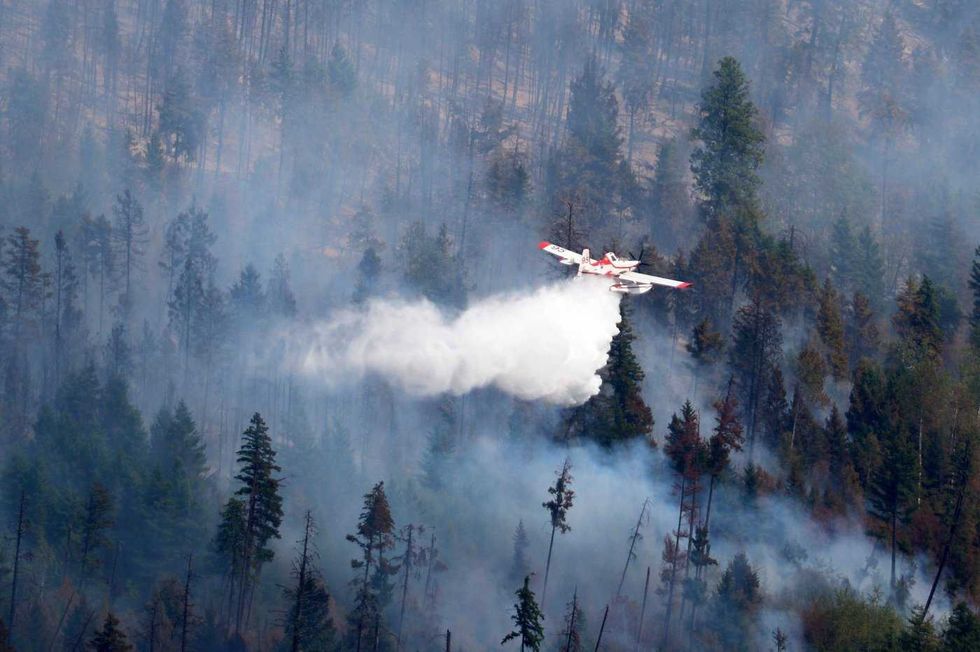 A water bomber drops its load on a wildfire near Kelowna, B.C., on Thursday, July 23, 2015.
THE CANADIAN PRESS/Jonathan Hayward
A water bomber drops its load on a wildfire near Kelowna, B.C., on Thursday, July 23, 2015.
THE CANADIAN PRESS/Jonathan Hayward
There’s even a risk that “somebody’s going to steal or re-engineer their planes,” added Wendy Gilmour, former director general of international and industry programs at the Department of National Defence. “All of a sudden we’re going to find out they’re making it in China for a quarter of the price — and just as good an aircraft.”
De Havilland still has a window of at least several years during which it will boast the strongest product, Read added. But upstarts are chasing its contrails.
Aerospace companies such as Positive Aviation, Kepplair Evolution and Hynaero of France are all developing water bombers. Italy’s 19-01 Holding aims to roll out its first prototype, which can scoop roughly twice the water volume of the DHC-515, by 2028.
“The iconic Canadair aircraft, the only plane of its kind, no longer meets reliability and availability requirements,” claims the website for Positive Aviation, based in a suburb of Toulouse.
“None of the projects announced over the past decade — whether to remanufacture the Canadair or develop a new aircraft of this type — are considered enough for the market needs.”
It pointed to the pace of production for Canadairs, which will be riveted by hand and roll of the line at a projected rate of 10 per year, partly due to a lack of automation. Positive Aviation's alternative claims a one-third higher water capacity, “superior stability” and a production rate of 12 per year starting in 2030.
Its critique could be seen as an inherent affirmation of Canadair as the “gold standard of firefighting aircraft” — for now — as De Havilland’s Sweeney frames it.
“There are a number of people that have ideas and are looking for backing in order to bring another one into production. That’s always a risk, that there’s a competitor. But at this point, we are the only large scooping aircraft in production,” Sweeney said.
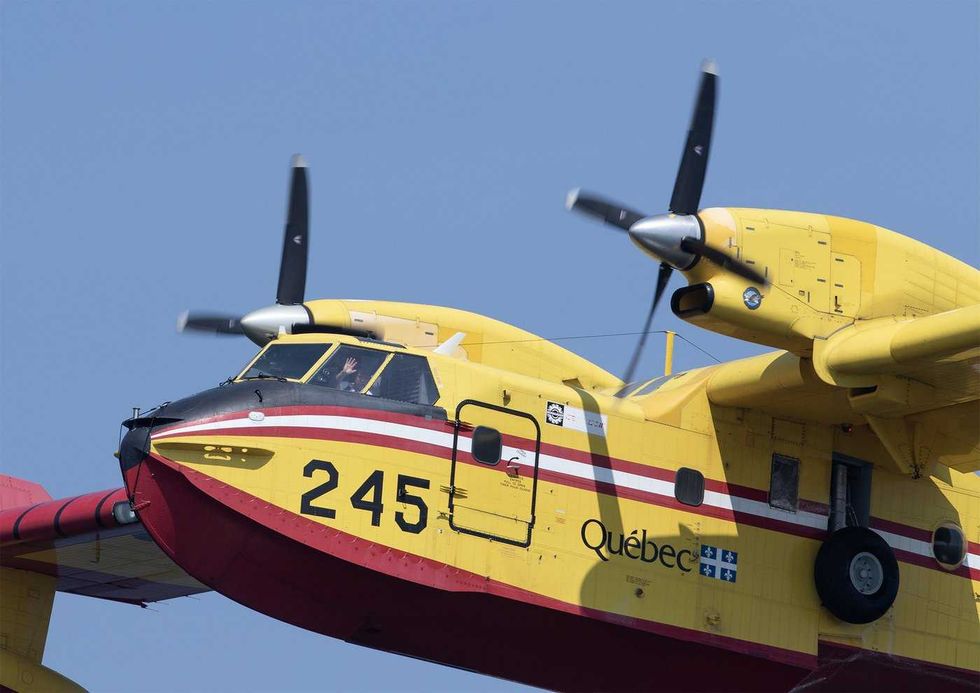 A Quebec water bomber pilot waves to onlookers after scooping water from Shediac Bay, N.B. The two Quebec-based planes helped to fight the forest fire near Irishtown, N.B., on Monday, Aug. 11, 2025.
THE CANADIAN PRESS/Ron Ward
A Quebec water bomber pilot waves to onlookers after scooping water from Shediac Bay, N.B. The two Quebec-based planes helped to fight the forest fire near Irishtown, N.B., on Monday, Aug. 11, 2025.
THE CANADIAN PRESS/Ron Ward
The first two Canadairs are currently in production, with the initial one bound for Greece. Spain, France, Portugal, Italy and Croatia are also all customers. The 38 planes now on the order book, which include six for Ontario, five for Alberta — at a $400 million price tag — and three for Manitoba, are sold out through 2034, Sweeney said.
Canada and the European Union will announce the joint purchase of 50 De Havilland water bombers at a conference in Montreal at the end of October, according to a draft joint statement seen by The Canadian Press. But it remains unclear whether that order includes the 38 aircraft already on the books or comes on top of them.
In May, the federal government set up Canada’s first-ever reserve of firefighting aircraft, leasing 10 planes for 150 days thanks to a $317-million spending allocation in the 2025 budget.
But experts say Canada needs more than money and orders to beat back the flames and protect communities.
“There’s no national co-ordination for the fleet of water bombers,” said John Gradek, who teaches aviation management at McGill University.
“There is a provincial focus on firefighting that’s very parochial. Governments do their own thing, manage their own budgets, pay for their own airplanes, pay for their own pilots, training and everything else,” he said.
Some provinces own water bombers — Ontario and Quebec operate nearly two dozen of the 160 Canadairs in circulation around the world. Other provinces rent or borrow them. But Canada has no national wildland firefighting strategy, despite years of demands to create one, including a Senate committee report in June that recommended a national aerial firefighting fleet.
In contrast, Australia has a more centralized model where states and territories fund the National Aerial Firefighting Centre, which leases or contracts planes from at home and abroad.
In August, Ontario Premier Doug Ford called for 60 new water bombers and a national fleet under a countrywide wildfire strategy.
The question now is how many can be churned out before the decade is over — and how those planes will be managed.
This report by The Canadian Press was first published Oct. 18, 2026.
Companies in this story: (TSX:BBD.B)
By Christopher Reynolds | Copyright 2026, The Canadian Press. All rights reserved.
13 hommes dévoilent des méthodes efficaces (selon eux) pour impressionner une femme
J'ai une fascination pour Reddit ces temps-ci. Je comprends aucunement l'utilité, mais je peux pas m'empêcher d'aller voir l'opinion des internautes, surtout sur les sujets qui touchent le dating. C'qui est un peu tordu, c’est que tout le monde semble donner son opinion en étant ben à l'aise, alors que souvent, les propos tenus ont aucun maudit bon sens.
Cette semaine, je suis tombée sur cette question sur Reddit : What's something men do to impress women that actually impress women? 11 843 commentaires et quelques bons gros rires gras plus tard, je t'ai déniché les plus savoureux. Certains sont même plutôt mignons!
1. La semaine dernière, j'ai retourné une omelette parfaitement pendant qu'on jasait, et c'est la première fois que j'ai vu dans son regard qu'elle était réellement impressionnée. -PerfectChaosOne
Ce à quoi un autre gars a répondu : Ok, je viens de passer 10 minutes à checker des tutoriels de flip d'omelette à cause de toi. L'entraide, c'est important!
2. La faire sourire, tout simplement. Maman m'a toujours dit : Il faut toujours découvrir ce qui fait sourire la femme que tu aimes. -Locotxork
Cute!
3. J'ai un vieux truck qui démarre pas tout le temps. Chaque fois que j'ai une femme avec moi et qu'il ne démarre pas, je lève le capot, donne 2-3 coups de tournevis aux bonnes places pis l'affaire est réglée. Je suis un supehéros à ses yeux. -ClosedMadscientist
J'pense qu'un char qui marche sans risquer de s'électrocuter, ça m'impressionne encore plus.
4. C'est ben facile: quand je datais ma femme, je lui disais que j'allais l'appeler en soirée ou à une certaine heure, je le faisais. Tiens tes promesses, être fiable ça amène des points. -ITworkguys
Dommage, il est marié.
5. Je tiens mon appart pas pire clean. Serviettes et draps propres, pas de moisissure, pas de salle de bain dégoûtante, j'ai même une plante! Conseil les gars, mettez un couvercle sur votre poubelle, les filles adorent! -serkenz
Voyons, qui parle? Tu fais faire le tour de ton appart pis tu pointes la poubelle avec un air de fierté?
6. S'excuser quand on fait des gaffes et accepter leurs excuses quand c'est elles les fautives. Et pardonner. -vinsmith93
Bien dit.
7. Aider des vieilles dames. No joke. J'ai eu du sexe une fois parce qu'une fille m'a vu aider une mamie à changer un flat. -mermaidhare
Charmant garçon. Change jamais le flat à ma grand-mère, j'vais m'arranger avec ça, merci.
8. Selon ma blonde, être drôle c'est ce qui marche le mieux. J'suis un average dude, mes cheveux sont ben ordinaires, j'suis pas musclé, mais ma blonde c't'une belle fille. L'humour, ça charme. -Elronnd
J'sais, c'est mon arme de séduction. C'pas ma belle attitude joviale, j'suis tout le temps grumpy.
9. Devenir le meilleur ami de son chat. C'est l'étape #1 pour gagner sa confiance. Je lui donne de l'attention comme si ma vie en dépendait, je le flatte, je joue avec, mais demande-moi jamais de changer sa litière. -thepiansbot
Ça a le mérite d'être honnête.
10. To impress a chick do the helicopter dick. -priceisalright
J'ai pas jugé bon de le traduire. Ça ne méritait pas vraiment cet effort.
11. Aller au Ikea sans devenir complètement fou, ça marche à tout coup. Les femmes adorent magasiner au Ikea, mais nous les hommes on se fait tellement chier quand on va la- Longrod1960
Vrai.
12. Lui amener de la bouffe quand tu sais qu'elle a eu une putain de grosse journée au boulot. Les femmes sont attendries quand tu fais des p'tites attentions pour les faire sentir bien. -dinizdude
Vrai aussi.
13. Couper des cordes de bois à la hache. On dirait que ça leur donne une version primitive de nous, le bûcheron protecteur qui peut les sauver d'un ours. Mais au fond, j'me pisserais dessus si un ours arrivait. -u32cg6
Garde ta hache dans tes mains svp.
Suis-nous donc sur Instagram!
https://www.instagram.com/p/BRvdUvvAnh7/?taken-by=narcity_montreal&hl=fr
Pis toi, qu'est-ce qui t'impressionne?