



THE CANADIAN PRESS/Sean Kilpatrick
Former deputy prime minister Chrystia Freeland says Canada must do everything it can to diversify trade away from the United States.
She told an audience in New York that it matters for national security, saying it's dangerous to deepen or maintain a close economic relationship with a partner that openly wants to "take you over."
U.S. President Donald Trump has repeatedly mused about turning Canada into the 51st state and, while he ruled out using military force to annex the country, has said he would consider "economic force."
Even if the U.S. had a president who believed in free trade with Canada, Freeland said relying on any one partner is not a great idea.
---
 Prime Minister Mark Carney attends a Forever Canadian rally in Calgary, Thursday, Oct. 15, 2026.
THE CANADIAN PRESS/Jeff McIntosh
Prime Minister Mark Carney attends a Forever Canadian rally in Calgary, Thursday, Oct. 15, 2026.
THE CANADIAN PRESS/Jeff McIntosh
Carney to bring his pro-Canada campaign to Edmonton with referendum just days away
Prime Minister Mark Carney continues his pro-Canada campaign in Alberta as the clock ticks down to a referendum on Monday on whether the province should break up with Confederation.
He is set to visit Red Deer with Premier Danielle Smith today and later rally in Edmonton with the federalist group Forever Canadian.
Carney spoke Thursday at one of the group's rallies in Calgary, telling the crowd of roughly 5,000 that a vote against Canada is a dangerous bluff that could lead to years of lost opportunities.
Meanwhile, Smith and federal Conservative Leader Pierre Poilievre will both speak at a conference in Calgary about keeping Alberta in the Confederation fold.
---
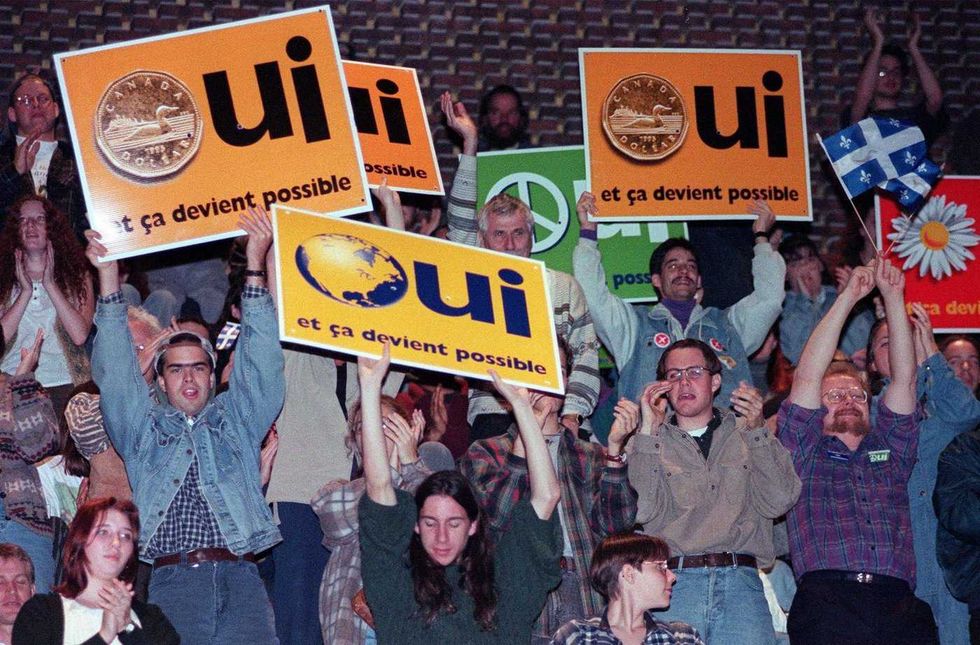 Quebec sovereignty referendum "Yes" supporters cheer during a speech by then-Bloc Québécois leader Lucien Bouchard at a junior college, in Montreal, on Tuesday, Oct. 24, 1995.
THE CANADIAN PRESS/Ryan Remiorz
Quebec sovereignty referendum "Yes" supporters cheer during a speech by then-Bloc Québécois leader Lucien Bouchard at a junior college, in Montreal, on Tuesday, Oct. 24, 1995.
THE CANADIAN PRESS/Ryan Remiorz
Quebec sovereigntists see fundamental rift with Alberta separatists
With just days before Alberta’s vote on an independence referendum, longtime Quebec sovereigntists are distancing themselves from the western province's separatists.
Question 10 on Monday’s referendum ballot asks whether Alberta should remain in Canada or if the government should start the legal process to hold a subsequent, binding referendum on separation.
Quebecers may have a sense of déjà vu after voting on similar questions in 1980 and 1995, both times being defeated by a "No" side, but ardent sovereigntists see profound differences in the two movements.
Marie-Anne Alepin, from the Société St-Jean-Baptiste de Montréal, believes Alberta is using the threat of separatism as leverage in negotiations with Ottawa and the referendum as a means of pressure rather than a genuine desire to form a country.
---
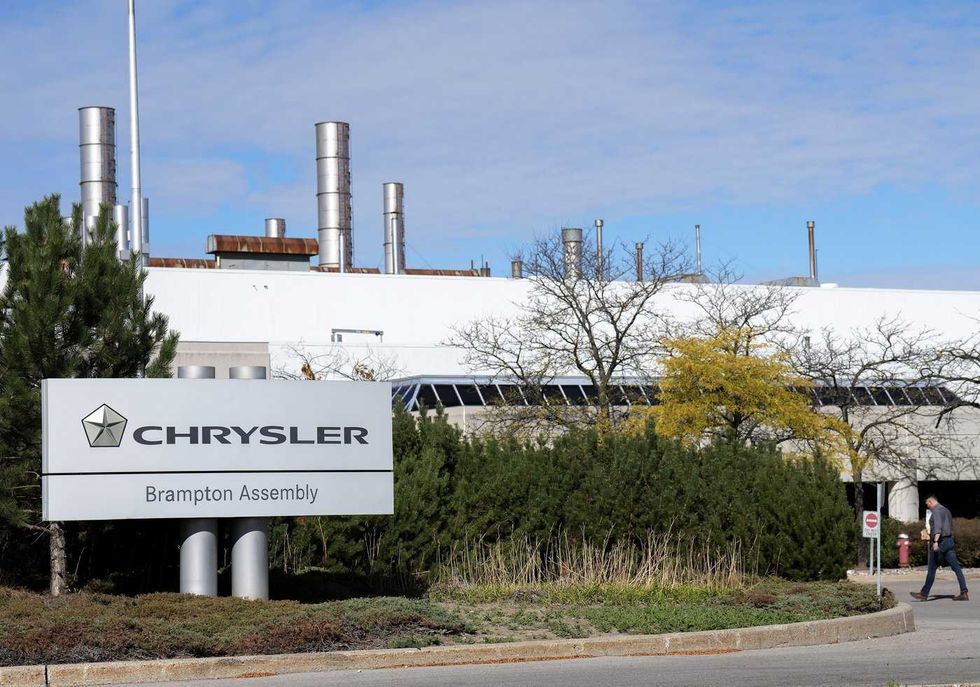 The Stellantis vehicle assembly plant is shown in Brampton, Ont., on Wednesday, Oct. 15, 2025.
THE CANADIAN PRESS/Nathan Denette
The Stellantis vehicle assembly plant is shown in Brampton, Ont., on Wednesday, Oct. 15, 2025.
THE CANADIAN PRESS/Nathan Denette
Stellantis workers set to vote on potential strike action this weekend
Stellantis workers in Canada will vote this weekend on whether to authorize a strike, as their union says contract talks with the automaker have stalled.
Unifor, which represents more than nine-thousand Stellantis workers, is holding strike votes Saturday and Sunday, but says authorization does not automatically mean a strike will happen.
The union says a strike mandate would give its bargaining committee leverage to reach a negotiated agreement, calling strike action a last resort.
Key sticking points include job security and the future of the Brampton, Ont., assembly plant, which Stellantis intends to sell to defence contractor Roshel.
---
 The Canadian Forces Snowbirds perform at the Aero Gatineau-Ottawa air show in Gatineau, Que., on Saturday, Sept. 19, 2026.
THE CANADIAN PRESS/Patrick Doyle
The Canadian Forces Snowbirds perform at the Aero Gatineau-Ottawa air show in Gatineau, Que., on Saturday, Sept. 19, 2026.
THE CANADIAN PRESS/Patrick Doyle
'Goodbye to a good friend': Snowbirds' final show to be livestreamed today
The Royal Canadian Air Force's Snowbirds perform their final air show with their Tutor jets in Moose Jaw, Sask., today, before the iconic aircraft are retired for good.
The annual season home closing show is set to be livestreamed online, though there will be one more chance to see the CT-114 Tutors in action before they are sent to Trenton, Ont., for disposal.
The Snowbirds are scheduled to perform a flyover at the Grey Cup game in Calgary on Nov. 15.
The aging Tutor jets are being retired and the Snowbirds will go on hiatus until the team can be trained on the replacement Pilatus aircraft, the CT-157 Siskin.
Captain Philip Rochon, the public affairs officer for the team, says it's a bittersweet time as the pilots say goodbye to the planes the Snowbirds have flown for nearly six decades.
---
This report by The Canadian Press was first published Oct. 16, 2026.
Copyright 2026, The Canadian Press. All rights reserved.
6 avantages de placer un peu de sous dans ton REER chaque année
Le plus tôt, le mieux!
À première vue, il peut sembler difficile de bien saisir le principe du REER, ses caractéristiques ainsi que ses avantages.
Tu te demandes peut-être quelle somme cotiser par année ou encore si tu peux utiliser ton REER pour certains de tes projets? Sache que Desjardins est là pour répondre à tes questions et te conseiller sur ce sujet et bien d'autres.
Le régime enregistré d'épargne-retraite (REER) est un véhicule de placement qui te permet, entre autres, d'accumuler de l'argent à l'abri de l'impôt et de réduire ton revenu imposable.
Combiné à de saines habitudes financières, le REER t'aidera à réaliser tes projets et à bénéficier d'une retraite heureuse et confortable.
Voici donc 6 avantages à investir chaque année dans un régime enregistré.
Investir à l'abri de l'impôt
Gabriel Vergani | Dreamstime
Faire un placement dans un REER te permet d’investir de l'argent à l'abri de l'impôt pour tes projets et ta retraite et de maximiser ton investissement sur le long terme, puisque les revenus générés dans ce régime sont imposables seulement au moment où tu les retires.
Et comme le taux d'imposition est normalement moins élevé à la retraite que durant la vie active, tu devrais payer moins d'impôts à la sortie de tes fonds.
Réduire son revenu imposable
Petrkurgan | Dreamstime
Lorsque tu cotises à ton REER, tu diminues, par le fait même, ton revenu imposable. Tu pourrais donc payer moins d'impôt et si tu y es éligible, augmenter tes prestations gouvernementales.
Sache que différents placements sont admissibles dans le REER comme les épargnes à terme, les placements garantis liés aux marchés et les fonds de placements.
Simplifier le financement d'un retour aux études
Tim Gouw | Unsplash
Savais-tu qu'il est possible d'utiliser ton REER pour financer ton retour aux études? Le Régime d'encouragement à l'éducation permanente (REEP) est un programme qui te permet de retirer jusqu'à 20 000 $ de ton REER sur une période de quatre ans pour retourner sur les bancs d'école.
Dans le cadre de ce programme gouvernemental, tu n'as pas à payer d'impôt sur les sommes retirées. Tu devras par contre rembourser le montant du retrait sur une période de 10 ans. Un avantage considérant les coûts engendrés par la vie d'étudiant.e!
Faciliter l'achat d'une première maison
Michel Bussieres | Dreamstime
Connais-tu le Régime d'accession à la propriété (RAP)? Ce programme gouvernemental te permet de retirer jusqu'à 35 000 $ de ton REER pour financer l'acquisition ou la construction de la maison de tes rêves, et ce, sans payer d'impôts.
Une fois tes fonds retirés, tu disposes d'un délai maximal de quinze ans pour rembourser la somme, sans intérêts.
Ainsi, tu dois commencer à payer deux ans après le retrait. Une méthode efficace et facile à appliquer pour t’aider dans l'achat de ta première résidence!
Profiter d'avantages fiscaux immédiats
Andrew Neel | Unsplash
Déposer une cotisation annuelle dans ton REER t'offre la possibilité de réduire ton impôt à payer et peut-être d'obtenir un remboursement d'impôt. Différents facteurs sont pris en compte afin de calculer ce montant tels que ton revenu, ta situation familiale et les différents crédits auxquels tu as déjà droit.
À noter que si tu as reçu un montant d’une aide gouvernementale, par exemple la PCRE, il demeure important de prévoir un montant minimal à cotiser à ton REER, pour ceux dont le revenu excède 38 000 $.
Comme ce revenu n'a pas été imposé à la source, déposer une somme à ton REER te permettra de réduire ton revenu imposable annuel et de payer moins d'impôts.
Profiter d'une retraite en toute quiétude
Jerome Cid | Dreamstime
Comme plusieurs, tu as probablement l’impression que la retraite est si lointaine que tu as largement le temps de commencer à épargner d’ici là.
Mais dis-toi que le REER offre des avantages fiscaux intéressants et que le plus important demeure de commencer à épargner tôt et de développer de saines habitudes financières pour t'assurer de pouvoir réaliser les projets qui te tiennent à cœur.
Si tu veux savoir combien tu peux cotiser cette année, tu peux consulter ton « Maximum déductible au titre du REER » à Mon dossier sur le site de l’Agence du revenu du Canada.
Sache que le maximum déductible se compose des droits de cotisation pour 2021 équivalent à 18 % de ton revenu gagné de l'année précédente, maximum 27 830 $ auxquels s’ajoutent les droits non utilisés des années précédentes.
Il est donc important de valider le tout avant d'effectuer un dépôt.
Si tu souhaites découvrir plus d'outils et de conseils sur l'épargne, l'investissement, les prêts et les finances personnelles, tu peux consulter le site Web de Desjardins ou encore leur page Facebook, Instagram, Twitter, YouTube ou LinkedIn.
Ce contenu est à titre informatif seulement et ne constitue pas un conseil financier, d'investissement, juridique, fiscal ou comptable.