



By launching a French-language service, The Canadian Press became the world’s first bilingual news agency.
In the early years, The Canadian Press’s French service was mostly a writing and translation service, with very little on-the-ground reporting except on Parliament Hill in Ottawa and in Quebec City, where it had its own correspondents.
Established as a cooperative, the PC — as it is often referred to in the news industry — produced 30,000 words a day for the nine newspapers in Quebec and Le Droit in Ottawa.
In 1954, the Évangéline, based in Moncton, N.B., became the 11th member to join the cooperative, and the Action catholique in Quebec City joined two years later.
Over the years, The Canadian Press’s French service established itself as a true national news organization with its own field reporters and correspondents. News dispatches, originally transmitted by telegraph, were then sent via teletype, increasing the transmission speed from 66 words per minute to 300.
When The Canadian Press switched to satellites, its transmission speed rose to 19,200 words per minute. Computerization and the advent of the internet in the late 1990s eliminated transmission limitations.
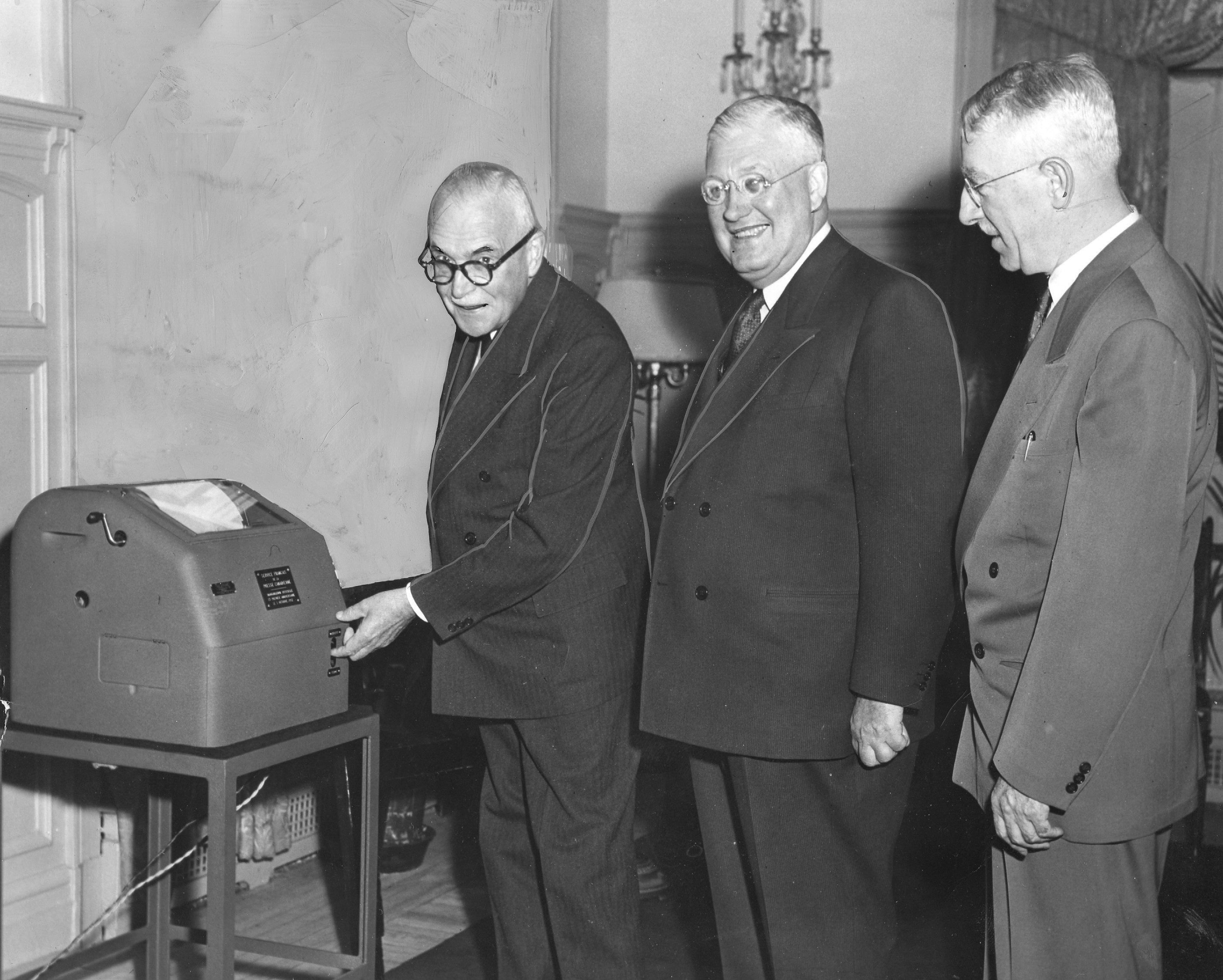
The company ultimately abandoned the cooperative model and became a private corporation owned equally by the daily newspaper La Presse, The Globe and Mail and Torstar.
Over the course of its 75-year history, the PC's staff has distinguished itself in its coverage of major events, including numerous federal and provincial elections, referendums, and countless landmark moments in Quebec, Canada, or abroad.
The Canadian Press, with its reporters in the field and journalists assigned to various news desks, has always distinguished itself by its speed in responding to events without sacrificing the accuracy of the information.
Among these historic moments, The Canadian Press's French service provided comprehensive coverage, notably during: the October Crisis (1970), the Montreal Olympics (1976), the shooting of Corporal Denis Lortie at the National Assembly (1984), the Montreal flood (1987), the death of René Lévesque (1987), the Polytechnique tragedy (1989), the Oka Crisis (1990), the Canadiens’ last Stanley Cup victory (1993), the Saguenay flood (1996), the Éboulements tragedy (1997), the ice storm (1998), the Maple Spring (2012), the Lac-Mégantic train derailment (2013), the attack on the Grand Mosque of Quebec City (2017), the pandemic (2020–2022), the attack on a daycare centre in Laval (2023), and the truck-ramming attack in Amqui (2023).
The PC also sent journalists to cover the Olympic Games around the world, stationed correspondents in Afghanistan when Canada had troops there, and provided its members and subscribers with coverage of the extraordinary funerals of Maurice Richard, Pierre Elliott Trudeau, and Guy Lafleur, held in Montreal.
These examples of the French service's coverage are just a tiny sample of the agency’s work that enables all French-language media outlets that are members or subscribers to its services to inform their audiences about events taking place outside their own coverage areas.
All major French-language media outlets employ journalists who once worked at The Canadian Press, which also boasted a few famous writers in the very early days of its French Service. These include the poets Alfred DesRochers and Olivier Marchand, the essayist Jean Lemoyne, the columnist Guy Fournier, comedian and screenwriter Carl Dubuc, and journalist Michel Roy, who would eventually hold executive positions at Le Devoir and La Presse.
This report by The Canadian Press was first published Oct. 15, 2026.
By Pierre Saint-Arnaud | Copyright 2026, The Canadian Press. All rights reserved.
Augmentation de loyer au Québec : Voici ce que ton proprio a le droit de faire ou non
Prends des notes pour ton prochain renouvellement de bail. 👀
Habituellement, au Québec, la grande majorité des baux se terminent le 31 juin et durent douze mois. Sachant que l'avis de renouvellement doit se faire entre trois à six mois avant la fin du bail, la plupart des locataires auront jusqu'au 31 mars pour renouveler ou mettre fin à celui-ci. Si cela est ton cas, il ne te reste donc que quelques semaines avant de remettre ta décision.
Si tu habites présentement un appartement loué, sache qu'ils existent des lois au Québec afin de protéger les locataires. En effet, les propriétaires n'ont pas le droit de tout faire concernant leur logement. Pour t'aider à en savoir plus sur tes droits en tant que locataires, et ce, surtout en cette période de renouvellement de bail, voici quelques informations qui peuvent t'être bien utiles si tu penses rester dans ton appart.
Suis-je obligé.e d'accepter une augmentation du coût du loyer?
Tu n'es jamais obligé.e d'accepter une augmentation du coût de ton loyer, surtout si celle-ci n'est pas basée sur des motifs clairs ou est injustifiée. Si par exemple ton ou ta proprio explique l'augmentation par une rénovation chez ton ou ta voisin.e ou par la récente inflation, ces justifications sont considérées comme invalides et peuvent être contestées.
Selon Éducaloi, et contrairement à la pensée populaire, il n'y a pas de taux fixes obligatoires pour une augmentation de loyer, mais tu peux tout de même te fier aux calculs effectués par le Tribunal administratif du logement (TAL) qui sort, chaque année, des pourcentages qui peuvent servir et guider les ajustements de loyer.
Qu'est-ce qui est considéré comme valide pour augmenter un loyer?
Plusieurs éléments peuvent venir justifier une augmentation de loyer. Ainsi, si ton ou ta propriétaire a effectué des rénovations majeures qui profitent à l'ensemble des locataires (par exemple, la réparation des fondations de l’immeuble, le sablage et le vernissage des planchers), si les frais d'énergie ou les taxes scolaires et municipales ont augmenté ou si les frais d'entretien (déneigement, entretien de la tuyauterie, peinture, etc.) ont grimpé.
« En ce qui concerne les réparations majeures, si ces dernières profitent à l’ensemble des locataires d’un immeuble à logement, l’augmentation sera alors divisée selon le nombre de logements », laisse savoir Éducaloi sur son site Internet.
Comment savoir si une augmentation est exagérée?
Si la hausse de ton logement te semble inexpliquée, tu peux utiliser le formulaire de calcul fournit par le TAL afin d'évaluer celle-ci et ainsi voir si oui ou non cela vaudra la peine de refuser l'augmentation et d'entrer dans des négociations avec ton ou ta propriétaire. Tu peux, bien sûr, aussi te fier aux critères nommés plus haut.
Comment refuser une augmentation de loyer?
Si ton bail est conforme à la loi, tu devrais pouvoir choisir entre trois options soit : j'accepte les modifications (le bail sera ainsi reconduit selon les nouvelles conditions), je désire quitter le logement (tu devras alors trouver un autre logement avant la fin du bail) ou je refuse les modifications proposées.
Si tu souhaites contester la hausse ou les modifications dans ton bail, tu peux alors t'embarquer dans des négociations à l'amiable avec ton ou ta propriétaire ou t'adresser au TAL pour qu’il décide du sort des modifications proposées. Sache que le ou la propriétaire peut lui aussi faire appel au TAL. Il ou elle aura alors un mois après avoir reçu ton refus pour le faire.
Est-ce que ton bail peut se renouveler automatiquement?
Oui, si tu n'informes pas ton ou ta propriétaire de tes intentions de quitter le logement ou que tu n'as pas indiqué que tu réfutes les modifications, ton bail sera renouvelé automatiquement sans que tu n'aies rien à faire. C'est pourquoi tu dois bien respecter les délais et envoyer ton avis avant la date limite (soit pour la majorité des baux au Québec, le 31 mars 2023).
Comment savoir les prix moyens pour un appartement dans mon quartier en 2023?
Quelques entreprises immobilières se sont amusées à récolter des données pour des quartiers précis ou des villes au Québec, et ce, pour diverses dimensions de logements. Cela peut te donner une idée du prix moyen des appartements dans ton secteur.
Le site Appartogo, par exemple, présente les prix moyens pour plusieurs villes au Québec. À Montréal, un trois et demi coûterait en moyenne 1 498 $ alors qu'à Québec, pour le même nombre de pièces, celui-ci coûterait 1 233 $.
Tu peux aussi consulter la plateforme liv.rent qui sort, chaque mois, les prix moyens des annonces de location de logements dans onze des quartiers les plus populaires de l'île de Montréal.
Ces chiffres ne sont pas à prendre au pied de la lettre, mais peuvent t'aider à savoir ce que tu devrais faire avec ton avis de renouvellement de bail.
Tu peux aussi regarder la section G de ton bail où ton ou ta propriétaire est obligé.e d'indiquer le loyer le plus bas douze mois avant ton arrivée.
Est-ce que mon proprio peut reprendre son logement?
Oui, mais à certaines conditions seulement. Selon le TAL, un.e propriétaire de l'immeuble peut reprendre le logement seulement s'il ou elle souhaite s'y loger ou pour un.e membre de sa famille nucléaire (parents ou enfants) ou une personne à charge dont iel est le soutien principal (matériel ou moral). Si c'est le cas, tu devras être averti.e six mois avant la fin de ton bail.
Sache aussi qu'un.e propriétaire n'a pas le droit de se servir de cette raison et par la suite de ne pas habiter le logement afin de le mettre sur le marché à un taux plus élevé.