



The Canadian Military Is Actually Allowed Take And Share Information From Your Phone
According to a newly disclosed federal directive obtained by The Canadian Press, Canada’s military spies have permission to collect and share information on Canadian citizens, even if the information has been collected inadvertently from open sources, like social media.
The directive, which is from August 2018, is entitled “Guidance on the Collection of Canadian Citizen Information.” It was obtained by The Canadian Press via the Access to Information Act, and revealed that data about Canadians, whether it's collected accidentally or not, “may be kept and used to support authorized defence-intelligence operations.”
According to the report, the directive is being reviewed by ‘The national-security and intelligence committee of parliamentarians,’ as part of a study on how the Canadian Forces use our information. The committee has studied thousands of pages and examined several ‘closed-door briefings’ and concluded that some citizen’s information was obtained through sensitive methods including by ‘technical means.’
The committee is now calling for stricter regulations on this ‘spying’ and intends to speak with Canada’s prime minister on the subject later this year. It will be the second report delivered to the prime minister following an April report that said the Canadian military does not face strong enough outside scrutiny.
While this sounds frightening, a spokeswoman for the National Defence assures Canadians that citizen’s information is only obtained is for the Canadian Forces national counter-intelligence unit. Capt. Nicola LaMarre said this refers to those being investigated by the Canadian military for threats to security from foreign intelligence services, or from individuals or groups engaged in sabotage, terrorist activities and other criminal acts.
Capt. LaMarre also said that although counter-intelligence programmes may investigate members of the Force and Defence employees, the unit cannot “arbitrarily conduct surveillance on Canadian citizens”. However, she did admit that in an “an increasingly complex global information environment” it is possible that military personnel may accidentally pick up information about citizens.
This information, including intelligence that is garnered unintentionally, can be retained by the military as investigative information and shared with other Canadian departments and agencies if the law allows.
It is this accidental information that concerns Tim McSorley, the national coordinator for the Ottawa-based International Civil Liberties Monitoring Group. According to The Canadian Press, he said “We're worried about what it means when they collect inadvertent information,” he said in an interview. “We don't know the scope or the degree to which Canadians' information is being captured.”
McSorely suggests that there should be stronger legislative control in play, to ensure the military’s intelligence isn’t overstepping privacy laws and infringing on Canadians' rights, saying “there can always be instances of over-reach, and that needs to be kept in check.”
 Prime Minister Mark Carney attends a Forever Canadian rally in Calgary, Thursday, Oct. 15, 2026.
THE CANADIAN PRESS/Jeff McIntosh
Prime Minister Mark Carney attends a Forever Canadian rally in Calgary, Thursday, Oct. 15, 2026.
THE CANADIAN PRESS/Jeff McIntosh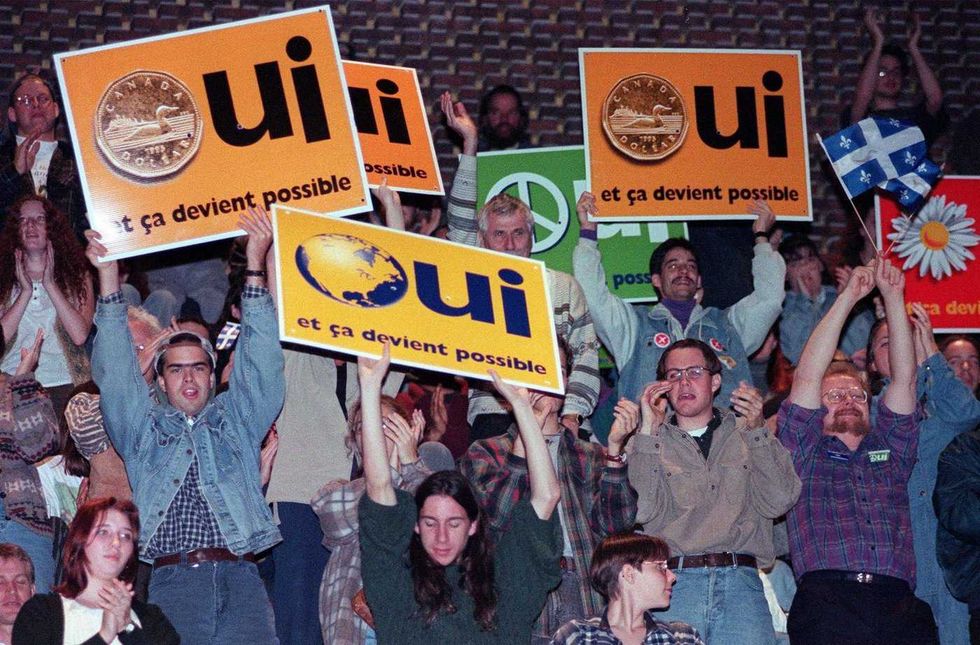 Quebec sovereignty referendum "Yes" supporters cheer during a speech by then-Bloc Québécois leader Lucien Bouchard at a junior college, in Montreal, on Tuesday, Oct. 24, 1995.
THE CANADIAN PRESS/Ryan Remiorz
Quebec sovereignty referendum "Yes" supporters cheer during a speech by then-Bloc Québécois leader Lucien Bouchard at a junior college, in Montreal, on Tuesday, Oct. 24, 1995.
THE CANADIAN PRESS/Ryan Remiorz The Stellantis vehicle assembly plant is shown in Brampton, Ont., on Wednesday, Oct. 15, 2025.
THE CANADIAN PRESS/Nathan Denette
The Stellantis vehicle assembly plant is shown in Brampton, Ont., on Wednesday, Oct. 15, 2025.
THE CANADIAN PRESS/Nathan Denette The Canadian Forces Snowbirds perform at the Aero Gatineau-Ottawa air show in Gatineau, Que., on Saturday, Sept. 19, 2026.
THE CANADIAN PRESS/Patrick Doyle
The Canadian Forces Snowbirds perform at the Aero Gatineau-Ottawa air show in Gatineau, Que., on Saturday, Sept. 19, 2026.
THE CANADIAN PRESS/Patrick Doyle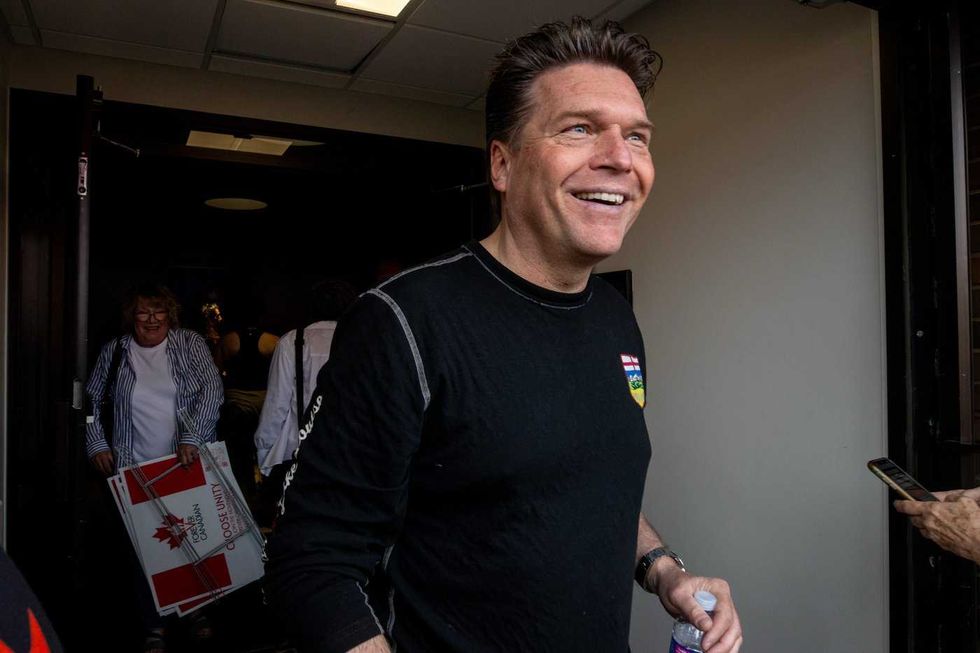 Former Deputy Premier, MLA and spokesperson for the Forever Canada petition, Thomas Lukaszuk, at a Forever Canadian rally, in Edmonton, Saturday, May 23, 2026.
THE CANADIAN PRESS/Amanda Erickson.
Former Deputy Premier, MLA and spokesperson for the Forever Canada petition, Thomas Lukaszuk, at a Forever Canadian rally, in Edmonton, Saturday, May 23, 2026.
THE CANADIAN PRESS/Amanda Erickson. Mitch Sylvestre hold boxes of signatures before submitting signatures for a separation referendum to Elections Alberta in Edmonton, on Monday, May 4, 2026.
THE CANADIAN PRESS/Jason Franson
Mitch Sylvestre hold boxes of signatures before submitting signatures for a separation referendum to Elections Alberta in Edmonton, on Monday, May 4, 2026.
THE CANADIAN PRESS/Jason Franson