



THE CANADIAN PRESS/Jeff McIntosh
1980 — The federal government ignites widespread alienation in Alberta with the National Energy Program, which keeps domestic oil prices below world levels to promote Canadian energy security and increase the federal share of oil revenues. Alberta views it as an unjustified attack and a federal money grab. The issue is later settled, but discontent with Ottawa continues.
1982 — Separatism enjoys a brief heyday. Gordon Kesler of the Western Canada Concept Party wins a provincial byelection in central Alberta on a separatist platform. Later that year in the general election, he loses a spot in the legislature. The party receives 12 per cent of the vote but no seats.
2019 — The anti-Ottawa mood ramps up as the United Conservative Party under Jason Kenney wins power in Alberta, capitalizing on discontent over federal rules and policies deemed to impair Alberta’s ability to create wealth, particularly in oil and gas. Premier Kenney fights for more independence from Ottawa but remains a staunch advocate for the province staying in Confederation.
2022-23 — Kenney is replaced by Danielle Smith, who wins government in the 2023 election on a platform of further asserting independence from Ottawa. Unlike Kenney, Premier Smith, while stressing her preference for a “sovereign Alberta within a united Canada,” refuses to characterize separatists as fringe extremists, saying they have valid grievances that deserve to be aired.
April 28, 2025 — Mark Carney and the Liberals defeat the federal Conservatives to win a minority government.
May 5, 2025 — Smith announces a panel to discuss Alberta's future in Canada. She says her government won't itself put separation on a ballot but would honour a successful citizen petition seeking such a vote. At the same time, her government takes steps to eventually pass rules to lower thresholds for citizen-led petitions.
June 2025 — Former Alberta Progressive Conservative deputy premier Thomas Lukaszuk launches a “Forever Canadian” petition to affirm the province stays in Canada. It eventually collects more than 400,000 names — enough to validate the petition. But by the spring of 2026, the petition is tied up in a legislature committee as Smith questions whether Lukaszuk gathered the names for a referendum or as a trigger for a vote among legislature members.
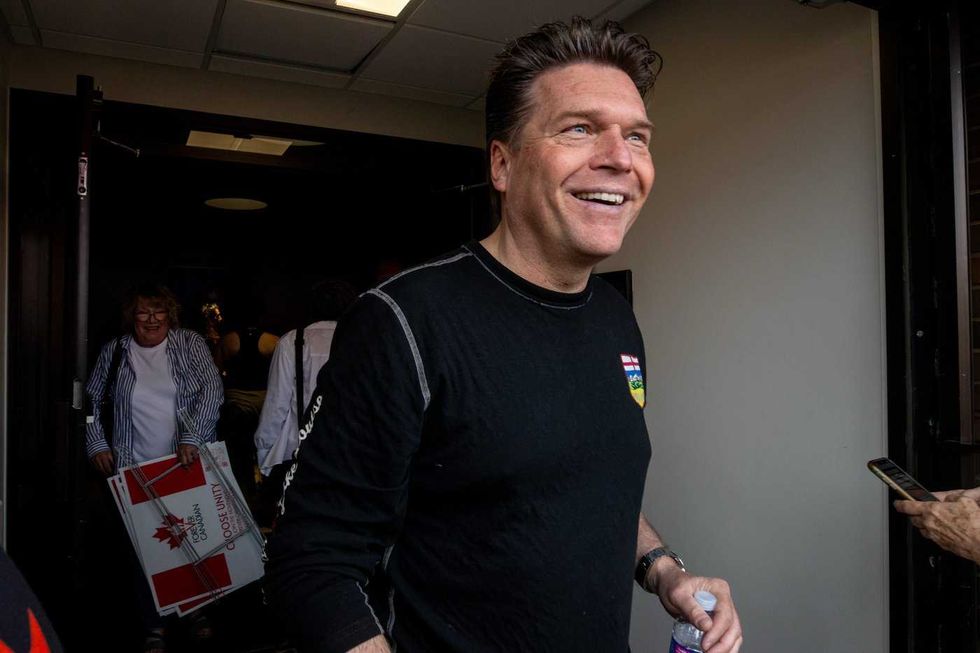 Former Deputy Premier, MLA and spokesperson for the Forever Canada petition, Thomas Lukaszuk, at a Forever Canadian rally, in Edmonton, Saturday, May 23, 2026.
THE CANADIAN PRESS/Amanda Erickson.
Former Deputy Premier, MLA and spokesperson for the Forever Canada petition, Thomas Lukaszuk, at a Forever Canadian rally, in Edmonton, Saturday, May 23, 2026.
THE CANADIAN PRESS/Amanda Erickson.
January 2026 — Mitch Sylvestre of the separatist Alberta Prosperity Project is given the green light by election officials to launch a petition asking whether Alberta should leave Canada. Months later, the petition is deemed successful, having gathered about 223,000 signatures.
Feb. 19, 2026 — Smith announces nine referendum questions about immigration and constitutional concerns will be put to Albertans in an Oct. 19 referendum.
May 13, 2026 — An Alberta Court of King's Bench judge quashes the separatist petition, ruling Smith’s government didn't properly consult First Nations as required in the Constitution. Smith later promises to challenge the ruling, and it remains in legal limbo.
 Mitch Sylvestre hold boxes of signatures before submitting signatures for a separation referendum to Elections Alberta in Edmonton, on Monday, May 4, 2026.
THE CANADIAN PRESS/Jason Franson
Mitch Sylvestre hold boxes of signatures before submitting signatures for a separation referendum to Elections Alberta in Edmonton, on Monday, May 4, 2026.
THE CANADIAN PRESS/Jason Franson
May 21, 2026 — Smith announces a 10th referendum question asking whether Alberta should stay in Canada or hold a binding vote on separation. Smith cites the legal uncertainty of the court decision on the separatist petition as the driving force, saying it unduly deprives thousands of Albertans of having a say. Smith later cites Lukaszuk's petition, too, as a reason. She says both show hundreds of thousands of Albertans want the issue decided.
Sept. 10, 2026 — The Alberta government launches a $4-million advertising campaign for the referendum and urges citizens to vote to stay in Canada. The move comes as polls suggest a broad majority of Albertans want to stay.
Sept. 14, 2026 — Smith's UCP loses a byelection to the Opposition NDP in their conservative stronghold of Calgary-Shaw. Critics across the political spectrum say the referendum was a factor in punishing Smith’s UCP. Her office says the party lost due to right-centre vote splitting.
Sept. 16, 2026 — Smith's government publishes a report it commissioned from the University of Calgary to determine what fiscal challenges and benefits an independent Alberta could see. It estimates an initial five-year price tag of $50 billion to $170 billion, noting that figures could swing sharply depending on factors outside Alberta's control.
This report by The Canadian Press was first published Oct. 16, 2026.
Copyright 2026, The Canadian Press. All rights reserved.
Cette blogueuse prouve que le «corps idéal» n'existe tout simplement pas
Ta mère te l'a sûrement déjà dit: dans la vie, c'est important d'avoir une bonne balance. On parle pas ici d'une balance pour te peser, mais bien d'un équilibre.
Anna Victoria, fille tout à fait normale de 28 ans devenue star d'Instagram, profite souvent de sa tribune pour passer des messages inspirants à ses abonnés. Elle a complètement changé son mode de vie il y a quelques années après en avoir eu marre d'être constamment malade.
Depuis, elle s'efforce de faire comprendre aux femmes que rien n'est jamais parfait, et qu'on devrait toutes se donner un peu de slack.
Si ton objectif de « corps idéal » est la photo de gauche, tu devrais tout de suite réajuster tes attentes! Ce type de silhouette n'existe pas.
Voici 6 réalités à comprendre immédiatement:
1. Ton ventre va enfler après avoir mangé. C'est normal, et ce même si tu t'entraînes comme une folle et que tu manges santé.
Et encore plus normal après un « cheat meal », hyper important pour maintenir un bon équilibre.
Anna pratique le 80/20: elle mange bien 80% du temps, puis se permet 20% de gâteries.
2. Tu n'auras jamais le corps des filles dans les magazines/sur Instagram, puisque ces filles n'ont même pas le corps qu'on voit sur leurs photos.
Tout est une question d'éclairage et de pose!
3. Tu n'as pas de cellulite sur les bras. C'est le miroir de l'ascenseur et l'éclairage qui donnent cette impression à tout le monde.
4. Il va toujours y avoir des plis sur ton ventre quand tu t'assois, même si tu t'entraînes.
5. Les poignées d'amour ce n'est pas une «imperfection». Ça vient avec le fait d'être humain!
6. Les pilules magiques et les thés détox c'est d'la m*arde et ça marche pas!
Voici des résultats réalistes pour 6 mois d'efforts (photo ci-dessus)! Sois réaliste et fière de toi tout au long de ta transformation physique, parce que c'est une longue aventure.
Toute ma vie, je me suis fiée au chiffre sur le pèse-personne pour dicter mon bonheur du jour. -2 livres = une maudite belle journée! +3: cr*ss, j'aurais pas dû manger le 2e burrito hier.
J'ai vécu comme ça pendant un beaucoup trop long moment, jusqu'à ce que je découvre l'histoire d'Anna Victoria, qui m'a fait comprendre c'est quoi être en accord avec son corps.
Tsé le fameux « poids santé/poids naturel », ben c'est vrai qu'il vient tout seul quand tu fais attention à toi-même, quand tu t'aimes, que tu bouges et que tu manges bien non pas pour maigrir, mais pour être bien dans ta tête et ton corps.
Et la shape idéale, c'est pas juste celle de Gigi Hadid ou de Maripier Morin. C'est la tienne également quand tu te sens bien dans ta peau (peu importe ton poids ou l'angle dans lequel tu es placée).
Alors, arrête tout de suite de penser que t'es grosse quand tu vois un plis sur ton corps, cesse de te comparer aux vedettes qui posent et sois patiente. ❤️