



THE CANADIAN PRESS/Jeff McIntosh
1980 — The federal government ignites widespread alienation in Alberta with the National Energy Program, which keeps domestic oil prices below world levels to promote Canadian energy security and increase the federal share of oil revenues. Alberta views it as an unjustified attack and a federal money grab. The issue is later settled, but discontent with Ottawa continues.
1982 — Separatism enjoys a brief heyday. Gordon Kesler of the Western Canada Concept Party wins a provincial byelection in central Alberta on a separatist platform. Later that year in the general election, he loses a spot in the legislature. The party receives 12 per cent of the vote but no seats.
2019 — The anti-Ottawa mood ramps up as the United Conservative Party under Jason Kenney wins power in Alberta, capitalizing on discontent over federal rules and policies deemed to impair Alberta’s ability to create wealth, particularly in oil and gas. Premier Kenney fights for more independence from Ottawa but remains a staunch advocate for the province staying in Confederation.
2022-23 — Kenney is replaced by Danielle Smith, who wins government in the 2023 election on a platform of further asserting independence from Ottawa. Unlike Kenney, Premier Smith, while stressing her preference for a “sovereign Alberta within a united Canada,” refuses to characterize separatists as fringe extremists, saying they have valid grievances that deserve to be aired.
April 28, 2025 — Mark Carney and the Liberals defeat the federal Conservatives to win a minority government.
May 5, 2025 — Smith announces a panel to discuss Alberta's future in Canada. She says her government won't itself put separation on a ballot but would honour a successful citizen petition seeking such a vote. At the same time, her government takes steps to eventually pass rules to lower thresholds for citizen-led petitions.
June 2025 — Former Alberta Progressive Conservative deputy premier Thomas Lukaszuk launches a “Forever Canadian” petition to affirm the province stays in Canada. It eventually collects more than 400,000 names — enough to validate the petition. But by the spring of 2026, the petition is tied up in a legislature committee as Smith questions whether Lukaszuk gathered the names for a referendum or as a trigger for a vote among legislature members.
 Former Deputy Premier, MLA and spokesperson for the Forever Canada petition, Thomas Lukaszuk, at a Forever Canadian rally, in Edmonton, Saturday, May 23, 2026.
THE CANADIAN PRESS/Amanda Erickson.
Former Deputy Premier, MLA and spokesperson for the Forever Canada petition, Thomas Lukaszuk, at a Forever Canadian rally, in Edmonton, Saturday, May 23, 2026.
THE CANADIAN PRESS/Amanda Erickson.
January 2026 — Mitch Sylvestre of the separatist Alberta Prosperity Project is given the green light by election officials to launch a petition asking whether Alberta should leave Canada. Months later, the petition is deemed successful, having gathered about 223,000 signatures.
Feb. 19, 2026 — Smith announces nine referendum questions about immigration and constitutional concerns will be put to Albertans in an Oct. 19 referendum.
May 13, 2026 — An Alberta Court of King's Bench judge quashes the separatist petition, ruling Smith’s government didn't properly consult First Nations as required in the Constitution. Smith later promises to challenge the ruling, and it remains in legal limbo.
 Mitch Sylvestre hold boxes of signatures before submitting signatures for a separation referendum to Elections Alberta in Edmonton, on Monday, May 4, 2026.
THE CANADIAN PRESS/Jason Franson
Mitch Sylvestre hold boxes of signatures before submitting signatures for a separation referendum to Elections Alberta in Edmonton, on Monday, May 4, 2026.
THE CANADIAN PRESS/Jason Franson
May 21, 2026 — Smith announces a 10th referendum question asking whether Alberta should stay in Canada or hold a binding vote on separation. Smith cites the legal uncertainty of the court decision on the separatist petition as the driving force, saying it unduly deprives thousands of Albertans of having a say. Smith later cites Lukaszuk's petition, too, as a reason. She says both show hundreds of thousands of Albertans want the issue decided.
Sept. 10, 2026 — The Alberta government launches a $4-million advertising campaign for the referendum and urges citizens to vote to stay in Canada. The move comes as polls suggest a broad majority of Albertans want to stay.
Sept. 14, 2026 — Smith's UCP loses a byelection to the Opposition NDP in their conservative stronghold of Calgary-Shaw. Critics across the political spectrum say the referendum was a factor in punishing Smith’s UCP. Her office says the party lost due to right-centre vote splitting.
Sept. 16, 2026 — Smith's government publishes a report it commissioned from the University of Calgary to determine what fiscal challenges and benefits an independent Alberta could see. It estimates an initial five-year price tag of $50 billion to $170 billion, noting that figures could swing sharply depending on factors outside Alberta's control.
This report by The Canadian Press was first published Oct. 17, 2026.
Copyright 2026, The Canadian Press. All rights reserved.
THE CANADIAN PRESS/Amanda Erickson
And when Albertans head to the polls Monday to vote on whether to hold a future referendum on separation from Canada, they'll also be answering five separate questions on immigration being pushed by the government of Alberta Premier Danielle Smith.
Those questions include:
— Should the province should have more say over economic immigration?
— Should provincially funded services should be restricted to citizens, permanent residents and those with "Alberta-approved" immigration status?
— Should non-permanent immigrants should be charged a fee for accessing health care and education services?
— Should non-permanent residents should have to reside in Alberta for at least 12 months before qualifying for provincially funded social supports?
— Should voters should have to present proof of citizenship when voting provincially?
Jason Kenney, a former Alberta premier and federal immigration minister, said Canada needs a broader debate on immigration policy based on facts.
"We do need a serious debate on immigration because demography is destiny. There are very few things that are more important," Kenney told The Canadian Press in an interview.
"But we have to do it in a disciplined and respectful, thoughtful way, as much as possible, based on evidence and data and experience around the world."
 Former Alberta premiers Rachel Notley, left, and Jason Kenney discuss their assessment of the possible economic cost of Alberta's referendum at an Edmonton Chamber luncheon in Edmonton on Tuesday, Oct. 13, 2026.
THE CANADIAN PRESS/John Ulan
Former Alberta premiers Rachel Notley, left, and Jason Kenney discuss their assessment of the possible economic cost of Alberta's referendum at an Edmonton Chamber luncheon in Edmonton on Tuesday, Oct. 13, 2026.
THE CANADIAN PRESS/John Ulan
Kenney warned that debates on immigration policy can easily become sidetracked by more extreme political views — by accusations of racism from the far left and by actual racism on the far right.
While Kenney said he doesn't see the immigration questions on the Alberta ballot as race-based or xenophobic, the Alberta separatist movement itself is something else entirely.
"If you listen to the key separatist leaders like Mitch Sylvestre, who's the leader of the primary separatist organization, he says that in his republic of Alberta, no one will have citizenship unless you're born there," Kenney said.
"So I do think there are some currents on the extreme right of Alberta politics that we should all be concerned about. I do not think that necessarily means we cannot have an adult, grown-up conversation about immigration policy."
But the immigration questions on the ballot are not sitting well with some diaspora communities in the province.
Lawyer Avnish Nanda, co-founder of the advocacy group Our Alberta Advantage, is campaigning for people to vote "no" on the immigration-related questions.
 Stampede Princess Breanna Correia carries the Canadian flag as the national anthem is sung prior to rodeo action at the Calgary Stampede in Calgary, Alta., Friday, July 4, 2025.THE CANADIAN PRESS/Jeff McIntosh
He said reactions to the questions from Alberta's cultural communities and from individuals who have considered running for the United Conservative Party have been overwhelmingly negative.
"They view these questions as targeting them, their journey here and the roots they've established over the past 60 years," he said.
"There's fear, there's confusion and anger at this government. They think this is not necessary. They think it's wrapped up in the separatism effort. They think that Danielle Smith is scapegoating them to continue to maintain the support of the more extreme separatist elements that brought her to power."
Nanda said the referendum is bringing out some ugly undercurrents in Alberta. He said his parents were recently "jeered by a couple of white guys in a car" while out for a walk — something that had never happened to them since coming to Canada in the 1970s.
"There's a notion that it impacts us all, whether you're a citizen or not, these questions," he said. "Because the people who are mobilized around this issue, in support of it, a lot of them don't differentiate between people who have been here 40 years [and] people who came here a week ago, because we all look the same to them."
Nanda said if the immigration ballot measures pass on Monday, they could undermine Canada's multicultural identity, while restricting access to provincial services would make it harder for newcomers to integrate.
 Parti Québécois Leader Paul St-Pierre Plamondon speaks to supporters after winning the provincial election in Montreal on Monday, Oct. 5, 2026.
THE CANADIAN PRESS/Graham Hughes
Parti Québécois Leader Paul St-Pierre Plamondon speaks to supporters after winning the provincial election in Montreal on Monday, Oct. 5, 2026.
THE CANADIAN PRESS/Graham Hughes
Across the country in Quebec, the new minority Parti Québécois government campaigned on a promise to tighten immigration controls. Quebec has maintained far more control over the immigration system than other provinces since 1991.
The PQ immigration platform included, among other things, promises to reduce annual permanent resident admissions from 45,000 to 35,000, to impose a moratorium on permanent immigration from outside Quebec, to prioritize permanent status for temporary residents already in the province, and to tighten the selection criteria for temporary workers.
Catherine Xhardez, a political-science professor at the University of Montreal, said the outgoing Coalition Avenir du Quebec government politicized Quebec's immigration debate by introducing restrictions the new government now wants to strengthen.
"Before that, they have kind of a consensus between political parties, how migration is good for the economy … good for demography, but even for French language," she said.
Xhardez said before 2018, Quebec's main parties generally agreed on the positive role immigration played in strengthening francophone culture by prioritizing certain immigrants.
"But then (the CAQ) broke this consensus between the parties by saying it was too much, too quickly, they needed less," she said.
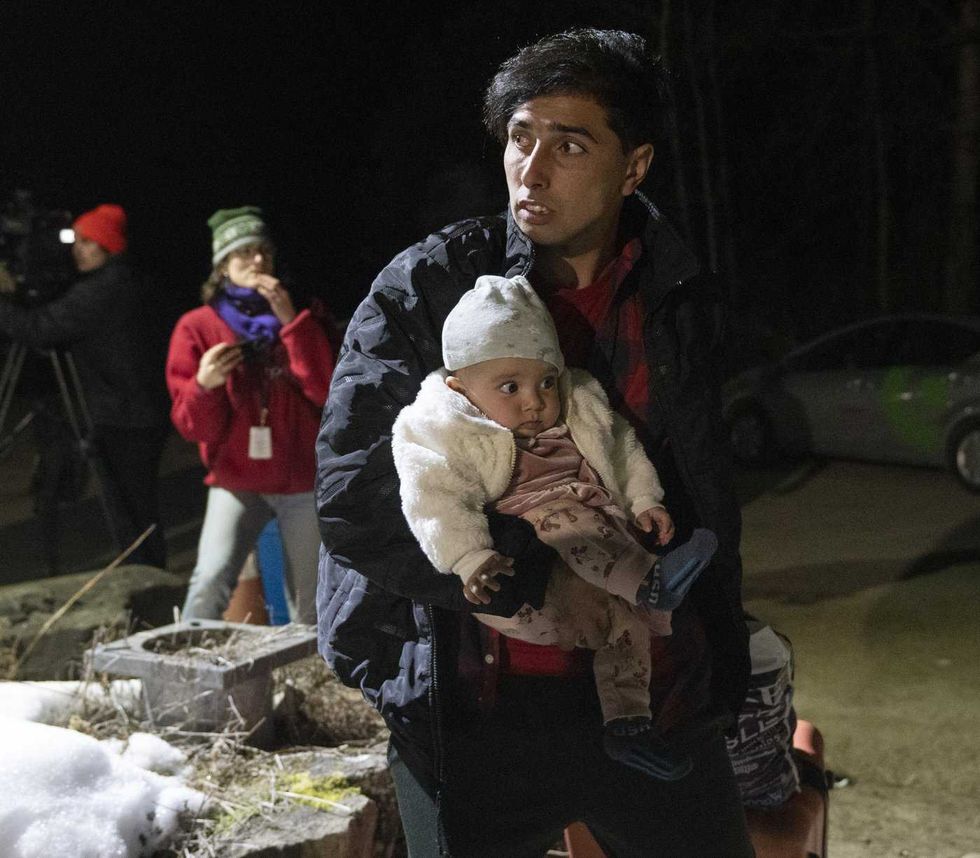 Asylum seeker Mahamed Yusef Niazi, from Afghanistan, carries his seven-month-old daughter Sahaba across the border at Roxham Road from New York into Canada on Friday, March 24, 2023 in Champlain, N.Y.
THE CANADIAN PRESS/Ryan Remiorz
Asylum seeker Mahamed Yusef Niazi, from Afghanistan, carries his seven-month-old daughter Sahaba across the border at Roxham Road from New York into Canada on Friday, March 24, 2023 in Champlain, N.Y.
THE CANADIAN PRESS/Ryan Remiorz
Xhardez said there's a key difference between the Quebec and Alberta immigration debates — the debate in Alberta is built around populist pushback blaming social service shortages on immigrants, while the debate in Quebec puts identity and culture at the forefront.
She added immigration has also become a bargaining chip for the Quebec government in its engagements with Ottawa.
Premier Smith wants a bargaining chip of her own. In a video released Wednesday, Smith encouraged Albertans to vote in favour of the nine immigration and constitutional questions in the referendum to "send Ottawa a message." She said the goal of one question on the ballot is to "give us the same power as Quebec to recruit economic migrants."
During a pro-unity campaign stop in Calgary on Thursday, Prime Minister Mark Carney urged his audience to vote "no to the nine" — repeating a phrase that has become a rallying cry among those opposed to separatism.
 Prime Minister Mark Carney attends a Forever Canadian rally in Calgary on Thursday, Oct. 15, 2026.
THE CANADIAN PRESS/Jeff McIntosh
Prime Minister Mark Carney attends a Forever Canadian rally in Calgary on Thursday, Oct. 15, 2026.
THE CANADIAN PRESS/Jeff McIntosh
Kenney said he's a "skeptic when it comes to greater provincial control" over a "sensitive" matter like immigration policy. He said provincial governments lack the federal government's ability to detect fraud and are inclined to focus solely on local issues — not on how immigration affects the national economy.
"In the western provinces, very typically, the permanent residents that they recommend have been low-skilled temporary foreign workers who they're flipping into permanent residency because the local MLAs get tired of being browbeaten by the Tim Hortons franchise owners," Kenney said.
Reflecting on his time as Alberta's premier, he said "certain premiers" told Ottawa after the COVID-19 pandemic that their biggest priority was to increase immigration — despite early evidence of the housing and youth unemployment challenges currently driving the immigration debate.
"When you don't have social permission to discuss these issues, again, that creates the kind of conditions where popular opinion gets totally detached from elite opinion. And if you want to know what that looks like, look at the politics of Europe today," Kenney said.
"So if you want to avoid (Alternative für Deutschland), Front National, U.K. Reform-style politics, then yes, we need a proper, open debate about these issues."
 People march as they take part in an anti-ICE protest near the U.S. Consulate in Montreal on Sunday, Feb. 1, 2026.
THE CANADIAN PRESS/Graham Hughes
People march as they take part in an anti-ICE protest near the U.S. Consulate in Montreal on Sunday, Feb. 1, 2026.
THE CANADIAN PRESS/Graham Hughes
Xhardez, who is originally from Belgium, said the Canadian political scene is very different from Europe and the U.S. — Canada has no mainstream anti-immigrant political party at the federal level. But public feelings about immigration have shifted — and no one knows for certain how that will affect Canada's politics going forward.
"Canada is maybe not so exceptional, we don't know. Or maybe it will become exceptional as being just less politicized, but it's not true that there is still this consensus and strong public support," Xhardez said.
Nanda said some of the loudest voices opposing the immigration questions in Alberta have been chambers of commerce, which represent businesses that have been struggling to recruit staff.
He said someone in politics needs to champion the idea that immigrants lift up economies, expand the tax base and help to fund social programs and services.
"What they're experiencing in their communities around affordability is because of failed government policies around investing in education, investing in health care, and the same immigrants that people are scapegoating as their reasons [are] a way to reverse that," he said.
"If you go to rural Alberta hospitals or long-term care facilities, most nurses and support staff are immigrants because we can't find local workers to work there. The same is true in many educational facilities."
This report by The Canadian Press was first published Oct. 17, 2026.
By David Baxter | Copyright 2026, The Canadian Press. All rights reserved.
Des blagues sur les dénonciations font réagir au gala Les Olivier et Radio-Canada répond
Le dimanche 21 mars avait lieu le gala Les Olivier sur les ondes de Radio-Canada. Lors de cet événement qui célèbre le milieu de l'humour, des blagues concernant la vague de dénonciations d'inconduites et d'agressions sexuelles au sein du vedettariat québécois ont fait réagir sur les réseaux sociaux.
Sur Facebook, le commentaire d'un téléspectateur sur le sujet a même retenu l'attention de Radio-Canada, qui y a répondu.
La sélection de l'éditeur : 7 couples québécois qui sont en amour à l'écran comme dans la vraie vie
Les blagues en lien avec les dénonciations de l’été 2020
Au cours de la soirée dédiée aux humoristes québécois, quelques artistes ont fait référence à la vague de dénonciations qui a eu lieu en juillet et août 2020.
Dès le numéro d'ouverture, François Bellefeuille a mentionné la carrière de Julien Lacroix, alors qu'il a cessé ses activités après des allégations, ainsi que le retour de Maripier Morin à l'écran dans La Faille 2 et en tête d’affiche du nouveau film de Mariloup Wolfe.
Rosalie Vaillancourt, de son côté, s'est moquée du fait que la salle ne comptait qu'un nombre limité d'artistes et de spectateurs dû aux consignes de distanciation, en soulevant à la blague qu'elle ne pensait pas qu'autant de personnes du milieu avaient été dénoncées.
La réaction du public
Sur Twitter, le journaliste Hugo Dumas a cité la flèche de François Bellefeuille concernant Maripier Morin ainsi que la blague de Rosalie Vaillancourt.
Au moment de publier ces lignes, le tweet à propos de Maripier Morin cumule près de 300 likes et celui concernant Rosalie plus de 650.
Cela dit, sur la page Facebook de Radio-Canada, un commentaire mentionne avoir l'impression que les participants du gala s'acharnaient sur Julien Lacroix suite aux propos à son égard.
Le gestionnaire dudit compte Facebook a donc répondu publiquement à l'auteur du commentaire.
[rebelmouse-image 26010941 photo_credit="Radio-Canada | Facebook" expand=1 original_size="1170x230"] Radio-Canada | Facebook
La réponse de Radio-Canada face à Julien Lacroix
[rebelmouse-image 26010942 photo_credit="Radio-Canada | Facebook" expand=1 original_size="1178x558"] Radio-Canada | Facebook
Le 27 juillet 2020, un article paru dans Le Devoir a dévoilé que Julien Lacroix était visé par plusieurs allégations entourant des inconduites sexuelles.
Par la suite, l'agence de Julien a rompu ses liens avec celui-ci et l'humoriste a quitté les réseaux sociaux après s'être exprimé à deux reprises au sujet de la controverse.
Cinq mois plus tard, il a présenté une lettre d'excuses en janvier 2021 sur ses réseaux sociaux afin de parler de son processus thérapeutique, ce qui a suscité plusieurs réactions de la part des gens qui l'ont côtoyé.
Radio-Canada a donc répondu au commentaire en ajoutant le lien vers l'article parlant des neuf femmes qui l'ont dénoncé :
« On peut comprendre qu'un milieu veuille se distancier de cette personne. »
[rebelmouse-image 26010943 photo_credit="Radio-Canada | Facebook" expand=1 original_size="1064x522"] Radio-Canada | Facebook
Un internaute a ensuite répondu que ce n'était peut-être pas le moment de faire des blagues de la sorte, ce à quoi le diffuseur a répliqué que les humoristes « n'ont [actuellement] pas tant de tribunes aussi larges que ça » pour le faire.