



Courtesy of President's Choice
You're familiar with President's Choice (PC) — the in-house grocery brand you see in stores under the Loblaw umbrella. Well, they have been working with greenhouse growers to stock your local grocery store with the taste of summer all year round.
And Canadians seem to be pretty into it. According to Mintel, 77% of Canadian consumers agree that growing produce in climate-controlled greenhouses in Canada is a good idea (Source: Mintel Reports Canada, Fruits and Vegetables, 2026).
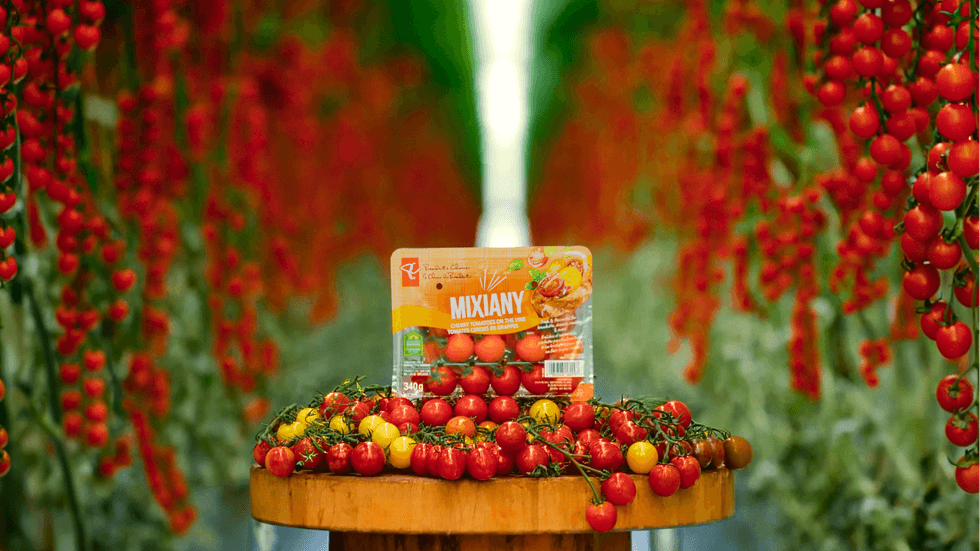 Colourful President’s Choice Mixiany Cherry TomatoesCourtesy of President's Choice
Protected from the weather and with the light, water and temperature dialled in just right, PC's greenhouse-grown Mixiany Cherry Tomatoes On The Vine are produced using a vine-ripening technique that allows the plant to fully nourish the tomato before they are picked — resulting in an enhanced aroma, rich flavour and often sweeter taste.
Whether you're tossing them in a salad, roasting them or snacking on them one by one and enjoying that crisp "pop," they're plump little bites of summer that you can get all year round, thanks to the near-perfect growing conditions inside the greenhouse.
 Fresh strawberries picked straight from the vine.Courtesy of President's Choice
Likewise, PC's greenhouse-grown strawberries (grown in Canada, including Leamington, ON, aka "the greenhouse capital of North America") grow up sweet and juicy, well outside their usual growing season, so you can still enjoy them on your French toast while the snow tumbles past your window.
 Fresh greenhouse grown lettuceCourtesy of President's Choice
Then, there are multiple varieties of lettuce that you can pick up, crisp and leafy, just like the ones at the farmers market in mid-July. And because the Live Lettuce Trio is sold with their roots still attached, it helps to maximize the flavour, maintain freshness, and prolong shelf life.
The whole reason this is possible is the combination of expertise and modern agricultural innovation across North America. By growing produce year-round in protected greenhouse environments, PC and the growers they work with can offer the quality and consistency people are looking for in their fresh produce.
 Fresh, juicy tomatoes on the vine. Courtesy of President's Choice
It also means that you can continue to support growers even when the traditional growing season wraps up and the farmers markets wind down.
So, the next time you're bundled up against the cold and craving something that tastes a little more like patio season, you might not have to look as far as you think thanks to PC's greenhouse-grown produce.
Une liste des pays les moins stricts aux frontières est sortie et voici le score du Canada
Les restrictions d'entrée sont assez sévères. 👀
La population canadienne est habituellement réputée pour sa gentillesse. On parle même d'une « sur-amabilité » qui nous vaudrait le stéréotype de nous excuser constamment. Qu'il soit vrai ou non, il n'en reste rien que d'être reconnu pour être sympathique n'est pas à plaindre et peut attirer moult expats qui cherchent une nouvelle contrée où s'installer. Le Canada avait d'ailleurs reçu le titre du troisième meilleur pays au monde selon le U.S. News en 2022.
Selon Passeport Index, une plateforme digitale qui évalue les types de passeports de la planète, les pays « les plus accueillants » seraient plutôt ceux qui possèdent le moins de restrictions aux frontières pour les visiter et qui seraient donc considérés comme moins stricts. Il semble que dans cette optique, le Canada est bien loin dans la liste qui comprend 84 positions au total. Pour effectuer le classement, Passeport Index s'est fié au nombre de types de passeports que chaque pays accepte sans visa, avec visa à l'arrivée ou avec eTA (autorisation de voyage requise), et ce, depuis le début de 2023.
En 68e position, le Canada est évalué comme assez sévère dans ses règlements pour entrer au pays. Il est suivi de l'Australie en 79e position, des États-Unis ainsi que l'Irak en 70e et du Mali en 71e. Cela signifie que ce n'est pas tout le monde qui peut passer les frontières et espérer entrer sur le territoire canadien puisque le pays permet à seulement 54 nationalités d'entrer sans visa, avec visa à l'arrivée ou avec eTA.
Parmi les pays « les plus accueillants » notons, entre autres, en première position, le Gabon, la Guinée, l'Éthiopie, l'Angola, le Djibouti, la Bolivie, les Maldives et le Burundi qui ont tou.tes accueilli près de 198 passeports en 2023.
La Corée du Nord, classée comme à éviter absolument selon le Gouvernement du Canada, s'est placée à la toute fin de la liste en 84e position ainsi que l'Afghanistan et le Turkmenistan puisqu'eux aussi n'ont accepté aucune entrée.