
Mathieu Perreault a (encore une fois) été opéré à l’oeil
November 17, 2021, 01:36 PM
November 17, 2021, 02:07 PM
Il y a un peu plus de deux semaines, on apprenait que Mathieu Perreault allait …
Don't have an account?
By continuing, you agree to our Terms & Conditions
Please check your e-mail to reset your password.


We use cookies to personalize content and ads, to provide social media features and to analyze our traffic. We also share information about your use of our site with our social media, advertising and analytics partners who may combine it with other information that you’ve provided to them or that they’ve collected from your use of their services. Learn More
Disons qu'il y a pas mal de bébés qui ont été conçus pendant le temps des Fêtes. 🤭
Si ta fête tombe en septembre, il y a de bonnes chances que tu partages ton gâteau avec pas mal de monde. Statistique Canada a classé les 366 jours de l'année, de la date de naissance la plus fréquente à la plus rare, et une date en particulier se démarque au sommet du palmarès au pays.
À lire également : Statistique Canada dévoile les prénoms de bébé les plus populaires au pays en 2025
L'agence fédérale a publié ce classement le 15 octobre 2026. Il repose sur les quelque 11,2 millions de naissances vivantes au Canada enregistrées de 1995 à 2025 à l’état civil. Et la tendance est claire : la fin de l'été et le début de l'automne dominent le haut du classement, tandis que le temps des Fêtes se retrouve tout en bas.
Sans surprise, le 29 février est la date de naissance la plus rare au Canada, puisqu'il ne revient qu'une fois aux quatre ans. Mais juste derrière lui, on retrouve une série de dates qui ont toutes un point en commun : elles tombent pendant les Fêtes.
Le 20 septembre est la date de naissance la plus fréquente au Canada de 1995 à 2025. Septembre accapare d'ailleurs neuf des dix premières places du classement :
Le 5 juillet est le seul intrus du top 10, en neuvième position.
Fait intéressant, juillet est le mois où il naît le plus de bébés au total au Canada depuis 1995. Mais il compte 31 jours, contre 30 pour septembre. Si on compare plutôt le nombre moyen de naissances par jour, c’est septembre qui l’emporte, ce qui explique pourquoi ses dates dominent le classement.
Et si tu recules de neuf mois à partir de la deuxième moitié de septembre, tu tombes en plein temps des Fêtes. Hasard, ou tes parents se sont échangé plus qu’un bec après avoir échappé leur bouchée dans le chaudron à fondue?
Voici les dates qui ferment la marche du classement :
Autrement dit, si tu partages ta fête avec le petit Jésus, ta date de naissance est la deuxième plus rare au pays. À part le 29 février, toutes ces dates tombent pendant le temps des Fêtes.
Décembre est d'ailleurs le mois avec la plus faible moyenne de naissances par jour, soit environ 921. Février, de son côté, est le mois où il naît le moins de bébés au total dans 25 des 31 années analysées, en bonne partie parce qu'il est plus court.
Le temps des Fêtes n'est pas la seule période spéciale à se retrouver en bas du classement. Voici où se situent d'autres dates marquantes du calendrier :
Les personnes nées à l'Halloween ont donc l'une des dates de fête les plus rares au pays, tout comme celles nées le 1er juillet. Le contraste est frappant avec le 5 juillet, qui se hisse dans le top 10 à peine quatre jours plus tard. La Saint-Valentin et la Fête nationale se retrouvent quant à elles en plein milieu du classement.
Les données de Statistique Canada montrent aussi l'évolution des naissances au fil des ans. En 2025, 372 521 bébés sont nés au Canada, une hausse par rapport à 2024 (366 494) et surtout à 2023 (353 265), qui avait été l'année la plus faible depuis 2005.
Le sommet de la période a été atteint en 2009, avec 384 651 naissances, alors que le creux remonte à l'an 2000, avec 328 596 naissances.
Pour trouver le rang exact de ta date de naissance, tu peux consulter le tableau complet de Statistique Canada.
Here is a roundup of stories from The Canadian Press designed to bring you up to speed …
Canada must diversify trade away from the U.S. for security reasons: Freeland
Former deputy prime minister Chrystia Freeland says Canada must do everything it can to diversify trade away from the United States.
She told an audience in New York that it matters for national security, saying it's dangerous to deepen or maintain a close economic relationship with a partner that openly wants to "take you over."
U.S. President Donald Trump has repeatedly mused about turning Canada into the 51st state and, while he ruled out using military force to annex the country, has said he would consider "economic force."
Even if the U.S. had a president who believed in free trade with Canada, Freeland said relying on any one partner is not a great idea.
---

Carney to bring his pro-Canada campaign to Edmonton with referendum just days away
Prime Minister Mark Carney continues his pro-Canada campaign in Alberta as the clock ticks down to a referendum on Monday on whether the province should break up with Confederation.
He is set to visit Red Deer with Premier Danielle Smith today and later rally in Edmonton with the federalist group Forever Canadian.
Carney spoke Thursday at one of the group's rallies in Calgary, telling the crowd of roughly 5,000 that a vote against Canada is a dangerous bluff that could lead to years of lost opportunities.
Meanwhile, Smith and federal Conservative Leader Pierre Poilievre will both speak at a conference in Calgary about keeping Alberta in the Confederation fold.
---
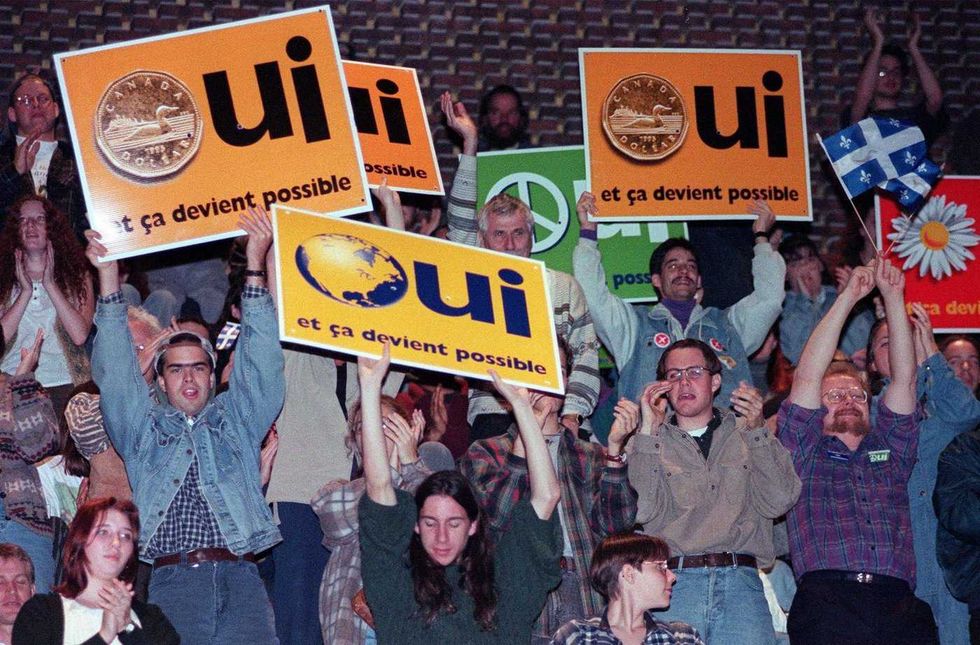
Quebec sovereigntists see fundamental rift with Alberta separatists
With just days before Alberta’s vote on an independence referendum, longtime Quebec sovereigntists are distancing themselves from the western province's separatists.
Question 10 on Monday’s referendum ballot asks whether Alberta should remain in Canada or if the government should start the legal process to hold a subsequent, binding referendum on separation.
Quebecers may have a sense of déjà vu after voting on similar questions in 1980 and 1995, both times being defeated by a "No" side, but ardent sovereigntists see profound differences in the two movements.
Marie-Anne Alepin, from the Société St-Jean-Baptiste de Montréal, believes Alberta is using the threat of separatism as leverage in negotiations with Ottawa and the referendum as a means of pressure rather than a genuine desire to form a country.
---

Stellantis workers set to vote on potential strike action this weekend
Stellantis workers in Canada will vote this weekend on whether to authorize a strike, as their union says contract talks with the automaker have stalled.
Unifor, which represents more than nine-thousand Stellantis workers, is holding strike votes Saturday and Sunday, but says authorization does not automatically mean a strike will happen.
The union says a strike mandate would give its bargaining committee leverage to reach a negotiated agreement, calling strike action a last resort.
Key sticking points include job security and the future of the Brampton, Ont., assembly plant, which Stellantis intends to sell to defence contractor Roshel.
---

'Goodbye to a good friend': Snowbirds' final show to be livestreamed today
The Royal Canadian Air Force's Snowbirds perform their final air show with their Tutor jets in Moose Jaw, Sask., today, before the iconic aircraft are retired for good.
The annual season home closing show is set to be livestreamed online, though there will be one more chance to see the CT-114 Tutors in action before they are sent to Trenton, Ont., for disposal.
The Snowbirds are scheduled to perform a flyover at the Grey Cup game in Calgary on Nov. 15.
The aging Tutor jets are being retired and the Snowbirds will go on hiatus until the team can be trained on the replacement Pilatus aircraft, the CT-157 Siskin.
Captain Philip Rochon, the public affairs officer for the team, says it's a bittersweet time as the pilots say goodbye to the planes the Snowbirds have flown for nearly six decades.
---
This report by The Canadian Press was first published Oct. 16, 2026.
Copyright 2026, The Canadian Press. All rights reserved.
Referendum day in Alberta is on Monday.
The provincial referendum has 10 questions about immigration policy, constitutional reform, and whether Alberta should remain in Canada or hold a binding, second referendum on quitting the country.
Advance voting locations opened Tuesday and close Saturday night.
Over 1,400 polling stations will be open Monday from 9 a.m. to 8 p.m.
Here's what to expect when you go to vote:
How long will it take?
Get familiar with the ballot questions ahead of time, which are on the Elections Alberta website. Officials say it will help avoid confusion and delays.
They say they're expecting a record turnout of between 80 and 85 per cent of Alberta's nearly three million electors.
You have as much time as you want to fill in the 10 ballots, but officials estimate it will take most people about two minutes.
What identification is needed?
You should get a "where to vote" card in the mail ahead of time if you're registered. Otherwise, visit Elections Alberta’s website to find out where to vote.
You must vote in your electoral division during advance voting or at your assigned location on Monday.
You’ll need one government-issued ID with your correct name, current address and photo, such as a driver's licence. You can use two pieces of ID that both have your full name, with one showing your current address.
There are 50 forms of acceptable ID listed on Elections Alberta’s website that can be one of those two pieces, from a library card or a hunting licence to a bank statement or vehicle registration.
Elections Alberta says it will accept expired forms of ID, including a certificate of Indian Status Card, provided it still has the correct name.
Another option, in special circumstances, is to bring an attestation form signed by an authorized person such as a First Nation band manager or a student housing staffer.
What if I’m not registered to vote?
A voting officer will ask you to sign a declaration that confirms your eligibility — including that you are a Canadian citizen, at least 18 years old and that you normally reside in Alberta.
How many ballots are there?
There are 10 ballots, in different colours for easy identification. You can mark some of them, all of them or none. Your choice.
The ballots go into separate boxes to make it easier to count them and to lessen the chances of a mistake spoiling one long ballot.
What if I’m still in line when the polls close at 8 p.m.?
Stay in line. Don’t leave. You will be allowed to vote.
How long before I know the results?
By law, the votes need to be counted by hand within 48 hours.
Question 10 — about separation — is to be counted first. Officials say early results are to be released after 8 p.m. Monday, with the final count announced in the early hours Tuesday.
The results of the other nine questions should be completed and announced by Wednesday.
This report by The Canadian Press was first published Oct. 16, 2026.
Copyright 2026, The Canadian Press. All rights reserved.