



FR - Nouvelles
Tu peux maintenant te stationner à Montréal gratuitement grâce à une application
Notre vie simplifiée...
By launching a French-language service, The Canadian Press became the world’s first bilingual news agency.
In the early years, The Canadian Press’s French service was mostly a writing and translation service, with very little on-the-ground reporting except on Parliament Hill in Ottawa and in Quebec City, where it had its own correspondents.
Established as a cooperative, the PC — as it is often referred to in the news industry — produced 30,000 words a day for the nine newspapers in Quebec and Le Droit in Ottawa.
In 1954, the Évangéline, based in Moncton, N.B., became the 11th member to join the cooperative, and the Action catholique in Quebec City joined two years later.
Over the years, The Canadian Press’s French service established itself as a true national news organization with its own field reporters and correspondents. News dispatches, originally transmitted by telegraph, were then sent via teletype, increasing the transmission speed from 66 words per minute to 300.
When The Canadian Press switched to satellites, its transmission speed rose to 19,200 words per minute. Computerization and the advent of the internet in the late 1990s eliminated transmission limitations.
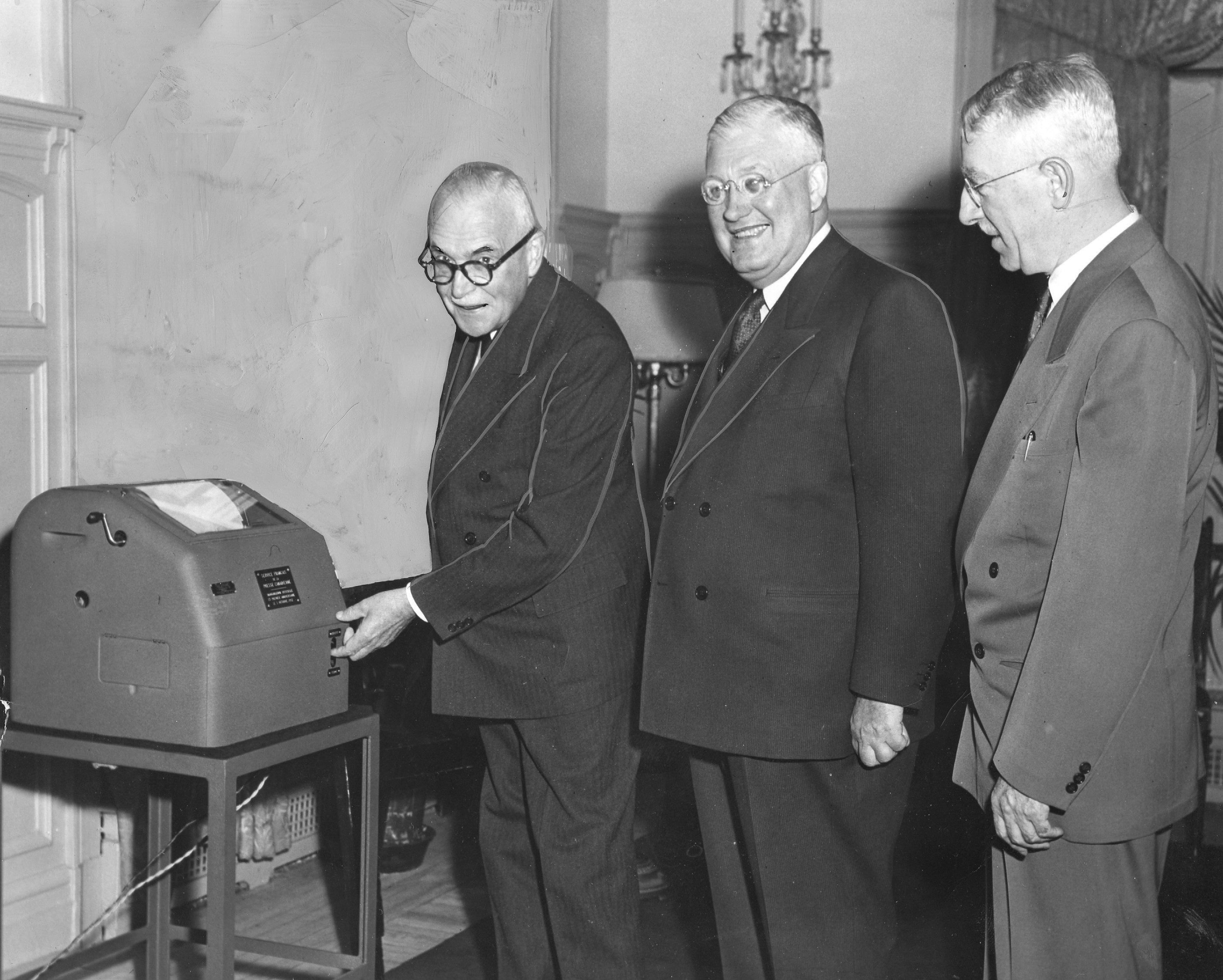
The company ultimately abandoned the cooperative model and became a private corporation owned equally by the daily newspaper La Presse, The Globe and Mail and Torstar.
Over the course of its 75-year history, the PC's staff has distinguished itself in its coverage of major events, including numerous federal and provincial elections, referendums, and countless landmark moments in Quebec, Canada, or abroad.
The Canadian Press, with its reporters in the field and journalists assigned to various news desks, has always distinguished itself by its speed in responding to events without sacrificing the accuracy of the information.
Among these historic moments, The Canadian Press's French service provided comprehensive coverage, notably during: the October Crisis (1970), the Montreal Olympics (1976), the shooting of Corporal Denis Lortie at the National Assembly (1984), the Montreal flood (1987), the death of René Lévesque (1987), the Polytechnique tragedy (1989), the Oka Crisis (1990), the Canadiens’ last Stanley Cup victory (1993), the Saguenay flood (1996), the Éboulements tragedy (1997), the ice storm (1998), the Maple Spring (2012), the Lac-Mégantic train derailment (2013), the attack on the Grand Mosque of Quebec City (2017), the pandemic (2020–2022), the attack on a daycare centre in Laval (2023), and the truck-ramming attack in Amqui (2023).
The PC also sent journalists to cover the Olympic Games around the world, stationed correspondents in Afghanistan when Canada had troops there, and provided its members and subscribers with coverage of the extraordinary funerals of Maurice Richard, Pierre Elliott Trudeau, and Guy Lafleur, held in Montreal.
These examples of the French service's coverage are just a tiny sample of the agency’s work that enables all French-language media outlets that are members or subscribers to its services to inform their audiences about events taking place outside their own coverage areas.
All major French-language media outlets employ journalists who once worked at The Canadian Press, which also boasted a few famous writers in the very early days of its French Service. These include the poets Alfred DesRochers and Olivier Marchand, the essayist Jean Lemoyne, the columnist Guy Fournier, comedian and screenwriter Carl Dubuc, and journalist Michel Roy, who would eventually hold executive positions at Le Devoir and La Presse.
This report by The Canadian Press was first published Oct. 15, 2026.
By Pierre Saint-Arnaud | Copyright 2026, The Canadian Press. All rights reserved.
The B.C. Conservatives have announced a plan to scrap the Massey Tunnel replacement project and instead build a new 10-lane bridge linking Richmond and Delta.
The party says the new bridge would cut commutes by up to 30 minutes.
The policy is a revival of plans under the previous BC Liberal government for a bridge that were switched to a new tunnel under the New Democrats, but the Conservatives say that "after nine years of the NDP, nothing has been built."
The Conservatives also pledged to complete the new hospital in Surrey's Cloverdale neighbourhood, a project that has suffered delays and budget overruns, while building another new hospital specifically for women and children.
NDP OFFERS SENIORS FREE BUS PASSES
New Democrat Leader David Eby has turned his campaign to transit with a pledge to roll out free bus passes for 350,000 low-income seniors across the province.
He says a re-elected NDP government would also support an "updated" bus route to the new Cowichan-region hospital set to open next year.
Eby has made two Surrey-specific announcements, saying his government would earmark $250 million to leverage federal funding and expand rapid bus service along King George Boulevard from Surrey to nearby White Rock.
 B.C. NDP Leader David Eby speaks during a provincial election campaign stop in Surrey, B.C., on Thursday, Oct. 15, 2026.
THE CANADIAN PRESS/Ethan Cairns
B.C. NDP Leader David Eby speaks during a provincial election campaign stop in Surrey, B.C., on Thursday, Oct. 15, 2026.
THE CANADIAN PRESS/Ethan Cairns
Eby also says Surrey would be given its own municipal charter, granting the city the same kind of authority Vancouver has.
BC GREENS PUSH COLLECTIVE BARGAINING CHANGES
BC Greens Leader Emily Lowan has released a labour plan she says will "strengthen and support B.C.’s workers and unions."
She says the NDP has used its "brand" as a party to cover up an "anti-labour agenda."
The Greens say the party will increase the minimum wage annually, at a rate of one per cent over inflation, until it matches the living wage.
It says it will also change bargaining to allow unions to reach collective agreements that covers all workers in an economic sector, instead of covering individual workplaces.
 B.C. Green Party Leader Emily Lowan arrives for the televised B.C. Leaders' Debate ahead of the provincial election, in Vancouver, on Wednesday, Oct. 14, 2026.
THE CANADIAN PRESS/Darryl Dyck
B.C. Green Party Leader Emily Lowan arrives for the televised B.C. Leaders' Debate ahead of the provincial election, in Vancouver, on Wednesday, Oct. 14, 2026.
THE CANADIAN PRESS/Darryl Dyck
CENTREBC PLANS MORE POLICE AND PROSECUTORS
CentreBC has announced a plan to deliver 500 new RCMP officers and 60 more Crown prosecutors along with "practical interventions" to reduce repeat offending.
The party, whose Leader Elenore Sturko is a former RCMP officer, says that includes doubling funding for two programs which target repeat and violent offenders to about $26 million annually.
The party says it would also open two voluntary recovery units in provincial corrections facilities, one for men and one for women, by 2028-2029, and ask Ottawa to direct prosecutors to charge those found in possession of drugs in public.
This report by The Canadian Press was first published Oct. 15, 2026.
Copyright 2026, The Canadian Press. All rights reserved.