



THE CANADIAN PRESS/James Maclennan
O Canada, Alberta is staying put.
In a historic referendum Monday that capped a long debate over separation, voters on both sides overwhelmingly marked their ballots to remain in the country that made Alberta a province 121 years ago.
In early returns, about 76 per cent of Albertans said yes to Confederation, while 24 per cent said they wanted the province to hold a second, binding referendum on leaving.
Both Alberta Premier Danielle Smith and Prime Minister Mark Carney lauded the result in statements on social media.
Smith said she would give a TV address Tuesday night to detail where the province goes from here.
---
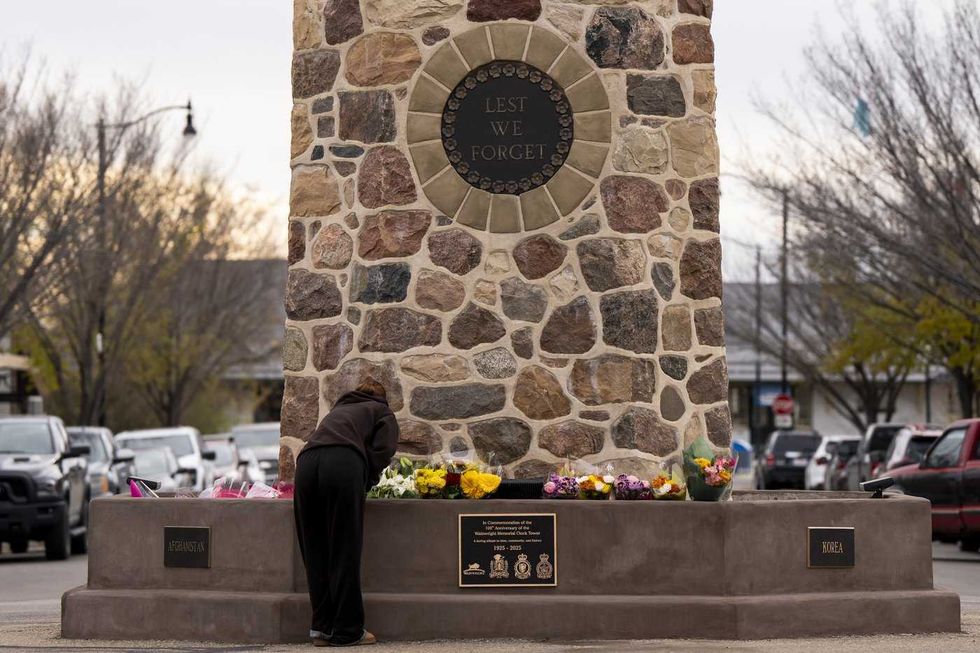 A young woman pays respects to the victims of a fire that killed four soldiers at CFB Wainwright, at the Memorial Clock Tower on Main Street, in Wainwright, Alta., on Monday, Oct. 19, 2026.
THE CANADIAN PRESS/Christopher Katsarov
Wainwright, Alta., residents grieving but resilient after tragic fire on army base
Residents of a central Alberta town are grieving but stoic after a vicious fire killed four soldiers and wounded dozens more at a nearby military base.
Living alongside soldiers preparing for battle, they say, has built up a deep stoicism and resilience in Wainwright, southeast of Edmonton.
Sharon Pashko says Saturday's tragedy at CFB Wainwright — one of Canada's busiest military bases — is heartbreaking, but that the town will bounce back.
Defence officials have said 84 members of the Princess Patricia's Canadian Light Infantry were in a training area of the base when strong and sudden winds sent flames from a nearby grass fire barrelling toward soldiers at lightning speed, sending 39 to hospital.
---
 Canada-U.S. Trade Minister Dominic LeBlanc and Minister of Transport Steven MacKinnon prepare to appear before the Legislative Committee on Bill C-39 in the Parliamentary Precinct in Ottawa, on Monday, Oct. 19, 2026.
THE CANADIAN PRESS/Justin Tang
Federal ministers defend major projects bill at House committee meeting
Four federal ministers defended the government's contentious legislation to speed up major projects in the House of Commons on Monday, as Ottawa continues to face criticism from Indigenous, environment and labour groups.
The 243-page bill would fast-track approvals for major projects, cut their review times and create zones of "national interest" to pre-approve certain types of projects.
Labour leaders and union members gathered across Canada last week to protest Bill C-39, arguing the legislation would undermine workers' right to strike, as it proposes changes to the Canada Labour Code.
Jobs Minister Patty Hajdu said Monday the bill strengthens the right to strike by removing the ability to use Section 107 before a labour disruption, adding that "Protecting workers and protecting the national interest go hand in hand."
---
 People arrive for advance voting at Stelly's Secondary School in Saanichton, B.C., on Friday, Oct. 16, 2026.
THE CANADIAN PRESS/Chad Hipolito
Advance voting in B.C. election is down compared to 2024
The number of ballots cast in the first three days of advance voting in the British Columbia election is down about 8 per cent compared to 2024.
Elections BC says there were about 440,000 votes cast from Friday to Sunday, compared to almost 480,000 in the first three days of advance voting last election, which set a record for total advance turnout.
Early voting continues at hundreds of places across the province today and tomorrow until 8 p.m. ahead of final voting day on Saturday.
There were more than one million advance ballots cast in 2024, a surge of 49 per cent compared to the previous election, and a report by the chief electoral officer says the process has been steadily increasing in popularity for two decades.
---
 A car burns at Republique square during a protest against rising living costs, joining students' grievances, in Paris, Saturday, Oct. 17, 2026. (AP Photo/Thibault Camus)
Paris police issue overnight curfew in 2 areas of French capital to try to prevent further disorder
Paris police issued an overnight curfew in two areas of the French capital “to protect people and property from the violence and looting.”
The statement on Monday said that the orders ban gatherings and demonstrations and impose a curfew prohibiting anyone from entering or remaining around the Place de la République, where rioting took place Saturday.
The shopping neighbourhood of Les Halles, which has been subject to looting, has also been included in the curfew.
The curfew was in effect from 11 p.m. Monday until 6 a.m. Tuesday.
---
This report by The Canadian Press was first published Oct. 20, 2026.
Copyright 2026, The Canadian Press. All rights reserved.
Ces plaques d'auto ont été refusées au Québec en 2022 et certaines sont épouvantables
Il y en a qui ont l'esprit tordu! 😲
Nul doute que les Québécois.es ont beaucoup d'imagination et cette liste de refus des demandes de plaques d'immatriculation personnalisées en est bien la preuve. Chaque année, des automobilistes de la Belle Province, désireux.euses d'orner leur voiture d'une plaque qui leur ressemble plus qu'un agencement aléatoire de chiffres et de lettres, tentent leur chance en envoyant leur proposition à la Société de l'assurance automobile du Québec (SAAQ).
Pour que ton idée soit acceptée, ce n'est pas chose si facile. Après ton envoi, les équipes de la SAAQ se penchent sur plusieurs critères afin d'évaluer si oui ou non ta plaque sera personnalisée comme tu le souhaites. Tu devras notamment t'assurer que la combinaison choisie n'exprime pas d'idées obscènes, scandaleuses ou de nature sexuelle, qu'elle n'utilise pas un langage abusif et qu'elle n'encourage pas une infraction criminelle. Tu devras aussi payer 272,49 $ pour les frais de changement, puis 37,66 $ par année.
Narcity a répertorié quelques-unes des 2725 combinaisons refusées les plus cocasses de 2022 dénichées sur une liste envoyée par la SAAQ. Et oui, tu vas vite t'apercevoir qu'il y a quelques petites thématiques qui semblent bien populaires chez les conducteurs et conductrices du Québec.
Marques de commerces
Les propriétaires de véhicule ne peuvent détenir « une plaque d'immatriculation qui renvoie à un nom distinctif utilisé comme marque de commerce enregistrée ». Cette consigne est inscrite bien clairement sur le formulaire de demande. Toutefois, certain.es tentent tout de même leur chance… Juste pour voir!
On a pu retrouver, entre autres, des noms d'entreprises bien connues telles que : VERSACE, AIRBNB, VISA, UBIS0FT, TWITTER, KIJIJI, AMAZ0N, Y0UP0RN et TINDER.
Les marques d'autres véhicules ont aussi été très populaires dans la dernière année avec P0RSCHE, TESLA, MUSTANG, T0Y0TA et plus encore. C'est sûr que de se promener en vieille Toyota Tercel avec une plaque FERRARI, c'est le comble de l'ironie.
Autres petites perles qui ouvriront certainement l'appétit aux automobilistes se trouvant à l'arrière de la voiture en question : 0RE0, TIMBITS et KFC. Tiens donc, j'ai une soudaine envie de poulet frit qui me tenaille!
Langage abusif et vulgaire
Peut-être en doutais-tu déjà, mais les « mauvais mots » et autres grossièretés ont la cote chez ceux et celles qui font des demandes de modification et ce n'est pas toujours très subtil. Parmi les nombreuses plaques refusées qui contiennent un langage abusif, voici celles qui se sont démarquées par leur candeur : WTFL0L, FUCKY0U, AZZH0LE, SXYMILF, CALISS, DATASS et le très chic 2FASTBK.
Une personne aurait même proposé FCKCOPS, ce qui semble être un moyen de s'attirer du trouble.
Film, télévision et musique
Plusieurs ont voulu se gâter un brin avec une plaque d'immatriculation qui fait référence à leurs films, chanteur.euses ou séries télévisées préférées. Hélas, ces propositions n'ont pas passé au conseil. Dans la liste on peut entre autres retrouver GANDALF, Y0SHI, P0KEM0N, MAD0NNA, JAGER, MINI0NS, NEM0 et AVENGER.
Voir une plaque écrite PIKACHU devant toi, c’est sûr que ça redonne le sourire, mais comme dirait un.e candidat.e au Banquier, c'est RE-FU-SÉ!
Infractions et actes criminels
Certaines personnes semblent avoir voulu mettre de l'avant leur penchant vers la criminalité. Est-ce pour appâter les forces de l'ordre? Sur la liste, les actes violents et les références à la mort sont nombreux : MURDER, MAFI0S0, DEATH, DEVIANT, PYR0MAN, KILLR, SANSL0I, CADAVR, M0RGUE, C0CAINE, PIMP1, ASSASIN, ILLEGAL.
La SAAQ est claire à ce sujet, le numéro choisi ne doit pas comporter une expression ou un message « qui encourage une infraction criminelle ».
Amoureux.euses de sports
On peut compter plusieurs fanatiques de sports parmi ceux et celles qui désirent une plaque d'immatriculation personnalisée. Avec des compositions comme WEBER, BRUINS, FIFA, WWE, LEBRON, PEEWEE et NASCAR on comprend que certain.es sont très fier.ères de leurs équipes et souhaitent le démontrer de toutes les manières.
Cependant, ce ne sera pas sur le derrière de leur véhicule, car le numéro de plaque ne doit pas laisser faussement croire que le propriétaire du véhicule routier est une autorité publique.