



THE CANADIAN PRESS/Amanda Erickson
And when Albertans head to the polls Monday to vote on whether to hold a future referendum on separation from Canada, they'll also be answering five separate questions on immigration being pushed by the government of Alberta Premier Danielle Smith.
Those questions include:
— Should the province should have more say over economic immigration?
— Should provincially funded services should be restricted to citizens, permanent residents and those with "Alberta-approved" immigration status?
— Should non-permanent immigrants should be charged a fee for accessing health care and education services?
— Should non-permanent residents should have to reside in Alberta for at least 12 months before qualifying for provincially funded social supports?
— Should voters should have to present proof of citizenship when voting provincially?
Jason Kenney, a former Alberta premier and federal immigration minister, said Canada needs a broader debate on immigration policy based on facts.
"We do need a serious debate on immigration because demography is destiny. There are very few things that are more important," Kenney told The Canadian Press in an interview.
"But we have to do it in a disciplined and respectful, thoughtful way, as much as possible, based on evidence and data and experience around the world."
 Former Alberta premiers Rachel Notley, left, and Jason Kenney discuss their assessment of the possible economic cost of Alberta's referendum at an Edmonton Chamber luncheon in Edmonton on Tuesday, Oct. 13, 2026.
THE CANADIAN PRESS/John Ulan
Former Alberta premiers Rachel Notley, left, and Jason Kenney discuss their assessment of the possible economic cost of Alberta's referendum at an Edmonton Chamber luncheon in Edmonton on Tuesday, Oct. 13, 2026.
THE CANADIAN PRESS/John Ulan
Kenney warned that debates on immigration policy can easily become sidetracked by more extreme political views — by accusations of racism from the far left and by actual racism on the far right.
While Kenney said he doesn't see the immigration questions on the Alberta ballot as race-based or xenophobic, the Alberta separatist movement itself is something else entirely.
"If you listen to the key separatist leaders like Mitch Sylvestre, who's the leader of the primary separatist organization, he says that in his republic of Alberta, no one will have citizenship unless you're born there," Kenney said.
"So I do think there are some currents on the extreme right of Alberta politics that we should all be concerned about. I do not think that necessarily means we cannot have an adult, grown-up conversation about immigration policy."
But the immigration questions on the ballot are not sitting well with some diaspora communities in the province.
Lawyer Avnish Nanda, co-founder of the advocacy group Our Alberta Advantage, is campaigning for people to vote "no" on the immigration-related questions.
 Stampede Princess Breanna Correia carries the Canadian flag as the national anthem is sung prior to rodeo action at the Calgary Stampede in Calgary, Alta., Friday, July 4, 2025.THE CANADIAN PRESS/Jeff McIntosh
He said reactions to the questions from Alberta's cultural communities and from individuals who have considered running for the United Conservative Party have been overwhelmingly negative.
"They view these questions as targeting them, their journey here and the roots they've established over the past 60 years," he said.
"There's fear, there's confusion and anger at this government. They think this is not necessary. They think it's wrapped up in the separatism effort. They think that Danielle Smith is scapegoating them to continue to maintain the support of the more extreme separatist elements that brought her to power."
Nanda said the referendum is bringing out some ugly undercurrents in Alberta. He said his parents were recently "jeered by a couple of white guys in a car" while out for a walk — something that had never happened to them since coming to Canada in the 1970s.
"There's a notion that it impacts us all, whether you're a citizen or not, these questions," he said. "Because the people who are mobilized around this issue, in support of it, a lot of them don't differentiate between people who have been here 40 years [and] people who came here a week ago, because we all look the same to them."
Nanda said if the immigration ballot measures pass on Monday, they could undermine Canada's multicultural identity, while restricting access to provincial services would make it harder for newcomers to integrate.
 Parti Québécois Leader Paul St-Pierre Plamondon speaks to supporters after winning the provincial election in Montreal on Monday, Oct. 5, 2026.
THE CANADIAN PRESS/Graham Hughes
Parti Québécois Leader Paul St-Pierre Plamondon speaks to supporters after winning the provincial election in Montreal on Monday, Oct. 5, 2026.
THE CANADIAN PRESS/Graham Hughes
Across the country in Quebec, the new minority Parti Québécois government campaigned on a promise to tighten immigration controls. Quebec has maintained far more control over the immigration system than other provinces since 1991.
The PQ immigration platform included, among other things, promises to reduce annual permanent resident admissions from 45,000 to 35,000, to impose a moratorium on permanent immigration from outside Quebec, to prioritize permanent status for temporary residents already in the province, and to tighten the selection criteria for temporary workers.
Catherine Xhardez, a political-science professor at the University of Montreal, said the outgoing Coalition Avenir du Quebec government politicized Quebec's immigration debate by introducing restrictions the new government now wants to strengthen.
"Before that, they have kind of a consensus between political parties, how migration is good for the economy … good for demography, but even for French language," she said.
Xhardez said before 2018, Quebec's main parties generally agreed on the positive role immigration played in strengthening francophone culture by prioritizing certain immigrants.
"But then (the CAQ) broke this consensus between the parties by saying it was too much, too quickly, they needed less," she said.
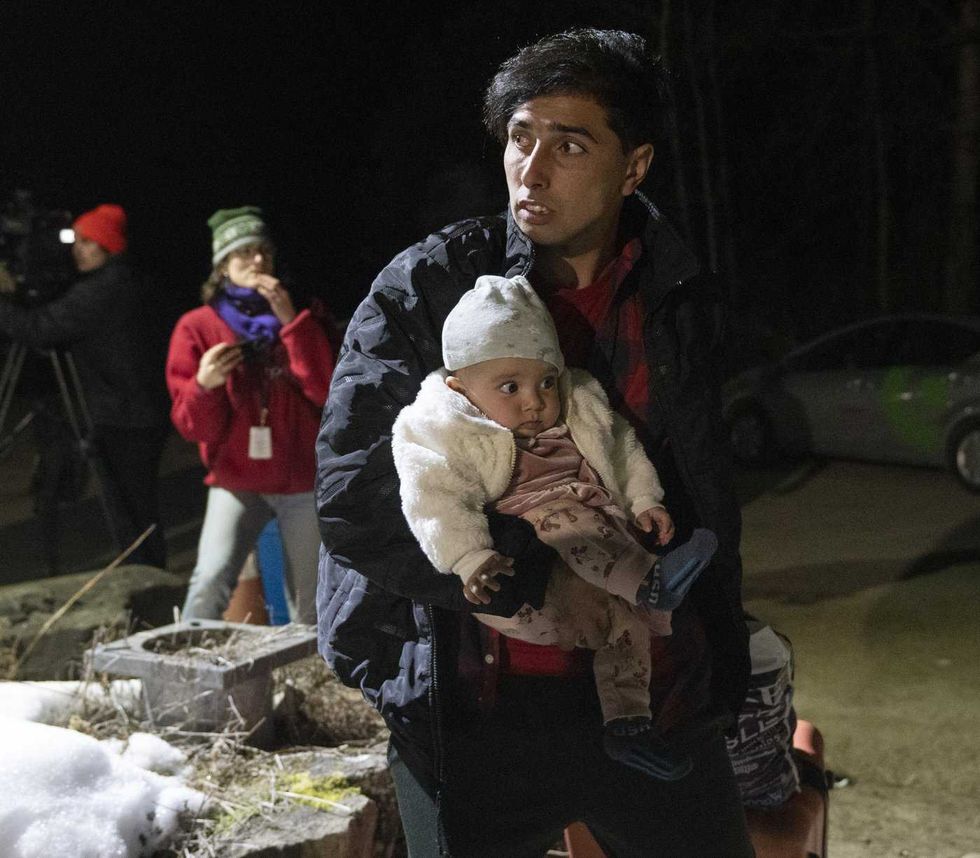 Asylum seeker Mahamed Yusef Niazi, from Afghanistan, carries his seven-month-old daughter Sahaba across the border at Roxham Road from New York into Canada on Friday, March 24, 2023 in Champlain, N.Y.
THE CANADIAN PRESS/Ryan Remiorz
Asylum seeker Mahamed Yusef Niazi, from Afghanistan, carries his seven-month-old daughter Sahaba across the border at Roxham Road from New York into Canada on Friday, March 24, 2023 in Champlain, N.Y.
THE CANADIAN PRESS/Ryan Remiorz
Xhardez said there's a key difference between the Quebec and Alberta immigration debates — the debate in Alberta is built around populist pushback blaming social service shortages on immigrants, while the debate in Quebec puts identity and culture at the forefront.
She added immigration has also become a bargaining chip for the Quebec government in its engagements with Ottawa.
Premier Smith wants a bargaining chip of her own. In a video released Wednesday, Smith encouraged Albertans to vote in favour of the nine immigration and constitutional questions in the referendum to "send Ottawa a message." She said the goal of one question on the ballot is to "give us the same power as Quebec to recruit economic migrants."
During a pro-unity campaign stop in Calgary on Thursday, Prime Minister Mark Carney urged his audience to vote "no to the nine" — repeating a phrase that has become a rallying cry among those opposed to separatism.
 Prime Minister Mark Carney attends a Forever Canadian rally in Calgary on Thursday, Oct. 15, 2026.
THE CANADIAN PRESS/Jeff McIntosh
Prime Minister Mark Carney attends a Forever Canadian rally in Calgary on Thursday, Oct. 15, 2026.
THE CANADIAN PRESS/Jeff McIntosh
Kenney said he's a "skeptic when it comes to greater provincial control" over a "sensitive" matter like immigration policy. He said provincial governments lack the federal government's ability to detect fraud and are inclined to focus solely on local issues — not on how immigration affects the national economy.
"In the western provinces, very typically, the permanent residents that they recommend have been low-skilled temporary foreign workers who they're flipping into permanent residency because the local MLAs get tired of being browbeaten by the Tim Hortons franchise owners," Kenney said.
Reflecting on his time as Alberta's premier, he said "certain premiers" told Ottawa after the COVID-19 pandemic that their biggest priority was to increase immigration — despite early evidence of the housing and youth unemployment challenges currently driving the immigration debate.
"When you don't have social permission to discuss these issues, again, that creates the kind of conditions where popular opinion gets totally detached from elite opinion. And if you want to know what that looks like, look at the politics of Europe today," Kenney said.
"So if you want to avoid (Alternative für Deutschland), Front National, U.K. Reform-style politics, then yes, we need a proper, open debate about these issues."
 People march as they take part in an anti-ICE protest near the U.S. Consulate in Montreal on Sunday, Feb. 1, 2026.
THE CANADIAN PRESS/Graham Hughes
People march as they take part in an anti-ICE protest near the U.S. Consulate in Montreal on Sunday, Feb. 1, 2026.
THE CANADIAN PRESS/Graham Hughes
Xhardez, who is originally from Belgium, said the Canadian political scene is very different from Europe and the U.S. — Canada has no mainstream anti-immigrant political party at the federal level. But public feelings about immigration have shifted — and no one knows for certain how that will affect Canada's politics going forward.
"Canada is maybe not so exceptional, we don't know. Or maybe it will become exceptional as being just less politicized, but it's not true that there is still this consensus and strong public support," Xhardez said.
Nanda said some of the loudest voices opposing the immigration questions in Alberta have been chambers of commerce, which represent businesses that have been struggling to recruit staff.
He said someone in politics needs to champion the idea that immigrants lift up economies, expand the tax base and help to fund social programs and services.
"What they're experiencing in their communities around affordability is because of failed government policies around investing in education, investing in health care, and the same immigrants that people are scapegoating as their reasons [are] a way to reverse that," he said.
"If you go to rural Alberta hospitals or long-term care facilities, most nurses and support staff are immigrants because we can't find local workers to work there. The same is true in many educational facilities."
This report by The Canadian Press was first published Oct. 17, 2026.
By David Baxter | Copyright 2026, The Canadian Press. All rights reserved.
Ces plaques d'auto ont été refusées au Québec en 2022 et certaines sont épouvantables
Il y en a qui ont l'esprit tordu! 😲
Nul doute que les Québécois.es ont beaucoup d'imagination et cette liste de refus des demandes de plaques d'immatriculation personnalisées en est bien la preuve. Chaque année, des automobilistes de la Belle Province, désireux.euses d'orner leur voiture d'une plaque qui leur ressemble plus qu'un agencement aléatoire de chiffres et de lettres, tentent leur chance en envoyant leur proposition à la Société de l'assurance automobile du Québec (SAAQ).
Pour que ton idée soit acceptée, ce n'est pas chose si facile. Après ton envoi, les équipes de la SAAQ se penchent sur plusieurs critères afin d'évaluer si oui ou non ta plaque sera personnalisée comme tu le souhaites. Tu devras notamment t'assurer que la combinaison choisie n'exprime pas d'idées obscènes, scandaleuses ou de nature sexuelle, qu'elle n'utilise pas un langage abusif et qu'elle n'encourage pas une infraction criminelle. Tu devras aussi payer 272,49 $ pour les frais de changement, puis 37,66 $ par année.
Narcity a répertorié quelques-unes des 2725 combinaisons refusées les plus cocasses de 2022 dénichées sur une liste envoyée par la SAAQ. Et oui, tu vas vite t'apercevoir qu'il y a quelques petites thématiques qui semblent bien populaires chez les conducteurs et conductrices du Québec.
Marques de commerces
Les propriétaires de véhicule ne peuvent détenir « une plaque d'immatriculation qui renvoie à un nom distinctif utilisé comme marque de commerce enregistrée ». Cette consigne est inscrite bien clairement sur le formulaire de demande. Toutefois, certain.es tentent tout de même leur chance… Juste pour voir!
On a pu retrouver, entre autres, des noms d'entreprises bien connues telles que : VERSACE, AIRBNB, VISA, UBIS0FT, TWITTER, KIJIJI, AMAZ0N, Y0UP0RN et TINDER.
Les marques d'autres véhicules ont aussi été très populaires dans la dernière année avec P0RSCHE, TESLA, MUSTANG, T0Y0TA et plus encore. C'est sûr que de se promener en vieille Toyota Tercel avec une plaque FERRARI, c'est le comble de l'ironie.
Autres petites perles qui ouvriront certainement l'appétit aux automobilistes se trouvant à l'arrière de la voiture en question : 0RE0, TIMBITS et KFC. Tiens donc, j'ai une soudaine envie de poulet frit qui me tenaille!
Langage abusif et vulgaire
Peut-être en doutais-tu déjà, mais les « mauvais mots » et autres grossièretés ont la cote chez ceux et celles qui font des demandes de modification et ce n'est pas toujours très subtil. Parmi les nombreuses plaques refusées qui contiennent un langage abusif, voici celles qui se sont démarquées par leur candeur : WTFL0L, FUCKY0U, AZZH0LE, SXYMILF, CALISS, DATASS et le très chic 2FASTBK.
Une personne aurait même proposé FCKCOPS, ce qui semble être un moyen de s'attirer du trouble.
Film, télévision et musique
Plusieurs ont voulu se gâter un brin avec une plaque d'immatriculation qui fait référence à leurs films, chanteur.euses ou séries télévisées préférées. Hélas, ces propositions n'ont pas passé au conseil. Dans la liste on peut entre autres retrouver GANDALF, Y0SHI, P0KEM0N, MAD0NNA, JAGER, MINI0NS, NEM0 et AVENGER.
Voir une plaque écrite PIKACHU devant toi, c’est sûr que ça redonne le sourire, mais comme dirait un.e candidat.e au Banquier, c'est RE-FU-SÉ!
Infractions et actes criminels
Certaines personnes semblent avoir voulu mettre de l'avant leur penchant vers la criminalité. Est-ce pour appâter les forces de l'ordre? Sur la liste, les actes violents et les références à la mort sont nombreux : MURDER, MAFI0S0, DEATH, DEVIANT, PYR0MAN, KILLR, SANSL0I, CADAVR, M0RGUE, C0CAINE, PIMP1, ASSASIN, ILLEGAL.
La SAAQ est claire à ce sujet, le numéro choisi ne doit pas comporter une expression ou un message « qui encourage une infraction criminelle ».
Amoureux.euses de sports
On peut compter plusieurs fanatiques de sports parmi ceux et celles qui désirent une plaque d'immatriculation personnalisée. Avec des compositions comme WEBER, BRUINS, FIFA, WWE, LEBRON, PEEWEE et NASCAR on comprend que certain.es sont très fier.ères de leurs équipes et souhaitent le démontrer de toutes les manières.
Cependant, ce ne sera pas sur le derrière de leur véhicule, car le numéro de plaque ne doit pas laisser faussement croire que le propriétaire du véhicule routier est une autorité publique.