



THE CANADIAN PRESS/Jeff McIntosh
1980 — The federal government ignites widespread alienation in Alberta with the National Energy Program, which keeps domestic oil prices below world levels to promote Canadian energy security and increase the federal share of oil revenues. Alberta views it as an unjustified attack and a federal money grab. The issue is later settled, but discontent with Ottawa continues.
1982 — Separatism enjoys a brief heyday. Gordon Kesler of the Western Canada Concept Party wins a provincial byelection in central Alberta on a separatist platform. Later that year in the general election, he loses a spot in the legislature. The party receives 12 per cent of the vote but no seats.
2019 — The anti-Ottawa mood ramps up as the United Conservative Party under Jason Kenney wins power in Alberta, capitalizing on discontent over federal rules and policies deemed to impair Alberta’s ability to create wealth, particularly in oil and gas. Premier Kenney fights for more independence from Ottawa but remains a staunch advocate for the province staying in Confederation.
2022-23 — Kenney is replaced by Danielle Smith, who wins government in the 2023 election on a platform of further asserting independence from Ottawa. Unlike Kenney, Premier Smith, while stressing her preference for a “sovereign Alberta within a united Canada,” refuses to characterize separatists as fringe extremists, saying they have valid grievances that deserve to be aired.
April 28, 2025 — Mark Carney and the Liberals defeat the federal Conservatives to win a minority government.
May 5, 2025 — Smith announces a panel to discuss Alberta's future in Canada. She says her government won't itself put separation on a ballot but would honour a successful citizen petition seeking such a vote. At the same time, her government takes steps to eventually pass rules to lower thresholds for citizen-led petitions.
June 2025 — Former Alberta Progressive Conservative deputy premier Thomas Lukaszuk launches a “Forever Canadian” petition to affirm the province stays in Canada. It eventually collects more than 400,000 names — enough to validate the petition. But by the spring of 2026, the petition is tied up in a legislature committee as Smith questions whether Lukaszuk gathered the names for a referendum or as a trigger for a vote among legislature members.
 Former Deputy Premier, MLA and spokesperson for the Forever Canada petition, Thomas Lukaszuk, at a Forever Canadian rally, in Edmonton, Saturday, May 23, 2026.
THE CANADIAN PRESS/Amanda Erickson.
January 2026 — Mitch Sylvestre of the separatist Alberta Prosperity Project is given the green light by election officials to launch a petition asking whether Alberta should leave Canada. Months later, the petition is deemed successful, having gathered about 223,000 signatures.
Feb. 19, 2026 — Smith announces nine referendum questions about immigration and constitutional concerns will be put to Albertans in an Oct. 19 referendum.
May 13, 2026 — An Alberta Court of King's Bench judge quashes the separatist petition, ruling Smith’s government didn't properly consult First Nations as required in the Constitution. Smith later promises to challenge the ruling, and it remains in legal limbo.
 Mitch Sylvestre hold boxes of signatures before submitting signatures for a separation referendum to Elections Alberta in Edmonton, on Monday, May 4, 2026.
THE CANADIAN PRESS/Jason Franson
May 21, 2026 — Smith announces a 10th referendum question asking whether Alberta should stay in Canada or hold a binding vote on separation. Smith cites the legal uncertainty of the court decision on the separatist petition as the driving force, saying it unduly deprives thousands of Albertans of having a say. Smith later cites Lukaszuk's petition, too, as a reason. She says both show hundreds of thousands of Albertans want the issue decided.
Sept. 10, 2026 — The Alberta government launches a $4-million advertising campaign for the referendum and urges citizens to vote to stay in Canada. The move comes as polls suggest a broad majority of Albertans want to stay.
Sept. 14, 2026 — Smith's UCP loses a byelection to the Opposition NDP in their conservative stronghold of Calgary Shaw. Critics across the political spectrum say the referendum was a factor in punishing Smith’s UCP. Her office says the party lost due to right-centre vote splitting.
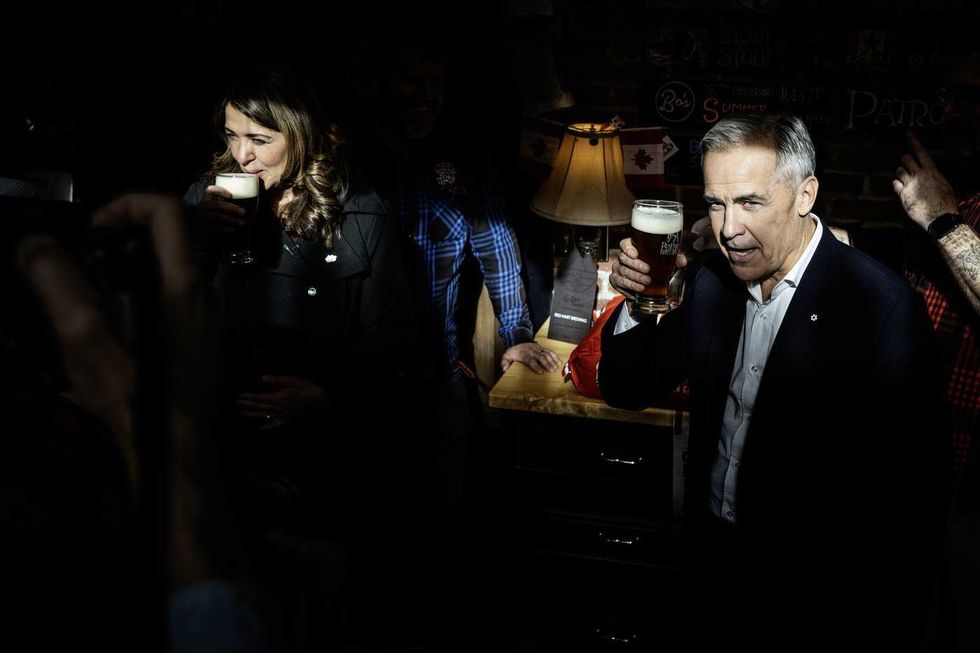 Prime Minister Mark Carney attends a national unity rally in Red Deer alongside Alberta Premier Danielle Smith on Friday, Oct. 16, 2026.
THE CANADIAN PRESS/John Ulan
Sept. 16, 2026 — Smith's government publishes a report it commissioned from the University of Calgary to determine what fiscal challenges and benefits an independent Alberta could see. It estimates an initial five-year price tag of $50 billion to $170 billion, noting that figures could swing sharply depending on factors outside Alberta's control.
Oct. 16, 2026 -- Carney wraps up a two-day barnstorming tour of Alberta, urging people to vote to stay in Canada. Carney and Smith sing O Canada, tap a keg and have a beer at a Red Deer brewery at a pro-Canada event.
Oct. 17, 2026 -- Advance voting closes. Elections Alberta reports 1.3 million Albertans -- about 43 per cent of eligible voters -- have already cast a ballot.
Oct. 19, 2026 -- Albertans vote by a wide margin to stay in Canada.
This report by The Canadian Press was first published Oct. 17, 2026.
Copyright 2026, The Canadian Press. All rights reserved.
La prod de STAT répond aux comparaisons à « District 31» et « Grey’s Anatomy »
La nouvelle quotidienne reçoit encore des critiques. 👀
La nouvelle quotidienne de Radio-Canada, STAT, fait encore bien des remous sur les réseaux sociaux. Après que les téléspectateur.trices aient critiqué les « erreurs médicales » ainsi que la prononciation des comédien.nes, les fans comparent aussi la série àDistrict 31 ainsi qu'à Grey's Anatomy, ce à quoi la production a répondu.
Ce n'est pas la première fois que la prod répond, alors qu'elle avait déjà abordé la question de la vraisemblance du milieu médical à l'émission. L'équipe avait donc expliqué que certaines décisions sont prises pour respecter la logistique de tournage. Cette fois, les responsables des réseaux sociaux de la série ont donné leur avis au sujet des comparaisons faites avec l'émission policière qui occupait la plage horaire avant celle-ci.
Tout a commencé quand, une fois de plus, des membres du public ont relevé des incohérences entre la réalité et l'organisation de l'hôpital St-Vincent. Un.e internaute a notamment relevé le fait que le personnage de Ludivine Reding, qui est infirmière en salle d'urgence, assiste aussi en salle d'opération, ce qui ne serait pas plausible :
« Je vais lâcher ça... fiction trop grossière [...]. Il y a beaucoup d'intrigues, mais les " conseillers experts médicaux " sont à côté [de] la coche trop souvent. »
« Ce n'est pas une erreur, c'est un choix lié à la réalité du nombre de comédiens qu'on peut avoir sur le plateau, et l'ensemble du projet. On ne peut pas avoir un rôle pour chaque poste, ce sont des choix narratifs. Ça ne change rien à l'histoire, au contraire, ça permet de suivre plus en profondeur chacun des personnages, au lieu de s'éparpiller sur 20 ou 25 histoires. », a alors écrit la production.« District 31 n’avait pas beaucoup de staff, mais les gestes posés étaient plus réels! », a écrit un.e fan, introduisant ainsi la comparaison avec l'émission chouchou de plusieurs Québécois.es.
« Les gestes étaient pas mal moins complexes et beaucoup moins nombreux. Tenir un pistolet, mettre des menottes, ça se résumait pas mal à ça, en termes de geste. Le reste, c'était des propos techniques au texte. Bon épisode! » , a rétorqué la production.
Lorsqu'une autre personne a comparé STAT à la populaire série médicale américaine Grey's Anatomy, la production a récidivé en expliquant les différences selon leur point de vue.
« Je comprends l’enjeu du [nombre] d’acteurs et de budget pour tout le staff et les unités de soins… mais appart les acteurs qui ont des personnages et personnalités attachantes... Il est vrai de dire qu['il y] a [beaucoup] « d’erreurs » qui sont terriblement loin de la réalité et qui me font réagir et décrocher à de nombreuses occasions moi aussi! Je vous jure que j’essaie tant que je peux, mais….(#onestloindeGreysAnatomy!)», a écrit un.e téléspectateur.trice.
« Grey's Anatomy n'est pas une quotidienne, et surtout elle n'a pas les mêmes enveloppes budgétaires. Ce serait bien de garder ça en tête...», a répondu l'équipe derrière la page Facebook de STAT.
« Oui je sais tout ça! Mais quand même... [Il y] a une méchante différence… même à côté de District ou j’ai embarqué tout de suite ! #fullaccro! Mais là… J’aime les personnages, mais [il y] a [quelque chose] qui cloche... À suivre ! », a dit un.e fan suite au commentaire de la production.
« Hiiii boboy [il y en] a une méchante gang qui [n'a] pas encore compris c'est quoi de la fiction... pour ma part j'adore vraiment beaucoup. »
« Formidable l'épisode [du] lundi 3 octobre, pour moi A+. »
Même si certain.es démontrent leur mécontentement, d'autres ne se gênent pas pour commenter à quel point iels aiment la série et les comédien.nes, qui font du bon travail.