



By launching a French-language service, The Canadian Press became the world’s first bilingual news agency.
In the early years, The Canadian Press’s French service was mostly a writing and translation service, with very little on-the-ground reporting except on Parliament Hill in Ottawa and in Quebec City, where it had its own correspondents.
Established as a cooperative, the PC — as it is often referred to in the news industry — produced 30,000 words a day for the nine newspapers in Quebec and Le Droit in Ottawa.
In 1954, the Évangéline, based in Moncton, N.B., became the 11th member to join the cooperative, and the Action catholique in Quebec City joined two years later.
Over the years, The Canadian Press’s French service established itself as a true national news organization with its own field reporters and correspondents. News dispatches, originally transmitted by telegraph, were then sent via teletype, increasing the transmission speed from 66 words per minute to 300.
When The Canadian Press switched to satellites, its transmission speed rose to 19,200 words per minute. Computerization and the advent of the internet in the late 1990s eliminated transmission limitations.
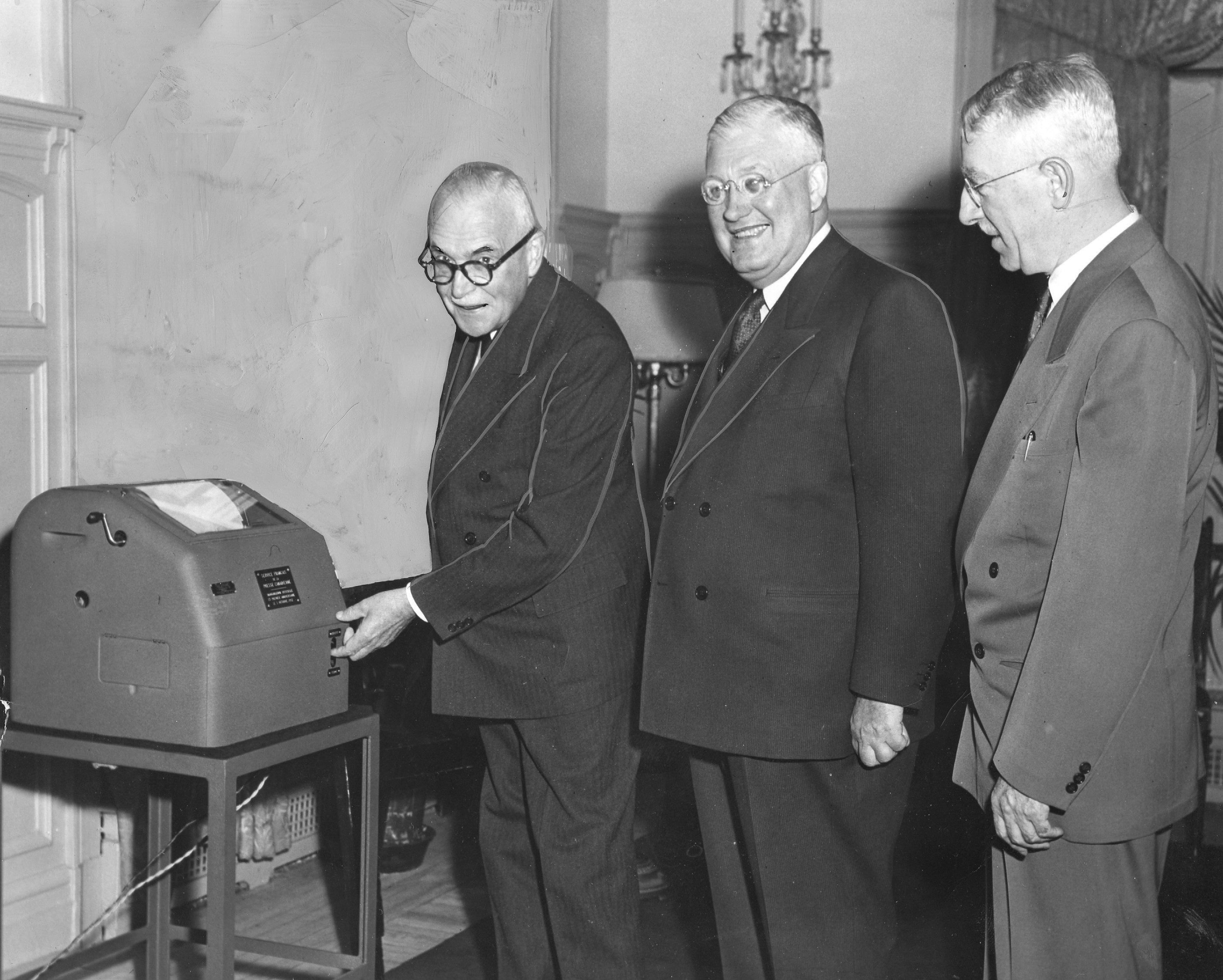
The company ultimately abandoned the cooperative model and became a private corporation owned equally by the daily newspaper La Presse, The Globe and Mail and Torstar.
Over the course of its 75-year history, the PC's staff has distinguished itself in its coverage of major events, including numerous federal and provincial elections, referendums, and countless landmark moments in Quebec, Canada, or abroad.
The Canadian Press, with its reporters in the field and journalists assigned to various news desks, has always distinguished itself by its speed in responding to events without sacrificing the accuracy of the information.
Among these historic moments, The Canadian Press's French service provided comprehensive coverage, notably during: the October Crisis (1970), the Montreal Olympics (1976), the shooting of Corporal Denis Lortie at the National Assembly (1984), the Montreal flood (1987), the death of René Lévesque (1987), the Polytechnique tragedy (1989), the Oka Crisis (1990), the Canadiens’ last Stanley Cup victory (1993), the Saguenay flood (1996), the Éboulements tragedy (1997), the ice storm (1998), the Maple Spring (2012), the Lac-Mégantic train derailment (2013), the attack on the Grand Mosque of Quebec City (2017), the pandemic (2020–2022), the attack on a daycare centre in Laval (2023), and the truck-ramming attack in Amqui (2023).
The PC also sent journalists to cover the Olympic Games around the world, stationed correspondents in Afghanistan when Canada had troops there, and provided its members and subscribers with coverage of the extraordinary funerals of Maurice Richard, Pierre Elliott Trudeau, and Guy Lafleur, held in Montreal.
These examples of the French service's coverage are just a tiny sample of the agency’s work that enables all French-language media outlets that are members or subscribers to its services to inform their audiences about events taking place outside their own coverage areas.
All major French-language media outlets employ journalists who once worked at The Canadian Press, which also boasted a few famous writers in the very early days of its French Service. These include the poets Alfred DesRochers and Olivier Marchand, the essayist Jean Lemoyne, the columnist Guy Fournier, comedian and screenwriter Carl Dubuc, and journalist Michel Roy, who would eventually hold executive positions at Le Devoir and La Presse.
This report by The Canadian Press was first published Oct. 15, 2026.
By Pierre Saint-Arnaud | Copyright 2026, The Canadian Press. All rights reserved.
La prod de STAT répond aux comparaisons à « District 31» et « Grey’s Anatomy »
La nouvelle quotidienne reçoit encore des critiques. 👀
La nouvelle quotidienne de Radio-Canada, STAT, fait encore bien des remous sur les réseaux sociaux. Après que les téléspectateur.trices aient critiqué les « erreurs médicales » ainsi que la prononciation des comédien.nes, les fans comparent aussi la série àDistrict 31 ainsi qu'à Grey's Anatomy, ce à quoi la production a répondu.
Ce n'est pas la première fois que la prod répond, alors qu'elle avait déjà abordé la question de la vraisemblance du milieu médical à l'émission. L'équipe avait donc expliqué que certaines décisions sont prises pour respecter la logistique de tournage. Cette fois, les responsables des réseaux sociaux de la série ont donné leur avis au sujet des comparaisons faites avec l'émission policière qui occupait la plage horaire avant celle-ci.
Tout a commencé quand, une fois de plus, des membres du public ont relevé des incohérences entre la réalité et l'organisation de l'hôpital St-Vincent. Un.e internaute a notamment relevé le fait que le personnage de Ludivine Reding, qui est infirmière en salle d'urgence, assiste aussi en salle d'opération, ce qui ne serait pas plausible :
« Je vais lâcher ça... fiction trop grossière [...]. Il y a beaucoup d'intrigues, mais les " conseillers experts médicaux " sont à côté [de] la coche trop souvent. »
« Ce n'est pas une erreur, c'est un choix lié à la réalité du nombre de comédiens qu'on peut avoir sur le plateau, et l'ensemble du projet. On ne peut pas avoir un rôle pour chaque poste, ce sont des choix narratifs. Ça ne change rien à l'histoire, au contraire, ça permet de suivre plus en profondeur chacun des personnages, au lieu de s'éparpiller sur 20 ou 25 histoires. », a alors écrit la production.« District 31 n’avait pas beaucoup de staff, mais les gestes posés étaient plus réels! », a écrit un.e fan, introduisant ainsi la comparaison avec l'émission chouchou de plusieurs Québécois.es.
« Les gestes étaient pas mal moins complexes et beaucoup moins nombreux. Tenir un pistolet, mettre des menottes, ça se résumait pas mal à ça, en termes de geste. Le reste, c'était des propos techniques au texte. Bon épisode! » , a rétorqué la production.
Lorsqu'une autre personne a comparé STAT à la populaire série médicale américaine Grey's Anatomy, la production a récidivé en expliquant les différences selon leur point de vue.
« Je comprends l’enjeu du [nombre] d’acteurs et de budget pour tout le staff et les unités de soins… mais appart les acteurs qui ont des personnages et personnalités attachantes... Il est vrai de dire qu['il y] a [beaucoup] « d’erreurs » qui sont terriblement loin de la réalité et qui me font réagir et décrocher à de nombreuses occasions moi aussi! Je vous jure que j’essaie tant que je peux, mais….(#onestloindeGreysAnatomy!)», a écrit un.e téléspectateur.trice.
« Grey's Anatomy n'est pas une quotidienne, et surtout elle n'a pas les mêmes enveloppes budgétaires. Ce serait bien de garder ça en tête...», a répondu l'équipe derrière la page Facebook de STAT.
« Oui je sais tout ça! Mais quand même... [Il y] a une méchante différence… même à côté de District ou j’ai embarqué tout de suite ! #fullaccro! Mais là… J’aime les personnages, mais [il y] a [quelque chose] qui cloche... À suivre ! », a dit un.e fan suite au commentaire de la production.
« Hiiii boboy [il y en] a une méchante gang qui [n'a] pas encore compris c'est quoi de la fiction... pour ma part j'adore vraiment beaucoup. »
« Formidable l'épisode [du] lundi 3 octobre, pour moi A+. »
Même si certain.es démontrent leur mécontentement, d'autres ne se gênent pas pour commenter à quel point iels aiment la série et les comédien.nes, qui font du bon travail.