



6 Reasons Your Canadian Citizenship Application May Be Rejected, According To An Expert
Watch out for these really common mistakes. 👇
Applying for Canadian citizenship is undoubtedly a momentous step for any newcomer to Canada who wants to permanently call this country home.
While the process is definitely exciting, it can also be nerve-wracking because your Canadian citizenship application can be rejected.
Narcity recently spoke to Franklin Rodriguez, a regulated Canadian immigration consultant with Mi Casa Canada Immigration Services, to get an insight into the process itself, and how to give yourself the best shot of being approved.
In fact, Rodriguez said that it's actually very easy to have your application rejected and it's often because of small, fixable issues.
Here are some of the most common reasons that your application might be rejected and what you can do to avoid them.
Applicants haven't met the time requirement
Rodriguez says this is actually the most common reason why citizenship applications get rejected.
For an applicant to attain citizenship, they need to have been physically present in Canada for at least three of the five years before submitting their application – that's 1,095 days in total.
However, a lot of applicants confuse the time required to maintain their status as a permanent resident (730 days) with the time requirements to become a citizen (1,095 days).
Bottom line? "You must do some math to calculate and meet your citizenship time requirements accurately," said Rodriguez.
Applicants don't have proof of language skills
"To be granted a Canadian Citizenship, you must meet the Canadian Language Benchmarks Level 4 (CLB4) or higher in speaking and listening," Rodriguez told Narcity.
This shouldn't be a hard one because, when people become permanent residents, they are usually required to do a language test anyway.
So, a handy tip would be to keep the result of this language test on record, even if it has expired.
"You could give those same results to prove your language abilities," advised Rodriguez.
"Otherwise, you will need to provide different documents to show that you meet the CLB4, which can be harder to get and delay your application."
Applicants fail the citizenship test
Hey, the Canadian Citizenship test is not one to be taken lightly!
During this test, 20 questions are asked which delve into Canada's history, geography, economy, government, laws and symbols.
Applicants have to answer at least 15 questions correctly to pass, which means they have to score 75% or more.
"If you fail the test, the IRCC will reschedule you for a second attempt, given you meet all other requirements," Rodriguez explained.
"If you are unsuccessful the second time, an oral hearing will be scheduled to access your knowledge. Not passing your oral hearing means IRCC will refuse your application," he said.
That being said, all is not lost.
"You can re-apply for citizenship again, but you will have to attempt the exam again," he added.
Applicants haven't filed taxes
Taxes are a must in Canada and applicants need to have filed taxes for three years before they can apply for Canadian citizenship.
"The easiest way is to give IRCC authorization to contact CRA to verify you have filed your taxes and met the requirement," said Rodriguez.
"Otherwise, you will need to personally submit evidence that you have completed your taxes."
Applicants don't attend the citizenship ceremony
All adult applicants and minors over the age of 14 have to take Canada's Oath of Citizenship during their citizenship ceremony.
But what many might not know is that you absolutely have to be in the country to do this.
"During COVID-19, the government held virtual citizenship ceremonies, but the applicant still needs to be in Canada," Rodriguez explained.
"Suppose you are outside of Canada and are scheduled for your ceremony. In that case, you need to return to Canada and attend your ceremony from inside the country or reschedule your interview for a later time when you are in Canada."
Applicants have a criminal record
This one is very important.
"If you commit a crime in or outside Canada, Canada might bar you from becoming a Canadian Citizen for some time or even permanently," Rodriguez said.
Being caught driving with over the acceptable blood alcohol level is one such example. So, be mindful that you are following all the rules and laws of the country you are in.
Rodriguez also pointed out that, to apply for a Canadian citizenship, you need to be a permanent resident first.
So, if you don't have permanent residency, there's really no point in applying for citizenship.
If your citizenship application is rejected, the resulting immigration letter should provide insight into the reason for rejection.
Based on that, you can re-apply for citizenship, granted you've solved the issue that led to you being rejected during the first attempt.
For example, if got rejected because you did not complete your 1,095 days within the country, you can re-apply after you have finished that time period.
In any case, it's always a good idea to contact an immigration expert, especially if you're unsure of what you did wrong in the first place.
Good luck, newcomers!
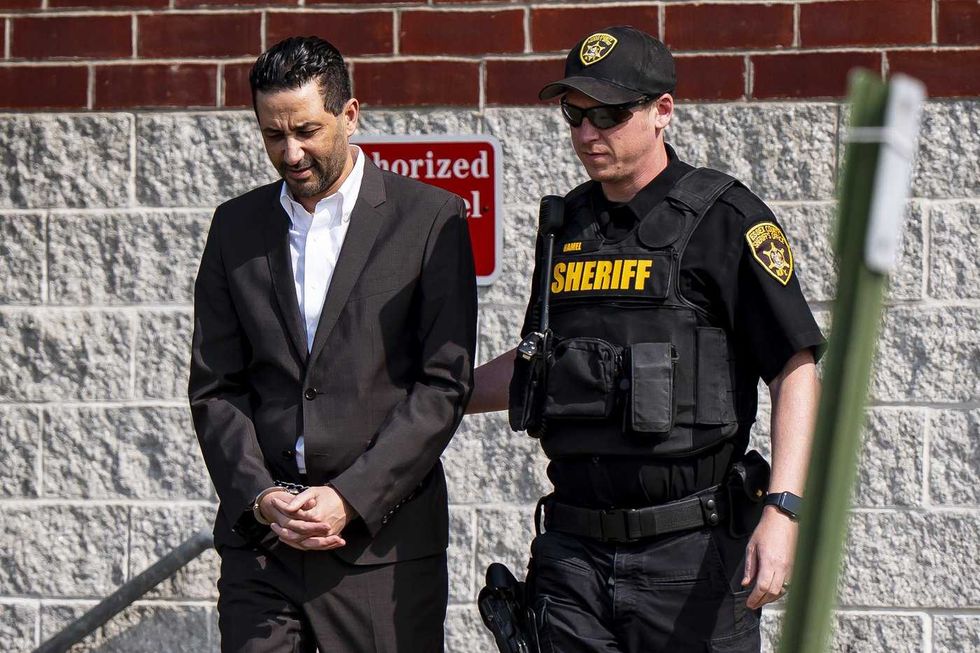 Luciano Frattolin is taken away in custody from the Essex County Court in Elizabethtown, New York on Friday, July 24, 2026. Luciano Frattolin charged with 2nd-degree murder and concealment of a human corpse.
THE CANADIAN PRESS/Christopher Katsarov
Luciano Frattolin is taken away in custody from the Essex County Court in Elizabethtown, New York on Friday, July 24, 2026. Luciano Frattolin charged with 2nd-degree murder and concealment of a human corpse.
THE CANADIAN PRESS/Christopher Katsarov Police officers open the back of a recovered truck during a press conference regarding Project 24K, a joint investigation into the theft of gold from Pearson International Airport, in Brampton, Ont., on Wednesday, April 17, 2024.
THE CANADIAN PRESS/Arlyn McAdorey
Police officers open the back of a recovered truck during a press conference regarding Project 24K, a joint investigation into the theft of gold from Pearson International Airport, in Brampton, Ont., on Wednesday, April 17, 2024.
THE CANADIAN PRESS/Arlyn McAdorey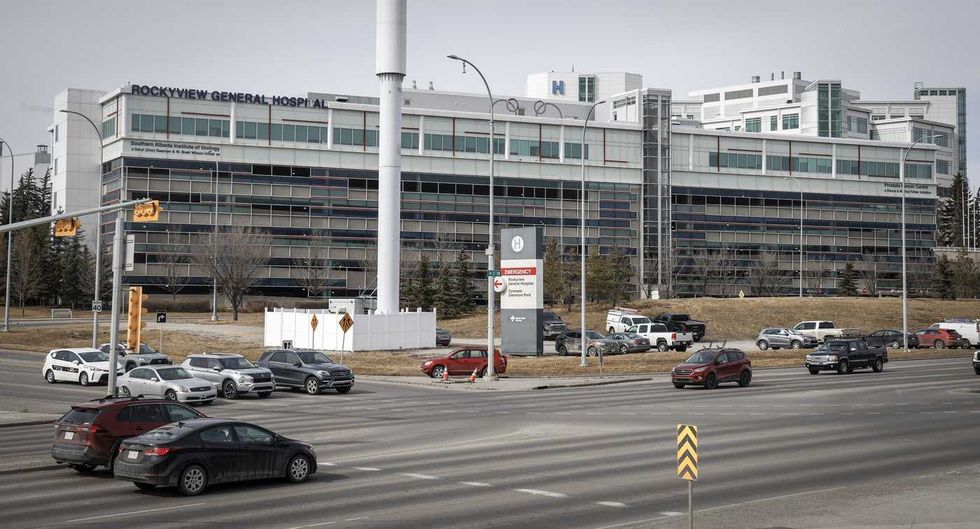 The Rockyview General Hospital is pictured in Calgary, Thursday, March 20, 2025.
THE CANADIAN PRESS/Jeff McIntosh
The Rockyview General Hospital is pictured in Calgary, Thursday, March 20, 2025.
THE CANADIAN PRESS/Jeff McIntosh This composite image shows, left to right, B.C. NDP Leader David Eby in Vancouver, on April 13, 2026; B.C. Conservative interim Leader Lorne Doerkson, in Vancouver, on Sept. 22, 2026; B.C. Green Party Leader Emily Lowan in Victoria, on Sept. 23, 2026.
THE CANADIAN PRESS/Darryl Dyck, Rich Lam, Kevin Light
This composite image shows, left to right, B.C. NDP Leader David Eby in Vancouver, on April 13, 2026; B.C. Conservative interim Leader Lorne Doerkson, in Vancouver, on Sept. 22, 2026; B.C. Green Party Leader Emily Lowan in Victoria, on Sept. 23, 2026.
THE CANADIAN PRESS/Darryl Dyck, Rich Lam, Kevin Light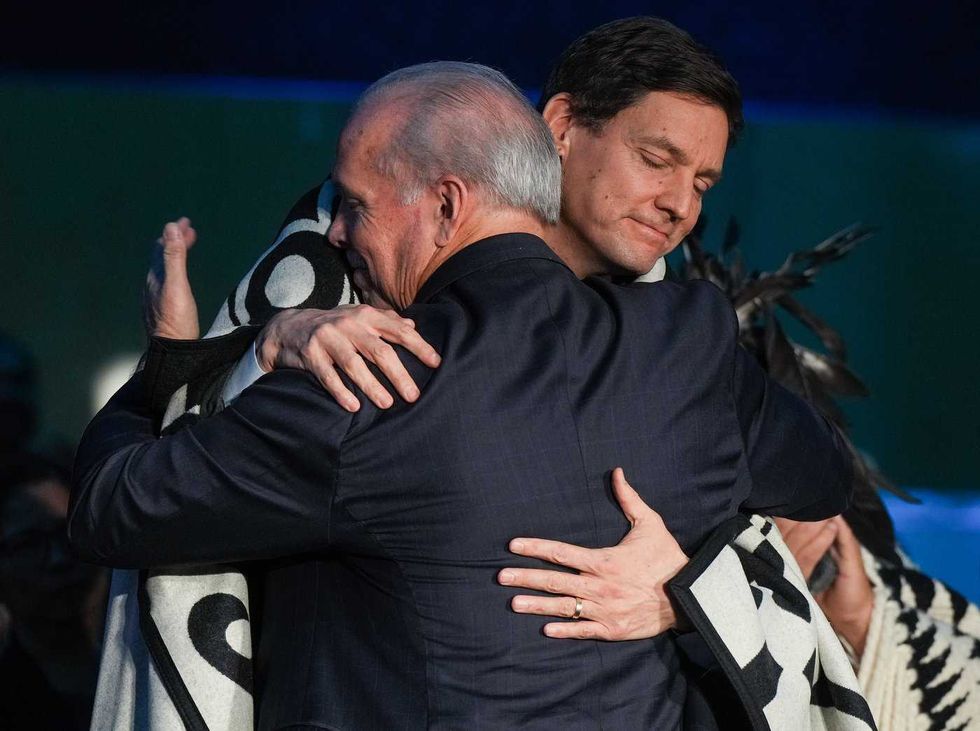 B.C. Premier David Eby, back, and outgoing premier John Horgan embrace during a swearing in ceremony where Eby became the province's 37th premier at the Musqueam Nation, in Vancouver, B.C., Friday, Nov. 18, 2022.
THE CANADIAN PRESS/Darryl Dyck
B.C. Premier David Eby, back, and outgoing premier John Horgan embrace during a swearing in ceremony where Eby became the province's 37th premier at the Musqueam Nation, in Vancouver, B.C., Friday, Nov. 18, 2022.
THE CANADIAN PRESS/Darryl Dyck