
Alberta is to vote on holding a separation referendum. A timeline on how we got here
Albertans vote Monday in a referendum asking whether they want the province to stay in Canada or to have a second, binding referendum on separating from Canada. Strains of western alienation go back decades.
Here's a look at some key events:
1980 — The federal government ignites widespread alienation in Alberta with the National Energy Program, which keeps domestic oil prices below world levels to promote Canadian energy security and increase the federal share of oil revenues. Alberta views it as an unjustified attack and a federal money grab. The issue is later settled, but discontent with Ottawa continues.
1982 — Separatism enjoys a brief heyday. Gordon Kesler of the Western Canada Concept Party wins a provincial byelection in central Alberta on a separatist platform. Later that year in the general election, he loses a spot in the legislature. The party receives 12 per cent of the vote but no seats.
2019 — The anti-Ottawa mood ramps up as the United Conservative Party under Jason Kenney wins power in Alberta, capitalizing on discontent over federal rules and policies deemed to impair Alberta’s ability to create wealth, particularly in oil and gas. Premier Kenney fights for more independence from Ottawa but remains a staunch advocate for the province staying in Confederation.
2022-23 — Kenney is replaced by Danielle Smith, who wins government in the 2023 election on a platform of further asserting independence from Ottawa. Unlike Kenney, Premier Smith, while stressing her preference for a “sovereign Alberta within a united Canada,” refuses to characterize separatists as fringe extremists, saying they have valid grievances that deserve to be aired.
April 28, 2025 — Mark Carney and the Liberals defeat the federal Conservatives to win a minority government.
May 5, 2025 — Smith announces a panel to discuss Alberta's future in Canada. She says her government won't itself put separation on a ballot but would honour a successful citizen petition seeking such a vote. At the same time, her government takes steps to eventually pass rules to lower thresholds for citizen-led petitions.
June 2025 — Former Alberta Progressive Conservative deputy premier Thomas Lukaszuk launches a “Forever Canadian” petition to affirm the province stays in Canada. It eventually collects more than 400,000 names — enough to validate the petition. But by the spring of 2026, the petition is tied up in a legislature committee as Smith questions whether Lukaszuk gathered the names for a referendum or as a trigger for a vote among legislature members.
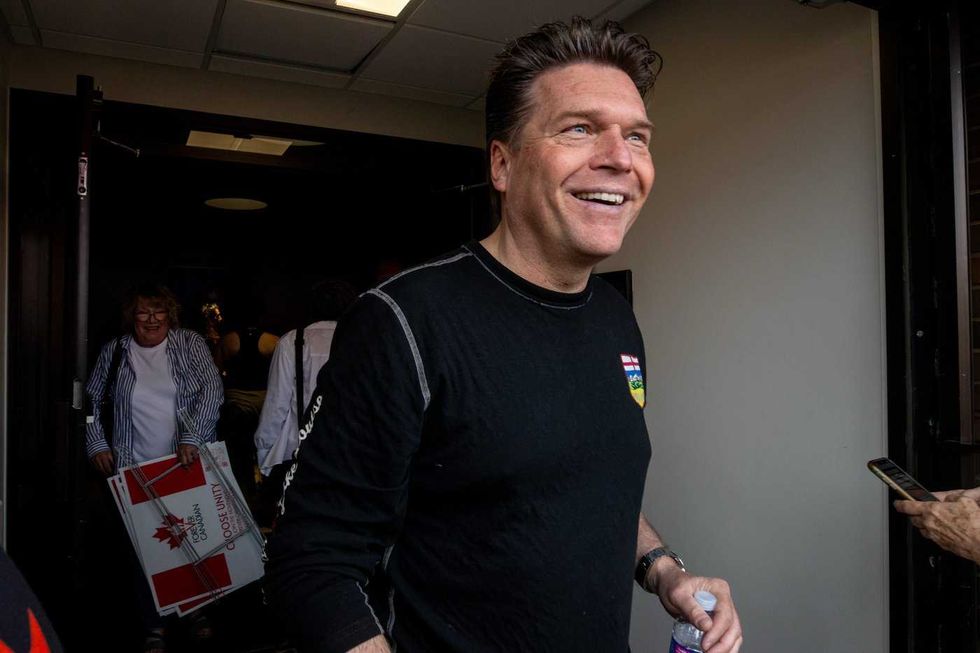
January 2026 — Mitch Sylvestre of the separatist Alberta Prosperity Project is given the green light by election officials to launch a petition asking whether Alberta should leave Canada. Months later, the petition is deemed successful, having gathered about 223,000 signatures.
Feb. 19, 2026 — Smith announces nine referendum questions about immigration and constitutional concerns will be put to Albertans in an Oct. 19 referendum.
May 13, 2026 — An Alberta Court of King's Bench judge quashes the separatist petition, ruling Smith’s government didn't properly consult First Nations as required in the Constitution. Smith later promises to challenge the ruling, and it remains in legal limbo.

May 21, 2026 — Smith announces a 10th referendum question asking whether Alberta should stay in Canada or hold a binding vote on separation. Smith cites the legal uncertainty of the court decision on the separatist petition as the driving force, saying it unduly deprives thousands of Albertans of having a say. Smith later cites Lukaszuk's petition, too, as a reason. She says both show hundreds of thousands of Albertans want the issue decided.
Sept. 10, 2026 — The Alberta government launches a $4-million advertising campaign for the referendum and urges citizens to vote to stay in Canada. The move comes as polls suggest a broad majority of Albertans want to stay.
Sept. 14, 2026 — Smith's UCP loses a byelection to the Opposition NDP in their conservative stronghold of Calgary-Shaw. Critics across the political spectrum say the referendum was a factor in punishing Smith’s UCP. Her office says the party lost due to right-centre vote splitting.
Sept. 16, 2026 — Smith's government publishes a report it commissioned from the University of Calgary to determine what fiscal challenges and benefits an independent Alberta could see. It estimates an initial five-year price tag of $50 billion to $170 billion, noting that figures could swing sharply depending on factors outside Alberta's control.
This report by The Canadian Press was first published Oct. 16, 2026.
Copyright 2026, The Canadian Press. All rights reserved.
National Ballet School, divinity college students among those affected by OSAP pause
A recent pause on financial assistance payments to private post-secondary institutions in Ontario is affecting divinity schools, Canada's National Ballet School and many others, with students feeling unfairly swept up in what they describe as a trawling net-like policy.
Colleges and Universities Minister Nolan Quinn announced last week that the province had tasked KPMG with auditing Ontario Student Assistance Program usage at career colleges, and that preliminary findings were of such concern that he referred the matter to the Ontario Provincial Police.
While the audit is ongoing, Quinn said, OSAP payments to private post-secondary institutions would be paused. Quinn said he is "working on" securing low-interest loans for affected students at financial institutions, but he has not indicated a timeline.
Many career college students have said they are worried about the pause, with no clear end in sight and with some students relying on that financial aid to cover not just tuition but living expenses while they study.
The broad nature of the pause affects all private post-secondary institutions, including private universities, chiropractic and naturopathic medicine colleges, and performing arts schools such as Canada's National Ballet School.
Alessia Di Palma is in her last year of the ballet school's five-year joint teacher training program with York University, and said she does not want to have to leave school when she is so close to finishing, but at the moment doesn't know how she will pay her rent, even though she works two jobs while going to school.
"I'm heartbroken," she said. "My heart sunk when I found out because it's unfair that I've had this funding for four years and then the fifth year it's just gone now because of something that didn't even have anything to do with me."
Initial concerns stemmed from activity at a few schools, Quinn's office says, but evidence of "systemic issues" has come up in recent weeks.
“At this time, we do not have assurances from the audit team that the issues are not more widespread, leaving us with no choice but to pause OSAP payments to all private institutions to protect taxpayer dollars and hold bad actors accountable," spokesperson Bianca Giacoboni wrote in a statement.
"We understand this is creating uncertainty for students and are working quickly to develop options for low-interest, third-party loans facilitated by financial institutions to help students through this period of transition.”
At the ballet school, programs are mostly at the secondary level, but it does have a post-secondary teacher training program that is affected by the OSAP pause. About half of those students rely on that aid to pay their tuition, said executive director John Dalrymple.
The government has chosen the bluntest and most harmful way of dealing with the root of the problem, he said, and it is especially disappointing that Quinn enacted the pause before securing those third-party loans.
"The fact that now all of these students who are working multiple jobs to make ends meet, who are at the very beginning of their career, are now left holding the bag to figure out how to finance something that the government had already assured them they qualified for and they were going to receive, I think is unconscionable," he said.
Theological schools like McMaster Divinity College, affiliated with McMaster University, are also affected by the pause. Ambrose Thomson, the school's registrar and director of student services, said students are beside themselves.
About 10 per cent of the non-profit institution's revenue is dependent on OSAP-paid tuition, he said. McMaster Divinity College is relatively well-positioned to weather that storm, Ambrose said, but not all schools are so lucky.
"The impression I get is that the government knows full well what the impacts are," he said.
"They're not stupid. All I can assume is that at the highest levels where these decisions were made, they're actually willing to allow career colleges and other schools to shut their doors ... I think they're trying to look like they're doing something in the face of 300-whatever million dollars that they were not smart enough to pay attention to."
Data obtained by The Canadian Press through a freedom-of-information request showed large increases in OSAP usage at a relatively small number of career colleges from 2020-21 to 2024-25.
The seven career colleges that had the highest OSAP usage in 2024-25 received $385 million in provincial grants – the same amount that went to students at all of Ontario's publicly funded colleges that year.
Career Colleges Ontario has raised concerns since 2023 about what it calls potentially "suspicious activity" with OSAP usage at a few schools.
Deanna Hutten, a second-year master's student in McMaster Divinity College's counselling and spiritual care program, is borrowing money from family and working 10 more hours per week at her marketing job to make up for her OSAP being on hold.
The single mother to a one-year-old daughter who hopes to work in hospital chaplaincy said it is frustrating to be lumped in with some suspected bad actors.
"It definitely feels very unfair," she said.
"They had known about this since 2023 that there were people kind of (allegedly) fudging the system, and now we as private career – not even career colleges, but private institutions – are kind of being swept into that field or that group of people, even though we're not a part of that."
At the Toronto Film School, there is also "tremendous uncertainty and anxiety" for many students, said president Andrew Barnsley. He is calling for prompt reinstatement of OSAP for eligible students, or at least a clear, expedited timeline to resolve the pause.
"The OSAP pause is deeply disappointing, and our greatest concern is the impact on our students who made significant commitments to their education with the reasonable expectation that financial assistance would be available," he wrote in a statement.
"Many students have rearranged their lives, reduced or left employment, made child-care arrangements and, in some cases, relocated to Toronto in order to pursue their studies. They need to know whether they can meet their financial obligations, including life essentials like rent or food, and continue the programs in which they have already invested time, money and effort."
This report by The Canadian Press was first published Oct. 16, 2026.
By Allison Jones | Copyright 2026, The Canadian Press. All rights reserved.
'Goodbye to a good friend': Snowbirds' final show to be livestreamed today
Members of the Royal Canadian Air Force Snowbirds aerial aerobatics team are set to perform their final air show Friday in Moose Jaw, Sask., before their decades-old Tutor jets head into retirement.
The RCAF is set to livestream the annual season home closer online at 2 p.m. ET on its Facebook page.
There will still be one more chance to see the CT-114 Tutors in action before they are sent to the airbase in Trenton, Ont., for disposal.
The Snowbirds are scheduled to perform a flyover at the Canadian Football League Grey Cup game in Calgary on Nov. 15.
Capt. Philip Rochon, public affairs officer for the Snowbirds, said it's a bittersweet time for the pilots who are saying farewell to the planes the team has flown for 55 years.
"It's like saying goodbye to a good friend," he said.
Rochon said the Snowbirds received an outpouring of support over the summer from Canadians across the country who shared memories of past shows and their encounters with an iconic "piece of Canadiana."
"At the same time, we're looking forward to the future with the new aircraft that was announced," he said. "That will come online hopefully in the next few years. We're looking forward to seeing what the next chapter of the Snowbirds will be."
Defence Minister David McGuinty announced in May that the old Tutors will be replaced eventually by the Swiss-made PC-21 Pilatus aircraft, known as the CT-157 Siskin II.
The RCAF is also acquiring those same aircraft for pilot training.
While the Snowbirds were formed in 1971, the air force obtained the Tutor jets in 1963.
The Snowbirds will go on a multi-year hiatus until the replacement aircraft are delivered and the team can be trained up on the new planes. That could take until the early 2030s but there's no set timeline.
The decision to ground the team came after planned upgrades to the Tutors' engines and escape systems meant to keep them in the air until 2030 encountered a range of problems, including parts obsolescence.
RCAF Commander Lt.-Gen. Jamie Speiser-Blanchet told reporters at the AERO Gatineau-Ottawa air show last month that it's been "heartwarming" to see how Canadians have responded over the last season.
"The Snowbirds are so much more than just an air demonstration team, obviously, and it evokes so much emotion and we all have such fond strong memories," she said.
"I really can't overstate just how significant they are to Canadians and specifically to the RCAF. The idea that we'd have to take a pause was definitely not an easy one. However, the Tutor aircraft is 63 years old and it is time to move into the future and make sure that we're doing things for the right reasons."
She said the demonstration team has been focused solely on finishing the current season. Once that's done, she said, the RCAF can "build the right kind of plan" to ensure the pilots don't get rusty in the meantime.
"We're looking at things like, can we send an exchange into some of our allied teams, or obviously instructing and working with the PC-21 in Moose Jaw as an option," she said.
This report by The Canadian Press was first published Oct. 16, 2026.
By Kyle Duggan | Copyright 2026, The Canadian Press. All rights reserved.

Reste célibataire jusqu'à ce que tu rencontres une personne comme ça
Le dating life en 2018 semble être un horrible cauchemar. Plein de filles célibataires autour de moi ''jouent'' à Tinder et passent tellement vite les profils qu'il est impossible de voir les gars comme il faut.
Le plus triste dans tout ça, c'est que si jamais j'étais tombée sur le profil de mon chum quand j'étais célibataire, j'aurais passé tout droit tellement vite. Je me souviens, il portait un drôle de t-shirt vert et posait à côté d'un arbre de bambou sur sa photo de profil FB et en 2018, ce genre de photo douteuse passerait rapidement à gauche.
J'ai rencontré mon chum en personne - il est venu me parler dans un 5 à 7 et on a échangé nos Facebook. Puis on s'est revu en date quelques jours plus tard. Quand notre soirée s'est terminée, il m'a texté sur le coup et on a continué nos discussions jusqu'à la deuxième date.
Après un mois de dates régulières, il m'a présenté comme sa blonde et c'est ainsi qu'on est devenu un couple. Je ne me suis jamais posé de questions du genre «Combien de temps j'attends avant de répondre à son texte?», «Je me demande si on est exclusifs» ou bien «Est-ce qu'il pense que je suis fatigante quand je le texte en premier». Je ne me suis jamais posé de questions point parce que le fit était juste bon, et dès les premières dates, jle savais.
Dans le passé, j'ai fait l'erreur à multiples reprises de m'embarquer dans des relations avec des gars (comme ce cave-là) en me disant «Il va changer ça», ou «Je l'aime bien, pourquoi pas». Mais ça n'avait jamais été 100% naturel, et aujourd'hui, je comprends qu'il vaut mieux rester célibataire que d'être avec une personne avec qui t'as pas grand-chose en commun.
Quand la période de passion du début va se terminer, tu vas te retrouver dans une relation plate, dans laquelle tu t'épanouis pas pantoute et devoir vivre plusieurs nuits d'anxiété en prévision d'une future rupture.
Sois patient(e), et attends de rencontrer une personne avec qui ça sera juste facile. Simple. Tsé le feeling que tu connais l'autre depuis toujours, que vous aimez les mêmes choses et que tu peux être gossant. Quand le fit est juste bon, tu te retrouves en couple sans vraiment le savoir parce que tu as juste envie d'être souvent avec la personne.
Oh, et bonne nouvelle, la police du dating n'existe pas: tu peux ne pas suivre les règles et faire ce que tu veux. Et si la personne te ghost parce que t'es honnête et toi-même, c'est une maudite bonne nouvelle pour toi!
Donc si tu dates quelqu'un depuis 3 mois, tu as de la misère à la voir plus qu'une fois par semaine, tu penses que c'est fini de temps en temps parce que les messages textes sont pas clairs et tu sais pas trop si vous pouvez fréquenter d'autre monde...ya des bonnes chances que ça ne vaille pas la peine de continuer à te torturer ainsi.
Tu vas aussi aimer: