
Test - NAR926
October 21, 2021, 03:30 PM
This is created 21-10-2021 at 1:20pm
I will schedule this for today at 1:30pm
Now, this is a change added at 1:21pm after scheduling the post. The idea is to see if this auto saves.
Don't have an account?
By continuing, you agree to our Terms & Conditions
Please check your e-mail to reset your password.


We use cookies to personalize content and ads, to provide social media features and to analyze our traffic. We also share information about your use of our site with our social media, advertising and analytics partners who may combine it with other information that you’ve provided to them or that they’ve collected from your use of their services. Learn More
This is created 21-10-2021 at 1:20pm
I will schedule this for today at 1:30pm
Now, this is a change added at 1:21pm after scheduling the post. The idea is to see if this auto saves.
Politics, like curling, is all about geometry.
Cameras swirl around New Democrat Leader David Eby as he uses a broom to mark a spot on the ice at the Victoria Curling Club. “Hurry hard, Richard,” he yells at candidate Richard Zussman down the ice.
Zussman's stone ends up nowhere near the proposed target, Eby stopping it with his right foot.
“Good sweeping,” Zussman says.
The question now is whether Eby's political calculations have similarly slid awry, as he faces a largely unknown opponent in interim B.C. Conservative leader Lorne Doerkson, whose sudden elevation has sent the election's stones ricocheting in unexpected directions. Eby called the snap Oct. 24 election just two days after Doerkson was installed.
When Eby first raised the possibility of a snap election in early September less than two years into his mandate, the Conservatives were undergoing self-immolation, suffering near-daily defections under the divisive reign of Kerry-Lynne Findlay.
But on Sept. 20, Findlay resigned.
It would go down as a hinge date in B.C. politics
That evening, NDP legislators met with campaign chair Cheryl Oates to discuss election plans in light of Findlay's exit. Later the same night, the Conservatives' board appointed Doerkson as interim leader, and he immediately set about persuading former Conservatives back to the party's caucus, including seven out of eight who had announced they were joining CentreBC days earlier.
With Findlay gone and the Conservatives coalescing, Eby nevertheless went ahead with the election call on Sept. 22. The question is why.
"The decision to go to an election was a serious one, and so is the moment, we face as a province," Eby said in an interview, betraying no hint of regret with the NDP lagging the Conservatives in recent polls.
"The decisive piece was for me whether or not we had a legislature to work, whether or not people had representatives that were actually going to stand up for what the priorities in the community were."
New Democrats held a one-seat majority with 47 seats at dissolution.
Former B.C. Liberal Mike de Jong, who served more than 30 years in the legislature, would have advised against an early election.
The NDP barely beat a "ragtag group" of Conservatives in 2024, he said, and there was a risk of being seen as manipulating the electoral process "purely for self-advantage" at a time when the Official Opposition was without a permanent leader, he said.
De Jong also pointed out the risk that an election call could unite the free-enterprise coalition.
He said Eby was "supremely confident in his own political instincts and his own political instincts, and his own political judgment."
"If it doesn’t turn out, it will be regarded as the biggest political blunder in this country, never mind this province, and that will be, for better or worse, within the NDP in particular, his legacy,” he said.
Eby’s biography shows no aversion to risk.
In 2011, when then premier Christy Clark needed a seat in the legislature after becoming leader of the B.C. Liberals, then 33-year-old Eby agreed to run and came within 564 votes of beating her.
Two years later, he reversed the result and cemented his reputation as a political giant-killer, beating Clark in a rematch.
Eby considered a leadership run after the NDP lost the 2013 provincial election. But he ruled himself out when he announced the pregnancy of wife his, Cailey Lynch, a doctor, with their first child, Ezra. They now have three children, with the addition of daughters Iva and Gwendolyn.
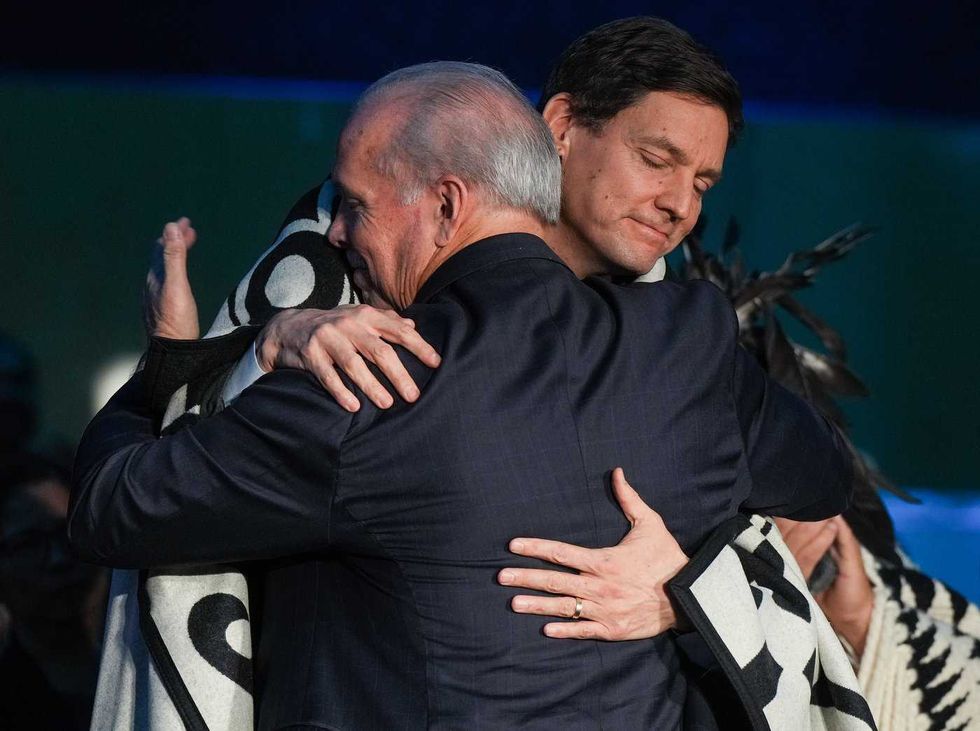
Eby’s political responsibilities grew after the NDP regained power in 2017 under John Horgan, the late premier who routinely tapped him to handle difficult files, from housing to the remaking of auto insurer ICBC.
When Horgan stepped down, Eby became premier in 2022, in an uncontested race after activist Anjali Appadurai was disqualified.
Former federal NDP MP Megan Leslie, who attended the Schulich School of Law at Dalhousie University with Eby, says his upbringing in a suburban cul-de-sac home shaped him.
Eby was born in Kitchener, Ont., in 1976, the eldest of four children, whose father was a personal injury lawyer, and whose mother was a high school principal.
She said Eby’s father encouraged neighbours to create and maintain a communal space. “It’s incredibly special because the neighbourhood has self-organized to make sure that there are no fences in their backyards."
As a teenager, Eby protested the treatment of elephants when the circus came to town, and he is a vegetarian.
Eby and Leslie's friendship dates back to orientation at law school during a bus trip to Peggy’s Cove. "I sat beside this really tall guy," she said. Eby is six-foot-seven.
Leslie shared her doubts about going to law school. “He said, 'well, I feel the same way. So, I bet there are other people who feel like this too. So, why don’t we start an activist club?’”
Leslie said this was the origin of the Social Activist Law Student Association.
"Dave challenged us," she said.
But she said Eby also had fun while at law school. He expanded Leslie's musical tastes, downloading music through Napster, and they performed karaoke together — Eby was "really good" at Whitney Houston’s "Greatest Love of All," and they also performed the B-52’s "Love Shack" as a duet, involving a feather boa.
"Guilty as charged," Eby said of Leslie's account.
Eby also sang and played guitar for Vancouver-based bands including Ladner and World of Science. He had permanently moved to the city in the early 2000s.
After graduation, Eby articled for the federal Department of Justice in Vancouver, before joining Pivot Legal Society in 2005, located in Vancouver's Downtown Eastside to offer legal support to one of Canada's poorest neighbourhoods.
In 2008, he joined the British Columbia Civil Liberties Association as executive director. Former president Robert Holmes said Eby’s impact was immediate.
"He managed to get the office humming and everybody working on their specific projects," he said. "Plus, he was in the news an awful lot."
This energy differentiated Eby. "He had drive and energy directed to the job at hand, and he pursued that," said Holmes
But Clark thinks Eby "has a real execution problem.”
"I don’t think I have ever seen a politician, who is so bad at delivering results," she said.
Clark and De Jong point to B.C.'s projected deficit of almost $14 billion — Eby inherited a surplus from Horgan. De Jong said Eby’s handling of the Declaration on the Rights of Indigenous Peoples Act has been "clumsy" at best.
"I think he wishes to contribute positively to the province," de Jong said. "I don't agree with many of the pathways he has take, but I have never questioned his motivation."
Clark warned against counting Eby out.
"I always thought of David Eby as a very serious opponent in the fight," Clark said. "I have never thought of him as a serious person when it comes to governing, but when it comes to elections, he’s a very tough opponent."
Eby himself said the race is continually shifting. He said he would wait to see what election day brings, when asked if he would stay on as leader of the NDP after a loss.
"If this province is anything, it is a province that pays attention and makes important decisions in key moments," he said.
"I have faith in the voters of B.C. to set us on the right track, and that is why I’m putting the question in front of them."
This report by The Canadian Press was first published Oct. 14, 2026.
By Wolfgang Depner | Copyright 2026, The Canadian Press. All rights reserved.
As drone-fuelled warfare rages on half a world away in Ukraine, the Canadian Army's program for rapidly acquiring basic drones is just ramping up.
And the pressure is on for the Canadian Armed Forces to speed up its adoption of drones as the technology changes the nature of modern warfare.
Lt.-Col. Jonathan Penney is a reservist who previously worked in defence manufacturing and now co-ordinates the forces' Minerva drone program. He said that while the army feels pressure to pick up the pace, it's focused both on finding the right mix of tech for its current needs and on building up the domestic drone industry.
"The army is really good at adapting and evolving," he said in an interview with The Canadian Press.
The Minerva program launched a batch of tenders in recent months for a range of new drones — everything from low-cost Arctic surveillance drones for the Canadian Rangers to ground and aerial drones that can conduct cargo supply runs.
"We are figuring out what 'right' looks like," Penney said. "Instead of just jumping in, buying a whole bunch of things that we don't need, we buy things that can use today and then let the system evolve so that it's integrated in how we conduct operations."
The Minerva program operates unlike a typical procurement, which sees the military draft a list of requirements.
Instead, Minerva launches what it calls "industry challenges" — ongoing projects which task companies with creating prototypes for specific uses. Army personnel will be testing those prototypes until roughly next summer or fall.
Another item the army is currently searching for is a low-cost targeting drone — an aerial spotter that allows artillery crews to hit targets they can't see.
Penney said it's safer to rely on an aerial drone for targeting instead of sending a soldier into the field with a set of binoculars and a laser rangefinder.
"If the drone gets shot down, we'll just send up another one," he said. "The reduction of risk to our personnel is significant."
That kind of equipment is easy enough to buy off the shelf — but part of the goal of the Canadian Armed Forces drone program is to build up the domestic drone sector and ensure the tech can be easily absorbed by Canadian military units.
"Does it integrate with our systems and does it exist as-is produced in Canada?" Penney said. "That's what we're driving for."
The army is expected to complete a new wish-list of drones for design and purchase over the next three to four months — including a breaching drone for dealing with ground-based obstacles such as mines.
The Minerva initiative launched roughly a year ago with the goal of quickly scaling up drone use in the army, rather than limiting it to ordering from the U.S. Defence Department's approved list of drone manufacturers.
Army Commander Lt.-Gen. Michael Wright has said he wants to "flood" Canada's land forces with drones.
Winning a drone prototype challenge is different from winning a large military production order, however.
The prototype challenge approach allows National Defence to cover research and development costs early in the process — which should encourage drone makers to take the risk of building prototypes with no guaranteed purchaser. The 15-month Arctic aerial drone challenge, for instance, has a $500,000 maximum funding award.
"Canadian companies, especially those small mid-sized companies that can offer some solutions, don't really know how the military operates. So when they create a product, it's not necessarily focused towards some of the things that we need," Penney said.
"They actually understand things better. So if you're working in the Arctic, you have big gloves on, it's understood that you can't operate with fine motor controls."
Lt.-Gen. Darcy Molstad has been tasked with overseeing the integration of drones across the entire armed forces. He said in a previous interview the military is starting to approach uncrewed systems more like munitions, rather than traditional equipment or expensive vehicles.
"We have to treat it almost like an expendable commodity versus something that we have to keep in inventory and capitalize the cost over 20 years," Molstad said. "These things just last a short amount of time."
Penney said that's particularly true for drones used by land forces.
"Especially from an army perspective, which will be different from the Air Force perspective, we are looking at … consumables, things that we're going to use, and if it gets destroyed, fine, we'll just send in another one," he said. "Low-cost, high-use, high-value things."
As Russia tests NATO allies in Europe with repeated drone incursions, Canada's military is looking for ways to counter the emerging threat.
The Canadian Armed Forces recently put out a separate tender for a counter-aerial drone system that could be deployed at military installations across the country.
This report by The Canadian Press was first published Oct. 13, 2026.
By Kyle Duggan | Copyright 2026, The Canadian Press. All rights reserved.
Ontario's colleges and universities minister has barred three career colleges from being able to offer publicly funded student financial assistance until at least 2030, after previously blocking them from the program just for this year.
An order in May from Nolan Quinn meant that six schools, including four Academy of Learning locations, could not access the Ontario Student Assistance Program for the 2026-27 academic year, which most of them are fighting in court.
Quinn's decision followed government inspections that found evidence suggesting third parties were completing the coursework — sometimes entire courses in one day — and a few students who couldn't name their school or program, officials allege in documents filed in court.
Three Academy of Learning locations, who share a parent company, updated their court complaint earlier this month to say that Quinn has now blocked them from OSAP for three more years following a "final" decision by his ministry.
Quinn's office would not comment, but rules governing the sector say that if an institution is found to be in non-compliance with those rules, they will not be eligible for OSAP for three years.
The schools argue in their court application that Quinn's decision was unreasonable and procedurally unfair.
The ministry "imposed and relied upon new approval criteria and evidentiary standards without adequate prior notice, and relied upon adverse information and analyses that was not adequately disclosed," the schools wrote.
Concerns about the use of OSAP at some career colleges are not limited to the six locations initially targeted by Quinn's order. Career Colleges Ontario began raising concerns in 2023, and in February highlighted 14 campuses whose application patterns "include indicators consistent with possible suspicious activity," they wrote to the government in a letter filed as part of the court case.
Quinn announced last week that the government called in auditors KPMG in August and based on "serious concerns" in their preliminary findings, the province has referred the matter to the Ontario Provincial Police.
The concerns include the involvement of immigration services firms and co-location between private career colleges and immigration recruitment or services firms, inadequate student validation and verification of course enrolment and outcomes, and unusually high concentrations of OSAP applications submitted from the same geographic locations, Quinn said.
He did not say if those issues apply to the three Academy of Learning locations he has now blocked from OSAP until 2029-30, though ministry inspectors expressed concerns about student validation and course enrolment verification at those schools, courts records show.
None of the findings and allegations have been proven in court. The Academy of Learning did not respond to a request for comment about the additional three-year OSAP ban, but has previously said students may not have responded to government verification attempts because they believed them to be scam calls, and other students may have had language difficulties.
As well, the schools had submitted corrective action plans in response to their failed inspections, showing dozens of actions taken to remedy problems identified by the province including two-factor authentication and investigation of unusual login activity, they noted.
The instances of unusually rapid completion of courses warrants review, the Academy acknowledged, but said some students download materials to study off-line. The schools have implemented additional monitoring of files before exam codes are issued, they said.
Data obtained by The Canadian Press through a freedom-of-information request shows that the Academy of Learning's Bay Street location went from 996 students on OSAP in 2021-22 to 7,435 in 2024-25. In that year, students qualified for more than $108 million in provincial OSAP grants.
The Brampton East location went from about 74 students accessing OSAP in 2020-21 to 4,260 in 2024-25, for a total of more than $64 million in provincial OSAP grants in the latter year.
Those two schools, plus the North York location, which is a campus of the Brampton East location, accounted for one-fifth of the nearly $1 billion in provincial OSAP grants that went to all career colleges that year.
The Academy of Learning says high growth in applications was due to offering programs relevant to workforce needs.
In response to rising OSAP costs, Quinn earlier this year announced that career college students would no longer be able to access grants, and students at publicly funded colleges and universities would qualify for much lower grant amounts, with a higher proportion of loans.
When Quinn announced last week that he had referred concerns to the OPP, he also said that OSAP loan payments for students at all career colleges and private post-secondary institutions across the province are paused while the KPMG audit is ongoing.
This report by The Canadian Press was first published Oct. 14, 2026.
By Allison Jones | Copyright 2026, The Canadian Press. All rights reserved.