



FR - Vedettes
The Rock a accepté son trophée Razzie pour son horrible performance dans Baywatch
Pissant.
Here's a look at some of the results.
BIG TURNOUT IN VANCOUVER, FRY WINS
Pete Fry will be Vancouver's first Green mayor, after a resounding win over incumbent Ken Sim.
It's a big turnaround for businessman Sim, just four years after he swept to power when his ABC Party claimed a majority on council with seven out of 10 seats.
ABC has now been reduced to one seat, secured by Mike Klassen, while a mix of progressives from the Greens, the Coalition of Progressive Electors, and OneCity Vancouver take nine seats.
Turnout surged to more than 209,000, up 36 per cent from 2022.
The preliminary tally shows Fry won more than 98,000 votes, far ahead of Sim on 67,000, with Colleen Hardwick a distant third with about 18,000 votes.
Sim's former chief of staff, Kareem Allam, received about 10,500 votes.
MCCALLUM BACK IN SURREY AGAIN … AGAIN
Doug McCallum is back for his third separate stint in the Surrey mayor's office, which he first occupied 30 years ago.
Preliminary results show he received about 32 per cent of the vote to comfortably defeat incumbent Brenda Locke, who had 23 per cent.
 Former Surrey mayor Doug McCallum reads a brief statement outside provincial court after being found not guilty of public mischief, in Surrey, B.C., on Monday, Nov. 21, 2022.
THE CANADIAN PRESS/Darryl Dyck
McCallum was bested by Locke four years ago, and the pair have clashed repeatedly over Surrey's switch to a municipal police force from the RCMP, a move McCallum supported and Locke fiercely opposed.
McCallum, 82, first sat as mayor from 1996 to 2005, then again from 2018 to 2022.
VOTERS BACK AMALGAMATION OF VICTORIA, SAANICH
Voters in Victoria and Saanich have supported amalgamation by about a two-thirds majority in a non-binding ballot.
Mayor Marianne Alto was meanwhile re-elected in Victoria, with about 44 per cent of the vote, defeating Bruce McGuigan on about 34 per cent.
The ballot question of whether to combine Victoria and Saanich into a single municipality received 62 per cent support in Victoria and 68 per cent support in the District of Saanich, where Rishi Sharma is forecast to win the mayoralty.
KAMLOOPS MAYOR'S TUMULTUOUS TENURE ENDS
Incumbent mayor of Kamloops Reid Hamer-Jackson has been soundly defeated, finishing fourth with just 12 per cent of the vote after a turmoil-filled tenure.
The new mayor will be Mike O'Reilly, a former councillor, who won 44 per cent of the vote, according to preliminary results.
Hamer-Jackson was stripped by council of his position as the city's official spokesman in 2024, amid protracted conflict with council and city staff.
PRINCE GEORGE GETS NEW MAYOR AFTER TIGHT RACE
Simon Yu has been defeated in his bid to retain the mayoralty in Prince George, in a tight three-way contest.
Preliminary tallies show Yu was defeated by Garth Frizzell, a longtime councillor, who won 28 per cent of the vote, compared to 24 per cent for Yu and 23 per cent for Kyle Sampson.
RICHMOND GETS FIRST NEW MAYOR IN 25 YEARS
Richmond is getting its first new mayor in a quarter century, with Rob Howard gaining a narrow win over former Olympian Alexa Loo.
Howard, a former provincial legislator, received almost 20,000 votes to defeat Loo by fewer than 900.
Malcolm Brodie had held the mayoralty since 2001, but decided not to run again.
BRAD WEST GETS 90 PER CENT OF PORT COQUITLAM'S VOTES
One of B.C.'s most prominent and popular mayors has been re-elected with a massive share of the vote.
 Port Coquitlam Mayor Brad West, centre, flanked by District of North Vancouver Mayor Mike Little, left, and City of Pitt Meadows Mayor Nicole MacDonald looks on during a news conference in Vancouver, B.C., Monday, Sept. 16, 2024.
THE CANADIAN PRESS/Ethan Cairns
Port Coquitlam's Brad West received about 90 per cent of the vote to retain the office he first won in 2018.
He says he's "deeply humbled and grateful" in a message on social media.
This report by The Canadian Press was first published Oct. 18, 2026.
By Canadian Press Staff | Copyright 2026, The Canadian Press. All rights reserved.
The event in north-central France underscored how wildfires are ranging even farther from their traditional grounds and fuelling an urgent need for water bombers to fend off climate disasters.
The iconic Canadair turboprops serve as the only amphibious firefighting aircraft currently in production built from the outset for that purpose, rather than being retrofitted to douse flames.
Now, the Canadian company behind the water-scooping planes is calling for a national fleet of them at home, even as it struggles to meet soaring demand from across a warming globe.
De Havilland Aircraft of Canada revived production of the legendary Canadair planes in 2024 after European countries from Portugal to Greece placed orders for a program whose assembly line had halted in 2015, when it was run by Bombardier Inc.
That hiatus meant a supply chain that drew on 60,000 parts for the firefighting turboprop had evaporated, with procurement a major hurdle that pushed the projected delivery date for the first Canadair DHC-515 (formerly called the CL-515) to early 2028.
Neil Sweeney, De Havilland’s vice-president of corporate affairs, says an order for 50 new water bombers from the federal government or the provinces would give it the financial runway — hundreds of millions of dollars — to launch a second production line at its new assembly plant east of Calgary.
“If we want to stop fires from becoming large and becoming megafires, we need to get on them quicker. And the only way to get on them quicker is to have the infrastructure to do so,” he said, citing water bombers as the backbone of an aerial strategy that includes smaller scoopers, evacuation helicopters and air tankers with fire retardants.
“These fires are becoming significantly more damaging — devastating — and either we invest money upfront in prevention or we’re going to pay for it in reconstruction.”
Sweeney pointed to wildfires that took out about 400 structures in Jasper, Alta., in 2024 and hundreds more since. Last summer, fires in northern Ontario blanketed large swaths of the province and some of the United States in a smoky orange haze, forcing First Nations communities to flee. In August, blazes in British Columbia destroyed hundreds of buildings near Vernon and Summerland and forced tens of thousands from their homes.
“We can’t afford to wait any longer,” Sweeney said.
Another reason to forge ahead has to do with competitors. If the backlog of plane orders gets too long, buyers will likely look elsewhere.
“The danger of a slow ramp-up here is that the scarcity creates its own competition,” said Christopher Read, former director of corporate development at Air Canada. “If it can’t turn that into delivered aircraft quick enough, customers won’t wait. They will find alternatives.”
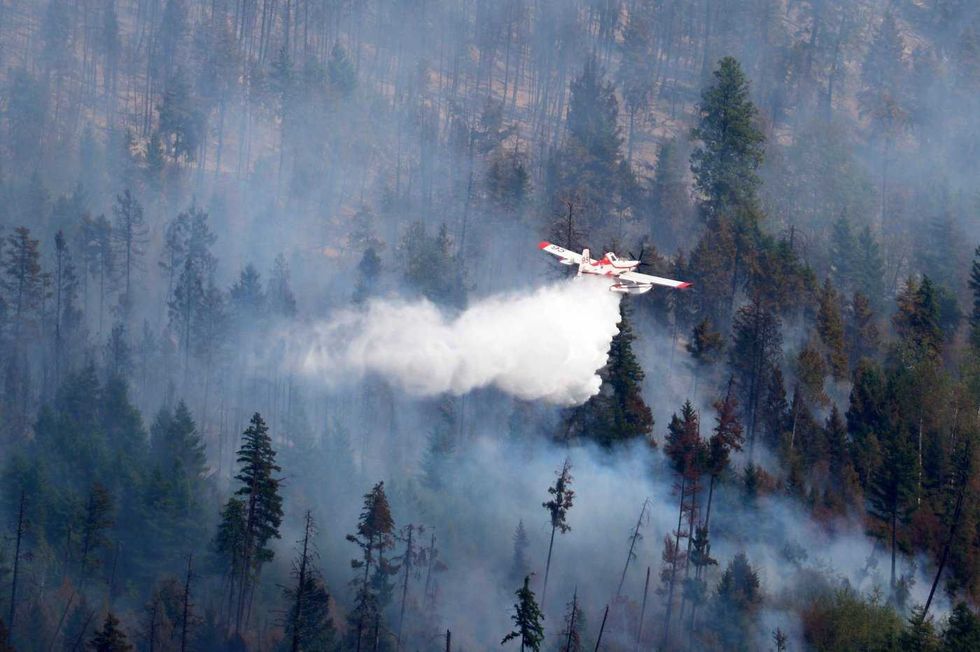 A water bomber drops its load on a wildfire near Kelowna, B.C., on Thursday, July 23, 2015.
THE CANADIAN PRESS/Jonathan Hayward
There’s even a risk that “somebody’s going to steal or re-engineer their planes,” added Wendy Gilmour, former director general of international and industry programs at the Department of National Defence. “All of a sudden we’re going to find out they’re making it in China for a quarter of the price — and just as good an aircraft.”
De Havilland still has a window of at least several years during which it will boast the strongest product, Read added. But upstarts are chasing its contrails.
Aerospace companies such as Positive Aviation, Kepplair Evolution and Hynaero of France are all developing water bombers. Italy’s 19-01 Holding aims to roll out its first prototype, which can scoop roughly twice the water volume of the DHC-515, by 2028.
“The iconic Canadair aircraft, the only plane of its kind, no longer meets reliability and availability requirements,” claims the website for Positive Aviation, based in a suburb of Toulouse.
“None of the projects announced over the past decade — whether to remanufacture the Canadair or develop a new aircraft of this type — are considered enough for the market needs.”
It pointed to the pace of production for Canadairs, which will be riveted by hand and roll of the line at a projected rate of 10 per year, partly due to a lack of automation. Positive Aviation's alternative claims a one-third higher water capacity, “superior stability” and a production rate of 12 per year starting in 2030.
Its critique could be seen as an inherent affirmation of Canadair as the “gold standard of firefighting aircraft” — for now — as De Havilland’s Sweeney frames it.
“There are a number of people that have ideas and are looking for backing in order to bring another one into production. That’s always a risk, that there’s a competitor. But at this point, we are the only large scooping aircraft in production,” Sweeney said.
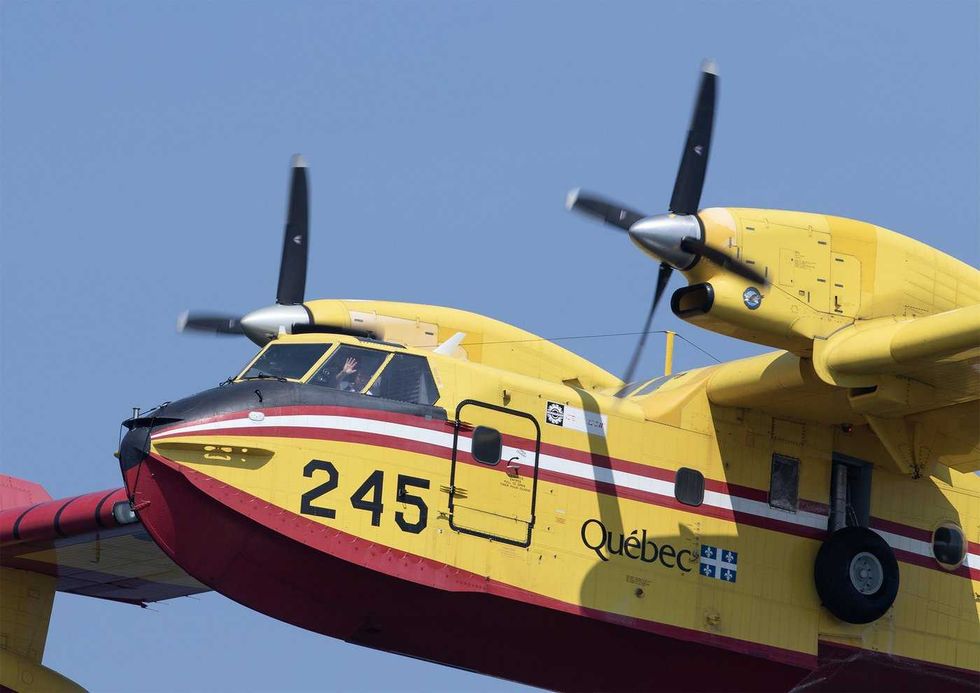 A Quebec water bomber pilot waves to onlookers after scooping water from Shediac Bay, N.B. The two Quebec-based planes helped to fight the forest fire near Irishtown, N.B., on Monday, Aug. 11, 2025.
THE CANADIAN PRESS/Ron Ward
The first two Canadairs are currently in production, with the initial one bound for Greece. Spain, France, Portugal, Italy and Croatia are also all customers. The 38 planes now on the order book, which include six for Ontario, five for Alberta — at a $400 million price tag — and three for Manitoba, are sold out through 2034, Sweeney said.
Canada and the European Union will announce the joint purchase of 50 De Havilland water bombers at a conference in Montreal at the end of October, according to a draft joint statement seen by The Canadian Press. But it remains unclear whether that order includes the 38 aircraft already on the books or comes on top of them.
In May, the federal government set up Canada’s first-ever reserve of firefighting aircraft, leasing 10 planes for 150 days thanks to a $317-million spending allocation in the 2025 budget.
But experts say Canada needs more than money and orders to beat back the flames and protect communities.
“There’s no national co-ordination for the fleet of water bombers,” said John Gradek, who teaches aviation management at McGill University.
“There is a provincial focus on firefighting that’s very parochial. Governments do their own thing, manage their own budgets, pay for their own airplanes, pay for their own pilots, training and everything else,” he said.
Some provinces own water bombers — Ontario and Quebec operate nearly two dozen of the 160 Canadairs in circulation around the world. Other provinces rent or borrow them. But Canada has no national wildland firefighting strategy, despite years of demands to create one, including a Senate committee report in June that recommended a national aerial firefighting fleet.
In contrast, Australia has a more centralized model where states and territories fund the National Aerial Firefighting Centre, which leases or contracts planes from at home and abroad.
In August, Ontario Premier Doug Ford called for 60 new water bombers and a national fleet under a countrywide wildfire strategy.
The question now is how many can be churned out before the decade is over — and how those planes will be managed.
This report by The Canadian Press was first published Oct. 18, 2026.
Companies in this story: (TSX:BBD.B)
By Christopher Reynolds | Copyright 2026, The Canadian Press. All rights reserved.