



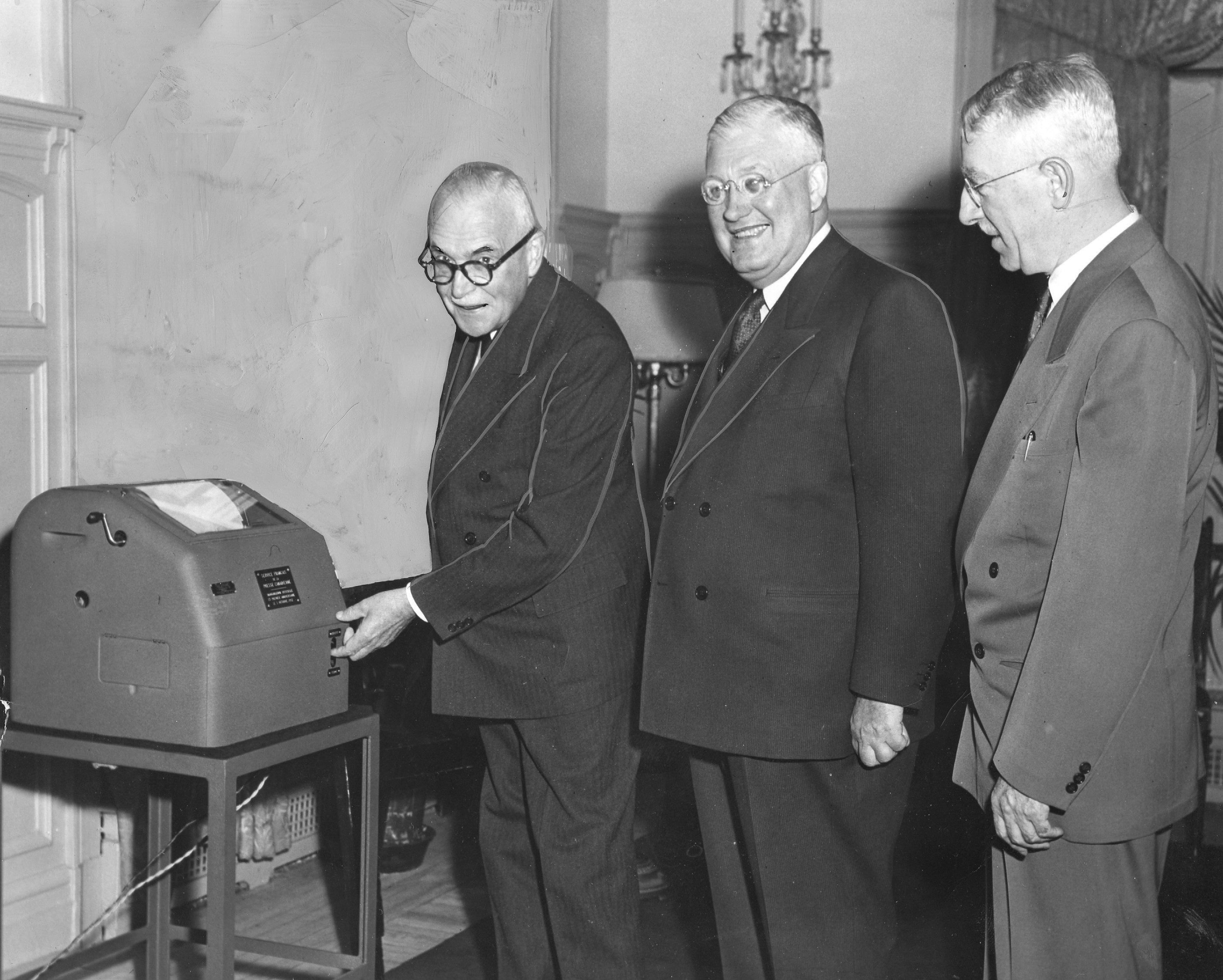
By launching a French-language service, The Canadian Press became the world’s first bilingual news agency.
In the early years, The Canadian Press’s French service was mostly a writing and translation service, with very little on-the-ground reporting except on Parliament Hill in Ottawa and in Quebec City, where it had its own correspondents.
Established as a cooperative, the PC — as it is often referred to in the news industry — produced 30,000 words a day for the nine newspapers in Quebec and Le Droit in Ottawa.
In 1954, the Évangéline, based in Moncton, N.B., became the 11th member to join the cooperative, and the Action catholique in Quebec City joined two years later.
Over the years, The Canadian Press’s French service established itself as a true national news organization with its own field reporters and correspondents. News dispatches, originally transmitted by telegraph, were then sent via teletype, increasing the transmission speed from 66 words per minute to 300.
When The Canadian Press switched to satellites, its transmission speed rose to 19,200 words per minute. Computerization and the advent of the internet in the late 1990s eliminated transmission limitations.
The company ultimately abandoned the cooperative model and became a private corporation owned equally by the daily newspaper La Presse, The Globe and Mail and Torstar.
Over the course of its 75-year history, the PC's staff has distinguished itself in its coverage of major events, including numerous federal and provincial elections, referendums, and countless landmark moments in Quebec, Canada, or abroad.
The Canadian Press, with its reporters in the field and journalists assigned to various news desks, has always distinguished itself by its speed in responding to events without sacrificing the accuracy of the information.
Among these historic moments, The Canadian Press's French service provided comprehensive coverage, notably during: the October Crisis (1970), the Montreal Olympics (1976), the shooting of Corporal Denis Lortie at the National Assembly (1984), the Montreal flood (1987), the death of René Lévesque (1987), the Polytechnique tragedy (1989), the Oka Crisis (1990), the Canadiens’ last Stanley Cup victory (1993), the Saguenay flood (1996), the Éboulements tragedy (1997), the ice storm (1998), the Maple Spring (2012), the Lac-Mégantic train derailment (2013), the attack on the Grand Mosque of Quebec City (2017), the pandemic (2020–2022), the attack on a daycare centre in Laval (2023), and the truck-ramming attack in Amqui (2023).
The PC also sent journalists to cover the Olympic Games around the world, stationed correspondents in Afghanistan when Canada had troops there, and provided its members and subscribers with coverage of the extraordinary funerals of Maurice Richard, Pierre Elliott Trudeau, and Guy Lafleur, held in Montreal.
These examples of the French service's coverage are just a tiny sample of the agency’s work that enables all French-language media outlets that are members or subscribers to its services to inform their audiences about events taking place outside their own coverage areas.
All major French-language media outlets employ journalists who once worked at The Canadian Press, which also boasted a few famous writers in the very early days of its French Service. These include the poets Alfred DesRochers and Olivier Marchand, the essayist Jean Lemoyne, the columnist Guy Fournier, comedian and screenwriter Carl Dubuc, and journalist Michel Roy, who would eventually hold executive positions at Le Devoir and La Presse.
This report by The Canadian Press was first published Oct. 15, 2026.
By Pierre Saint-Arnaud | Copyright 2026, The Canadian Press. All rights reserved.
Une photo de Jenny d'OD suscite des commentaires déplacés et elle répond avec une vidéo
« Honnêtement, ça me fait f*cking ch*er...»
Le samedi 9 avril, Jenny d'Occupation Double Dans l'Ouest a publié une photo d'elle sur Instagram qui a été prise en plein tournage de L'Après-OD. Peu de temps après, elle s'est adressée à ses abonné.es afin de s'ouvrir sur les messages qu'elle reçoit depuis, à propos de son physique.
Alors qu'elle pose devant un coucher de soleil dans un ensemble jaune, l'attention des internautes s'est plutôt porté sur son décolleté, sur lequel iels se sont permis.es de commenter.
Jenny a donc pris parole dans une série de stories pour dire à ceux et celles qui donnent leur opinion sur son corps, que cela la fâche :
« Je trouve ça assez flagrant les commentaires que j'ai eus sur ma photo d'Occupation Double. J'ai publié une photo récemment, aujourd'hui [9 avril] en fait, qui est pour moi un merveilleux moment. Mais pour plusieurs, ils sont en train de commenter mes seins. Ils sont comme " Oh My God, tes seins sont collés ensemble ".
Elle a ensuite pris elle-même sa défense en affirmant que sa poitrine est naturelle, mais en faisant à son tour un commentaire sur les seins plus tombants :
« Eh bien tu sais quoi? J'ai 23 ans, tant mieux si mes seins sont collés ensemble parce qu’[ils] sont naturels. Et s'ils sont capables de tenir en haut et qu'ils ne sont pas rendus à mon nombril parce qu'ils sont gros, bien tant mieux pour moi. »
« Sérieusement, mes seins sont naturels, ça s'appelle des bijoux de famille, je suis une Québécoise, j'ai des origines de Gaspésie [...]. Honnêtement, ça me fait f*cking ch*er donc arrêtez vos commentaires parce que je ne peux rien dire dessus, je suis née avec, la seule chose que je pourrais avoir c'est une réduction, mais tu sais quoi, je ne vais pas l'avoir tout de suite. »
Dans les commentaires, dont la plupart ont été supprimés depuis, les gens parlaient de son chandail « trop serré » ou du fait que l'image paraissait mal retouchée pour donner cet effet remonté à sa poitrine.
« C'est peut-être juste le chandail qui est (trop) serré sur la poitrine et qui fait remonter le tout dans la " gorge " ? »
« Moi je ne suis pas jalouse du tout, mais c'est gros et haut et on dirait qu'ils sont collés avec [de la] crazy glue, surement Photoshop mal fait. »
Suite à ces commentaires, plusieurs personnes, dont Kathleen et Rasheeda de sa saison à Occupation Double, sont venues à la défense de Jenny.
« Vos commentaires dégradants on s'en passe. »
« Vous abusez avec vos commentaires négatifs. »
Suite aux interventions négatives, plusieurs internautes étaient déçu.es que ce soit des femmes qui dénigrent l'apparence d'une autre femme et certain.es abonné.es se sont empressé.es de dire que faire des commentaires « sur le corps de quelqu'un d'autre, c'est non ».