



THE CANADIAN PRESS/Jeff McIntosh
Albertans vote on Monday on 10 referendum questions including whether or not to hold a binding referendum on the province leaving Canada. Elections Alberta officials say the separation question will be counted first with the result expected to be known sometime early the following morning.
Stellantis strike vote
Unifor, the union representing more than 9,000 workers at Stellantis, will release results Monday of a weekend strike vote by workers at the automaker. The union has said a strike mandate would give its bargaining committee leverage to reach a negotiated agreement, calling strike action a last resort. A major sticking point in the contract talks is the future of the Brampton, Ont., assembly plant, which Stellantis wants to sell to defence contractor Roshel.
 A person pumps gas at a gas station in Toronto, on Wednesday, Sept. 2, 2026.
THE CANADIAN PRESS/Keito Newman
A person pumps gas at a gas station in Toronto, on Wednesday, Sept. 2, 2026.
THE CANADIAN PRESS/Keito Newman
Inflation
Statistics Canada will release its September inflation reading on Monday when it publishes its consumer price index for the month. The report is expected to help give the Bank of Canada a look at how energy price pressures are influencing other parts of the economy. The annual inflation rate in August was three per cent, matching the pace set in July.
 A person walks past the Bank of Canada in Ottawa, on Wednesday, Sept. 2, 2026.
THE CANADIAN PRESS/Adrian Wyld
A person walks past the Bank of Canada in Ottawa, on Wednesday, Sept. 2, 2026.
THE CANADIAN PRESS/Adrian Wyld
Outlook survey
The Bank of Canada will release its business outlook survey and its survey of consumer expectations on Monday. They come ahead of the central bank's next interest rate decision and monetary policy report scheduled for Oct. 28.
 The Rogers Communications sign is marks the company's headquarters in Toronto, April 25, 2012.
THE CANADIAN PRESS/Aaron Vincent Elkaim
The Rogers Communications sign is marks the company's headquarters in Toronto, April 25, 2012.
THE CANADIAN PRESS/Aaron Vincent Elkaim
Rogers results
Rogers Communications Inc. will report its third-quarter financial results on Friday. The company recently completed its purchase of the remaining 25 per cent stake in Maple Leaf Sports & Entertainment it did not already hold, giving it complete ownership of the sports conglomerate that includes the Maple Leafs, Raptors, Toronto FC and Argonauts.
This report by The Canadian Press was first published Oct. 18, 2026.
Companies in this story: (TSX:RCI.B)
Copyright 2026, The Canadian Press. All rights reserved.
THE CANADIAN PRESS/ Patrick Doyle
The event in north-central France underscored how wildfires are ranging even farther from their traditional grounds and fuelling an urgent need for water bombers to fend off climate disasters.
The iconic Canadair turboprops serve as the only amphibious firefighting aircraft currently in production built from the outset for that purpose, rather than being retrofitted to douse flames.
Now, the Canadian company behind the water-scooping planes is calling for a national fleet of them at home, even as it struggles to meet soaring demand from across a warming globe.
De Havilland Aircraft of Canada revived production of the legendary Canadair planes in 2024 after European countries from Portugal to Greece placed orders for a program whose assembly line had halted in 2015, when it was run by Bombardier Inc.
That hiatus meant a supply chain that drew on 60,000 parts for the firefighting turboprop had evaporated, with procurement a major hurdle that pushed the projected delivery date for the first Canadair DHC-515 (formerly called the CL-515) to early 2028.
Neil Sweeney, De Havilland’s vice-president of corporate affairs, says an order for 50 new water bombers from the federal government or the provinces would give it the financial runway — hundreds of millions of dollars — to launch a second production line at its new assembly plant east of Calgary.
“If we want to stop fires from becoming large and becoming megafires, we need to get on them quicker. And the only way to get on them quicker is to have the infrastructure to do so,” he said, citing water bombers as the backbone of an aerial strategy that includes smaller scoopers, evacuation helicopters and air tankers with fire retardants.
“These fires are becoming significantly more damaging — devastating — and either we invest money upfront in prevention or we’re going to pay for it in reconstruction.”
Sweeney pointed to wildfires that took out about 400 structures in Jasper, Alta., in 2024 and hundreds more since. Last summer, fires in northern Ontario blanketed large swaths of the province and some of the United States in a smoky orange haze, forcing First Nations communities to flee. In August, blazes in British Columbia destroyed hundreds of buildings near Vernon and Summerland and forced tens of thousands from their homes.
“We can’t afford to wait any longer,” Sweeney said.
Another reason to forge ahead has to do with competitors. If the backlog of plane orders gets too long, buyers will likely look elsewhere.
“The danger of a slow ramp-up here is that the scarcity creates its own competition,” said Christopher Read, former director of corporate development at Air Canada. “If it can’t turn that into delivered aircraft quick enough, customers won’t wait. They will find alternatives.”
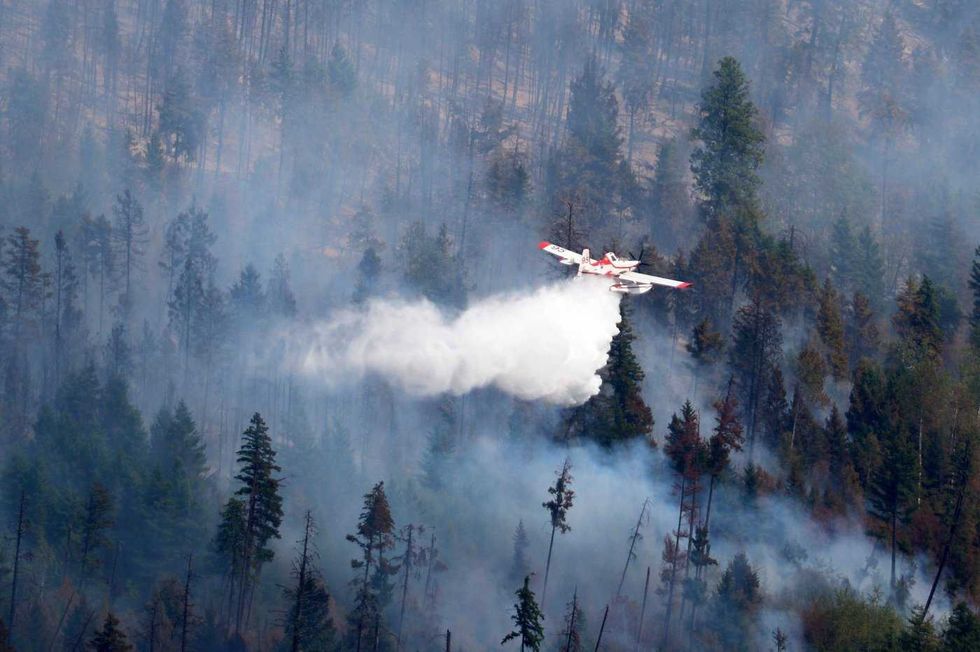 A water bomber drops its load on a wildfire near Kelowna, B.C., on Thursday, July 23, 2015.
THE CANADIAN PRESS/Jonathan Hayward
A water bomber drops its load on a wildfire near Kelowna, B.C., on Thursday, July 23, 2015.
THE CANADIAN PRESS/Jonathan Hayward
There’s even a risk that “somebody’s going to steal or re-engineer their planes,” added Wendy Gilmour, former director general of international and industry programs at the Department of National Defence. “All of a sudden we’re going to find out they’re making it in China for a quarter of the price — and just as good an aircraft.”
De Havilland still has a window of at least several years during which it will boast the strongest product, Read added. But upstarts are chasing its contrails.
Aerospace companies such as Positive Aviation, Kepplair Evolution and Hynaero of France are all developing water bombers. Italy’s 19-01 Holding aims to roll out its first prototype, which can scoop roughly twice the water volume of the DHC-515, by 2028.
“The iconic Canadair aircraft, the only plane of its kind, no longer meets reliability and availability requirements,” claims the website for Positive Aviation, based in a suburb of Toulouse.
“None of the projects announced over the past decade — whether to remanufacture the Canadair or develop a new aircraft of this type — are considered enough for the market needs.”
It pointed to the pace of production for Canadairs, which will be riveted by hand and roll of the line at a projected rate of 10 per year, partly due to a lack of automation. Positive Aviation's alternative claims a one-third higher water capacity, “superior stability” and a production rate of 12 per year starting in 2030.
Its critique could be seen as an inherent affirmation of Canadair as the “gold standard of firefighting aircraft” — for now — as De Havilland’s Sweeney frames it.
“There are a number of people that have ideas and are looking for backing in order to bring another one into production. That’s always a risk, that there’s a competitor. But at this point, we are the only large scooping aircraft in production,” Sweeney said.
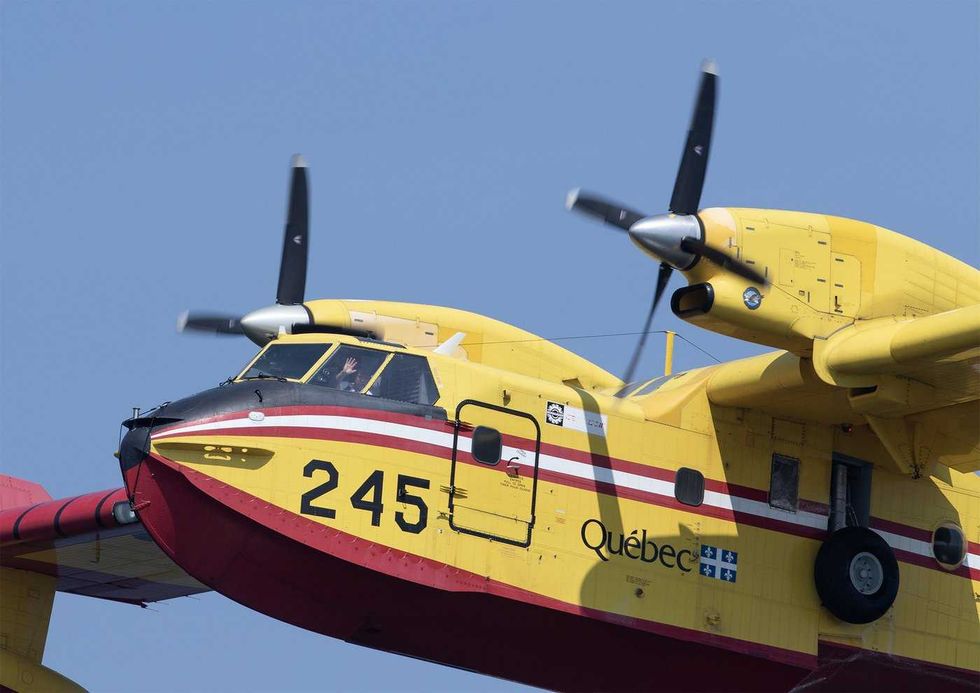 A Quebec water bomber pilot waves to onlookers after scooping water from Shediac Bay, N.B. The two Quebec-based planes helped to fight the forest fire near Irishtown, N.B., on Monday, Aug. 11, 2025.
THE CANADIAN PRESS/Ron Ward
A Quebec water bomber pilot waves to onlookers after scooping water from Shediac Bay, N.B. The two Quebec-based planes helped to fight the forest fire near Irishtown, N.B., on Monday, Aug. 11, 2025.
THE CANADIAN PRESS/Ron Ward
The first two Canadairs are currently in production, with the initial one bound for Greece. Spain, France, Portugal, Italy and Croatia are also all customers. The 38 planes now on the order book, which include six for Ontario, five for Alberta — at a $400 million price tag — and three for Manitoba, are sold out through 2034, Sweeney said.
Canada and the European Union will announce the joint purchase of 50 De Havilland water bombers at a conference in Montreal at the end of October, according to a draft joint statement seen by The Canadian Press. But it remains unclear whether that order includes the 38 aircraft already on the books or comes on top of them.
In May, the federal government set up Canada’s first-ever reserve of firefighting aircraft, leasing 10 planes for 150 days thanks to a $317-million spending allocation in the 2025 budget.
But experts say Canada needs more than money and orders to beat back the flames and protect communities.
“There’s no national co-ordination for the fleet of water bombers,” said John Gradek, who teaches aviation management at McGill University.
“There is a provincial focus on firefighting that’s very parochial. Governments do their own thing, manage their own budgets, pay for their own airplanes, pay for their own pilots, training and everything else,” he said.
Some provinces own water bombers — Ontario and Quebec operate nearly two dozen of the 160 Canadairs in circulation around the world. Other provinces rent or borrow them. But Canada has no national wildland firefighting strategy, despite years of demands to create one, including a Senate committee report in June that recommended a national aerial firefighting fleet.
In contrast, Australia has a more centralized model where states and territories fund the National Aerial Firefighting Centre, which leases or contracts planes from at home and abroad.
In August, Ontario Premier Doug Ford called for 60 new water bombers and a national fleet under a countrywide wildfire strategy.
The question now is how many can be churned out before the decade is over — and how those planes will be managed.
This report by The Canadian Press was first published Oct. 18, 2026.
Companies in this story: (TSX:BBD.B)
By Christopher Reynolds | Copyright 2026, The Canadian Press. All rights reserved.
THE CANADIAN PRESS/Giordano Ciampini
In Canada, lobbyists are pushing the federal government to go even further by banning smoking and vaping products for the next generation entirely.
Sarah Sleet, CEO of Asthma + Lung U.K., said there has been broad public support for the move in Britain but it took decades of lobbying and advocacy.
"If you survey smokers, they do not want their children to be smoking. They know what a terrible thing it is, they know how bad it is for their health, they know how expensive it is," she said.
The law also had cross-partisan support. It was proposed by a Conservative government in 2023 and eventually passed under the current Labour government.
The proposed bill initially included vaping products, but the final version is limited to smoking. The Lung Health Foundation in Canada wants to bring vaping into the conversation.
"Kids who vape are 3 1/2 times more likely to smoke tobacco in the future," said Jessica Buckley, president and CEO of the foundation.
Sleet said some in the United Kingdom were concerned about the law limiting access to vaping products that are used to help people stop smoking. The law did bring in stronger rules on the sale of vapes, including plain packaging and a requirement that stores keep the products behind screens.
The British law didn't come without pushback from the tobacco industry.
Eric Gagnon, vice-president of regulatory affairs for Imperial Tobacco Canada, said while he shares the goal of keeping cigarettes and vapes out of the hands of youth, the tobacco industry does not support a prohibition on smoking, however gradual.
He pointed out that Canada has gone in the opposite direction with cannabis by legalizing and regulating the product, despite research showing smoking and vaping cannabis is harmful. He also warned that a ban would feed the black market.
"Canada already has a huge illicit market, not only on cigarettes but on nicotine pouches, on vaping products," Gagnon said.
Convenience store retailers are also opposed to such a ban and argue the illicit market has well-documented links to organized crime.
"Canada is unique in the illegal tobacco market, with one of the most sophisticated contraband trades in the world. Illegal tobacco products account for 50 per cent of the national market, and even more in some regions," said Jeff Brownlee, vice-president of communications for the Convenience Industry Council of Canada.
Brownlee called for a national strategy to crack down on contraband.
In the United Kingdom, advocates' research showed the size of the illicit market "is massively overestimated," Sleet said. The British government said raising the smoking age to 18 from 16 in 2007 and 2008 led to a 25 per cent reduction in the number of illicit cigarettes consumed.
"What it takes is, obviously, strong enforcement," she said.
 Two pallets of tobacco products on display during a RCMP news conference announcing the results of the latest enforcement against organized crime groups involved in trafficking contraband tobacco in Surrey, B.C., Friday, March 8, 2024.
THE CANADIAN PRESS/Ethan Cairns
Two pallets of tobacco products on display during a RCMP news conference announcing the results of the latest enforcement against organized crime groups involved in trafficking contraband tobacco in Surrey, B.C., Friday, March 8, 2024.
THE CANADIAN PRESS/Ethan Cairns
U.K. research estimates smoking costs the equivalent of $5.6 billion a year in health and social services, and costs the wider economy some $32 billion. Sleet said those sums outweigh the estimated losses in government revenue from excise taxes and sales of cigarettes.
In Canada, the estimated public cost of tobacco use is $11.2 billion a year and as many as 46,000 people die from tobacco-related illnesses each year.
The federal government collected $2.6 billion in tobacco excise tax revenue in 2024, according to a report from the parliamentary budget officer.
Buckley and dozens of advocates plan to be on Parliament Hill next week for a lobbying push to convince the federal government that a generational tobacco ban could save health care funding desperately needed for Canada's aging population.
"It's very difficult to have levers to pull on the health-care side in order to reduce those costs long-term," she said.
Buckley said they'll also be armed with polling that suggests broad public support in Canada for a generational ban.
She said they have meetings scheduled with advisers to Health Minister Marjorie Michel and her parliamentary secretary Maggie Chi.
Canada has a national strategy to reduce tobacco use to five per cent of the population by 2035 — currently, about 11 per cent of Canadians smoke — and directs $66 million a year toward stop-smoking programs.
Michel's office said in a statement that Canada isn't currently considering introducing a prohibition.
"We continue to monitor measures taken by like-minded countries to reduce youth smoking, including the United Kingdom's recent initiative," said Alexandre Bergeron, Michel's spokesperson.
From the other side of the pond, Sleet has a message for Canadian lawmakers.
"Be brave, go for it," she said. "You're not going to regret it."
This report by The Canadian Press was first published Oct. 18, 2026.
By Sarah Ritchie | Copyright 2026, The Canadian Press. All rights reserved.
Voici quand tu devrais «booker» tes vacances pour voyager durant les fériés 2023 au Canada
Va falloir t'y prendre d'avance si tu veux avoir du choix!
Chalet mignon devant un lac avec feu extérieur pour faire griller des guimauves, villa sur la plage avec vue sur de magnifiques couchers de soleil, ce n'est pas pour rien que ces logements de rêve se booke comme de petits pains chauds. Afin de t'aider à mettre toutes les chances de ton côté, l’entreprise de location de maisons de vacances, Vrbo, une filiale d'Expedia, a publié les meilleures dates pour faire la réservation de ton logement.
Selon la compagnie, les mois de janvier et de février seraient les plus populaires pour faire une demande de location puisqu'après les Fêtes, plusieurs Canadien.nes commencent déjà à organiser leurs vacances. Marque bien les dates proposées dans ton calendrier, car elles pourraient t'être bien utiles si tu désires t'offrir un repos bien mérité dans un décor haut en couleur. Eh oui, il faut faire vite pour avoir la chance de siroter son café sur son balcon dans les montagnes.
Vrbo prévoit, d’ailleurs, qu'en 2023, les réservations augmenteront grandement : « Toutes ces dates sont avancées de deux semaines par rapport aux années précédentes. Ces deux semaines sont déterminantes pour permettre ou non l'obtention d'un chalet de montagne convoité pour un voyage de ski pendant les vacances de printemps ou d'un chalet en bord de mer pour les vacances d'été annuelles. »
Ainsi, il te faudrait effectuer tes réservations environ deux mois à l'avance. En plus d'avoir une plus grande offre de logements et l'opportunité d'économiser, ce délai te permettrait d'obtenir plus de flexibilité pour des annulations ou modifications.
Voici les dates recommandées par l'entreprise de location :
Si ta maison de rêve se trouve à l'extérieur du pays ou de l'autre côté du Canada et qu'il te faut prendre l'avion, sache que l'agence de voyages Expedia a récemment publié sa liste des meilleurs trucs pour obtenir les prix les plus bas des compagnies aériennes et ça vaut assurément la peine d'y jeter un coup d'oeil . Tu pourras ainsi savoir quels sont les meilleurs jours et la bonne heure pour acheter tes billets au plus bas prix, quand est-il mieux de partir en voyage si l'on veut économiser et plus encore.
Avec ces astuces en poche, cela peut te permettre de te gâter sur des activités ou de bons repas.